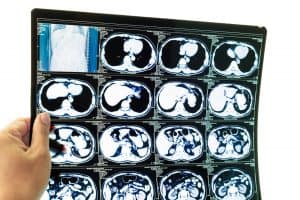
A team of researchers from the University of Cambridge and Imperial College London have developed an AI algorithm that can successfully detect different types of brain injuries.
Hospitals are inundated with patients suffering from head injuries, which affect about 60 million people each year. The process of identifying the injury can take hours, as a radiologist needs to analyze the CT scan to determine if surgery is required.
SEE ALSO: AI-Powered Tech by Qure.ai Looks Brainy on CT Scans
“Detailed assessment of a CT scan with annotations can take hours, especially in patients with more severe injuries,” said Cambridge’s Department of Medicine professor, Dr. Virginia Newcombe.
“We wanted to design and develop a tool that could automatically identify and quantify the different types of brain lesions so that we could use it in research and explore its possible use in a hospital setting.”
The researchers fed the algorithm 600 different CT scans, showing all types of brain injuries. It was then able to classify different parts of the brain and determine if there was an injury, using a larger data set.
The results were published in The Lancel Digital Health.
Using AI To Reduce Hospital Wait Time
While the algorithm will only be used for research in the near future, the team sees its clinical potential for hospitals with limited radiologists. The AI could also be deployed as a way to sift through cases, as less than 15 percent of people with brain injuries have wounds that are visible on a CT scan.
“We hope it will help us identify which lesions get larger and progress, and understand why they progress so that we can develop more personalized treatment for patients in the future,” said Menon.
One of the key aims of the NHS for the past decade has been 95 percent of people getting discharged, admitted or transferred within four-hours, although the current government has attempted to scrap this target after failing to meet it.
Algorithms like this one could be of vital importance in hitting that target, as it could give quicker diagnostics of a patient and free up more hospital staff.

 Best Practices for Deploying and Scaling Industrial AIArtificial Intelligence (AI) is transforming industrial operations, helping organizations optimize workflows, reduce downtime, and enhance productivity. Different industry verticals leverage AI in unique ways.Link to The Center for Adaptive Edge Intelligence
 The Center for Adaptive Edge IntelligenceAdaptive edge intelligence brings real-time decision-making to the point of data creation, whether from sensors, machines, or cameras.Link to The Value of Vehicle Electrification
 The Value of Vehicle ElectrificationElectric vehicles (EVs) present automakers with many design, engineering, and manufactu ring challenges.Link to Accelerating Manufacturing Digital Transformation with Industrial Connectivity and IoT
 Accelerating Manufacturing Digital Transformation with Industrial Connectivity and IoTDigital transformation is empowering industrial organizations to deliver sustainable innovation, disruption-proof products and services, and continuous operational improvement.Link to Smart Manufacturing for Automotive
 Smart Manufacturing for AutomotiveLeading a transportation revolution in autonomous, electric, shared mobility and connectivity with the next generation of design and development tools.Link to Center for Data Pipeline Automation
 Center for Data Pipeline AutomationAs businesses become data-driven and rely more heavily on analytics to operate, getting high-quality, trusted data to the right data user at the right time is essential.Link to Center for Automated Integration
 Center for Automated IntegrationThe goal of automated integration is to enable applications and systems that were built separately to easily share data and work together, resulting in new capabilities and efficiencies that cut costs, uncover insights, and much more.Link to Continuous Intelligence: Insights
 Continuous Intelligence: InsightsDigital transformation requires continuous intelligence (CI). Today’s digital businesses are leveraging this new category of software which includes real-time analytics and insights from a single, cloud-native platform across multiple use cases to speed decision-making, and drive world-class customer experiences.