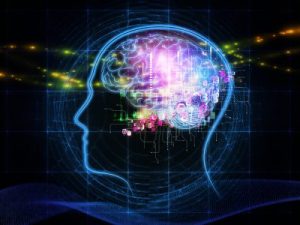
Abstract design made of head outlines, lights and abstract design elements on the subject of intelligence, consciousness, logical thinking, mental processes and brain power
Deployed for AI, e-prop would require only 20 watts, approximately one-millionth the energy a supercomputer uses.
Artificial intelligence models
continue to grow in sophistication and complexity, adding to the need for more
data, computation, and energy.
To help combat increasing energy costs, researchers at TU Graz’s Institute of Theoretical Computer Science have developed a new algorithm, called e-propagation (e-prop for short).
SEE ALSO: Researchers Develop Algorithm to Detect Crude Oil on Water
E-prop mimics how neurons send electrical impulses to other neurons in our brain, which massively reduces the amount of energy human brains use, in comparison to machine learning. Deployed for AI, e-prop would require only 20 watts, approximately one-millionth the energy a supercomputer uses.
“E-prop relies on two types
of signals that are abundantly available in the brain, but whose precise role
for learning have not yet been understood: eligibility traces and learning
signals,” said Wolfgang Maass and Robert Legenstein, authors of the e-prop
paper.
With this enormous reduction
in energy usage, AI models could theoretically be trained and tested on
computers far less exclusive than the current world-class supercomputers.
Another differential with
e-prop works completely online, rather than storing data centrally, which
improves efficiency by not requiring separate memory for constant data transfer.
The theory of e-prop makes a
concrete experimentally testable prediction: that the time constant of the
eligibility trace for a synapse is correlated with the time constant for the
history-dependence of the firing activity of the postsynaptic neuron,” said the
research team.
“It also suggests that the
experimentally found diverse time constants of the firing activity of
populations of neurons in different brain areas are correlated with their
capability to handle corresponding ranges of delays in temporal credit
assignment for learning.”
David is a technology writer with several years experience covering all aspects of IoT, from technology to networks to security.

 Best Practices for Deploying and Scaling Industrial AIArtificial Intelligence (AI) is transforming industrial operations, helping organizations optimize workflows, reduce downtime, and enhance productivity. Different industry verticals leverage AI in unique ways.Link to The Center for Adaptive Edge Intelligence
 The Center for Adaptive Edge IntelligenceAdaptive edge intelligence brings real-time decision-making to the point of data creation, whether from sensors, machines, or cameras.Link to The Value of Vehicle Electrification
 The Value of Vehicle ElectrificationElectric vehicles (EVs) present automakers with many design, engineering, and manufactu ring challenges.Link to Accelerating Manufacturing Digital Transformation with Industrial Connectivity and IoT
 Accelerating Manufacturing Digital Transformation with Industrial Connectivity and IoTDigital transformation is empowering industrial organizations to deliver sustainable innovation, disruption-proof products and services, and continuous operational improvement.Link to Smart Manufacturing for Automotive
 Smart Manufacturing for AutomotiveLeading a transportation revolution in autonomous, electric, shared mobility and connectivity with the next generation of design and development tools.Link to Center for Data Pipeline Automation
 Center for Data Pipeline AutomationAs businesses become data-driven and rely more heavily on analytics to operate, getting high-quality, trusted data to the right data user at the right time is essential.Link to Center for Automated Integration
 Center for Automated IntegrationThe goal of automated integration is to enable applications and systems that were built separately to easily share data and work together, resulting in new capabilities and efficiencies that cut costs, uncover insights, and much more.Link to Continuous Intelligence: Insights
 Continuous Intelligence: InsightsDigital transformation requires continuous intelligence (CI). Today’s digital businesses are leveraging this new category of software which includes real-time analytics and insights from a single, cloud-native platform across multiple use cases to speed decision-making, and drive world-class customer experiences.