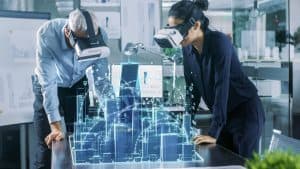
Think about the vast boosts in productivity that can be seen within workforces — especially frontline workers and technicians — when all they have to do is slip on a headset and explore the intricate parts of machines and systems. Augmented reality (AR) is bringing real-time data to life in ways unimaginable in the days when data was just bits and bytes sitting in databases.
The potential of AR was recently explored by Vladimir Lukic, managing director and partner with BCG, and Craig Melrose, executive vice president of digital transformation solutions for PTC, in a webcast hosted by MIT Sloan Management Review.
See also: Augmented Reality is ‘IoT for People’
“There’s much more data being generated, but data is stuck,” says Lukic. “Even when you migrate it into data lakes, the long processing times and latency before you can do something with it are hindering ability in the field to do something with it.” In addition, he continues, ” data sources are still fairly disjointed, the protocols are always different, and what it results in is that limited information is at the fingertips of the operators in the field. That operator can be a doctor, a farmer, or a person moving parcels and loading up a truck, and anything in between.”
AR can “potentially unlock that data and put the technology into action,” Lukic continues. ” It can liberate that data and put it, at the right time, to the right person in the field.”
BCG recently completed a survey of 900 companies that found more than 80 percent that are deploying IoT are also deploying AR in parallel. Thirty percent of these efforts are well underway, and the remainder are still in the early pilot stages of AR, Lukic relates. “We were surprised at how much
companies are seeing linkage directly between data generation, and then projecting it into the field. So, it’s happening, and it’s coming pretty fast at us and over the next two to five years. We should see some pretty interesting deployments.”
Lukic outlines five key attributes that are required to deliver a successful AR environment:
A connection between digital and physical. The tasks being performed through AR are those that are not fully capable of being automated. “There needs to be a linkage where the execution will happen in a physical way, but having a piece of info or digital interaction would be helpful to make it more effective.”
Tasks need to be human-driven. “We need a human in the equation who is actually executing a specific task.”
Data aggregation is complex. “It’s not just a simple phone call or a simple display of one data point, but actually there are different data sources that need to be amalgamated, and somehow delivered at the moment when they’re needed.”
It’s real-time. “All AR applications are in the moment, and they need to be real-time. You’re in an action for a few seconds, and you need a piece
of information in front of you at that moment.”
There are hidden layers in the equation. “Probably all of us have, at some point, had to go to the instructions on the printer and replace a cartridge or a piece of it, and the little projections that were happening on it that were super annoying,” Lukic quips. “There are a lot of hidden layers when you’re interacting with objects and augmented reality brings a unique ability to help you see beyond just what the eye sees at the front face.”

 Best Practices for Deploying and Scaling Industrial AIArtificial Intelligence (AI) is transforming industrial operations, helping organizations optimize workflows, reduce downtime, and enhance productivity. Different industry verticals leverage AI in unique ways.Link to The Center for Adaptive Edge Intelligence
 The Center for Adaptive Edge IntelligenceAdaptive edge intelligence brings real-time decision-making to the point of data creation, whether from sensors, machines, or cameras.Link to The Value of Vehicle Electrification
 The Value of Vehicle ElectrificationElectric vehicles (EVs) present automakers with many design, engineering, and manufactu ring challenges.Link to Accelerating Manufacturing Digital Transformation with Industrial Connectivity and IoT
 Accelerating Manufacturing Digital Transformation with Industrial Connectivity and IoTDigital transformation is empowering industrial organizations to deliver sustainable innovation, disruption-proof products and services, and continuous operational improvement.Link to Smart Manufacturing for Automotive
 Smart Manufacturing for AutomotiveLeading a transportation revolution in autonomous, electric, shared mobility and connectivity with the next generation of design and development tools.Link to Center for Data Pipeline Automation
 Center for Data Pipeline AutomationAs businesses become data-driven and rely more heavily on analytics to operate, getting high-quality, trusted data to the right data user at the right time is essential.Link to Center for Automated Integration
 Center for Automated IntegrationThe goal of automated integration is to enable applications and systems that were built separately to easily share data and work together, resulting in new capabilities and efficiencies that cut costs, uncover insights, and much more.Link to Continuous Intelligence: Insights
 Continuous Intelligence: InsightsDigital transformation requires continuous intelligence (CI). Today’s digital businesses are leveraging this new category of software which includes real-time analytics and insights from a single, cloud-native platform across multiple use cases to speed decision-making, and drive world-class customer experiences.