Best Practices for Deploying and Scaling Industrial AI
Artificial Intelligence (AI) is transforming industrial operations, helping organizations optimize workflows, reduce downtime, and enhance productivity. Different industry verticals leverage AI in unique ways.
Accelerating Manufacturing Digital Transformation with Industrial Connectivity and IoT
Digital transformation is empowering industrial organizations to deliver sustainable innovation, disruption-proof products and services, and continuous operational improvement.
Leading a transportation revolution in autonomous, electric, shared mobility and connectivity with the next generation of design and development tools.
As businesses become data-driven and rely more heavily on analytics to operate, getting high-quality, trusted data to the right data user at the right time is essential.
The goal of automated integration is to enable applications and systems that were built separately to easily share data and work together, resulting in new capabilities and efficiencies that cut costs, uncover insights, and much more.
Digital transformation requires continuous intelligence (CI). Today’s digital businesses are leveraging this new category of software which includes real-time analytics and insights from a single, cloud-native platform across multiple use cases to speed decision-making, and drive world-class customer experiences.
Best Practices for Deploying and Scaling Industrial AI
Artificial Intelligence (AI) is transforming industrial operations, helping organizations optimize workflows, reduce downtime, and enhance productivity. Different industry verticals leverage AI in unique ways.
Accelerating Manufacturing Digital Transformation with Industrial Connectivity and IoT
Digital transformation is empowering industrial organizations to deliver sustainable innovation, disruption-proof products and services, and continuous operational improvement.
Leading a transportation revolution in autonomous, electric, shared mobility and connectivity with the next generation of design and development tools.
As businesses become data-driven and rely more heavily on analytics to operate, getting high-quality, trusted data to the right data user at the right time is essential.
The goal of automated integration is to enable applications and systems that were built separately to easily share data and work together, resulting in new capabilities and efficiencies that cut costs, uncover insights, and much more.
Digital transformation requires continuous intelligence (CI). Today’s digital businesses are leveraging this new category of software which includes real-time analytics and insights from a single, cloud-native platform across multiple use cases to speed decision-making, and drive world-class customer experiences.
Federated Averaging: The Backbone of Federated Learning
Federated Averaging represents a significant advancement in the use of artificial intelligence in privacy-sensitive applications. By allowing for collaborative model training without direct data sharing, it paves the way for a new era of secure, decentralized machine learning.
In the rapidly evolving field of data privacy and decentralized computing, Federated Learning (FL) stands out by enabling collaborative machine learning without compromising the privacy of individual data sources. Central to this paradigm is Federated Averaging (FedAvg), an algorithm that optimizes data analysis across multiple decentralized endpoints. This article explores the core principles of Federated Averaging, examining its operational mechanics, benefits, and the obstacles it addresses.
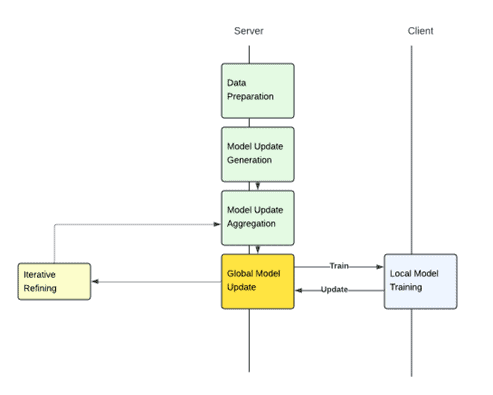
Local Model Training: In a typical Federated Learning scenario, multiple client devices, each with its unique dataset, train local machine learning models. This decentralization ensures that personal or sensitive data remains strictly on the device, never shared or exposed to external threats.
Aggregation: Once local training phases are complete, each device computes model updates—essentially, changes made to model parameters during training. These updates are sent to a central server where Federated Averaging comes into play.
Model Update: The central server uses FedAvg to combine these updates into a new, improved global model. This model synthesizes learning from all participating devices. It is then sent back to the devices, updating their local models and starting the next iteration of training.
Advertisement
Advertisement
Advantages of Federated Averaging
Privacy Preservation: By only exchanging updates to model parameters rather than raw data, Federated Averaging keeps sensitive information securely on the device.
Efficient Communication: Since only parameter updates are transmitted, rather than entire datasets, the method significantly reduces the bandwidth required for communication, making it feasible even for devices with limited connectivity.
Improved Model Accuracy: Aggregating diverse updates from a wide range of devices and data distributions enhances the robustness and generalizability of the global model, often resulting in higher accuracy than any single device could achieve alone.
Understanding the Loss Landscape
To grasp why Federated Averaging is effective, particularly in heterogeneous environments, it’s helpful to consider the “loss landscape”—an abstract representation of how different parameter settings of a model affect its performance (loss).
Visualizing Loss Landscape: By mapping out this landscape, researchers can visualize where the global model falls relative to the ideal lowest-loss point (the global minimum). Surprisingly, even when the global model does not hit the absolute lowest point, it often achieves better performance than models trained on individual datasets.
Addressing Deviation with Iterative Moving Averaging (IMA)
Problem of Deviation: One notable challenge in Federated Learning is that the global model may stray from the optimal path in the loss landscape due to the varied nature of data across devices. This deviation can degrade the model’s effectiveness.
Solution with IMA: Iterative Moving Averaging addresses this by periodically adjusting the global model using a moving average of previous models. This technique not only corrects deviations but also smoothens the model’s trajectory through the loss landscape, leading to more stable and accurate learning outcomes.
Overcoming Challenges in Federated Averaging
Device Heterogeneity: Disparities in device capabilities and data types can skew the learning process. Transfer learning and adaptive techniques like data normalization help align disparate data types and distributions, ensuring coherent and effective aggregation.
Communication Overhead: Regular transmission of updates can be communication intensive. Techniques such as data compression and protocol optimization are employed to manage this load efficiently, ensuring the system’s scalability.
Security Threats: The decentralized nature of Federated Learning can introduce vulnerabilities, such as data poisoning or model tampering. Advanced cryptographic techniques, like secure multi-party computation and differential privacy, are integrated to safeguard the system against such threats.
Advertisement
Federated Averaging in Action
Healthcare and Finance Applications: In sectors like healthcare and finance, where data sensitivity is paramount, Federated Averaging enables predictive analytics and fraud detection without compromising individual data privacy. Real-world examples include hospitals predicting patient outcomes and banks detecting fraudulent activities, all while maintaining strict data confidentiality.
Conclusion
Federated Averaging represents a significant advancement in the use of artificial intelligence in privacy-sensitive applications. By allowing for collaborative model training without direct data sharing, it paves the way for a new era of secure, decentralized machine learning. As technology evolves and more industries adopt Federated Learning, the impact of Federated Averaging will continue to grow, reinforcing its role as a cornerstone of modern AI strategies.
References
Zhou, T., Lin, Z., Zhang, J., & Tsang, D. H. K. (2023, May 13). Understanding and improving model averaging in federated learning on heterogeneous data. arXiv.org. https://arxiv.org/abs/2305.07845
Cross-silo and cross-device federated learning on Google Cloud. (2024, April 12). Google Cloud. https://cloud.google.com/architecture/cross-silo-cross-device-federated-learning-google-cloud
Federated Learning of Cohorts (FLOC) – the privacy sandbox. (n.d.). https://privacysandbox.com/proposals/floc/
Isha Chhatwal is a seasoned tech professional and Staff Product Manager at Big Retailer and an Independent Researcher for Industry nonprofits. She brings a rich background in Computer Science and Information Sciences to the forefront of digital advertising technology. Her career is marked by a commitment to innovation, particularly in developing AI-based advertising technologies that enhance privacy and user control, impacting millions globally. Isha's expertise extends to creating groundbreaking products that improve data engineering productivity and evolve identity solutions, with her work spanning startups to leading tech companies. Recognized for her contributions, Isha has played a pivotal role in advancing privacy-centric advertising solutions, making significant strides toward transparency and user empowerment in the digital realm.
Accepting that AI is being designed for machines rather than humans forces a shift in responsibility. The burden moves away from making systems intuitively understandable and toward making them structurally accountable.
By treating unstructured data as a strategic asset rather than an operational byproduct, enterprises can resolve the tension between innovation and control.
AI is quickly growing, and so must the enterprise environments that support it. Organizations that succeed will be those that pair innovation with governance, autonomy with accountability, and speed with structure.
Accepting that AI is being designed for machines rather than humans forces a shift in responsibility. The burden moves away from making systems intuitively understandable and toward making them structurally accountable.
By treating unstructured data as a strategic asset rather than an operational byproduct, enterprises can resolve the tension between innovation and control.
AI is quickly growing, and so must the enterprise environments that support it. Organizations that succeed will be those that pair innovation with governance, autonomy with accountability, and speed with structure.
Analysis and market insights on real-time analytics including Big Data, the IoT, and cognitive computing. Business use cases and technologies are discussed.
Advertiser Disclosure: Some of the products that appear on
this site are from companies from which TechnologyAdvice
receives compensation. This compensation may impact how and
where products appear on this site including, for example,
the order in which they appear. TechnologyAdvice does not
include all companies or all types of products available in
the marketplace.

 Best Practices for Deploying and Scaling Industrial AIArtificial Intelligence (AI) is transforming industrial operations, helping organizations optimize workflows, reduce downtime, and enhance productivity. Different industry verticals leverage AI in unique ways.Link to The Center for Adaptive Edge Intelligence
 The Center for Adaptive Edge IntelligenceAdaptive edge intelligence brings real-time decision-making to the point of data creation, whether from sensors, machines, or cameras.Link to The Value of Vehicle Electrification
 The Value of Vehicle ElectrificationElectric vehicles (EVs) present automakers with many design, engineering, and manufactu ring challenges.Link to Accelerating Manufacturing Digital Transformation with Industrial Connectivity and IoT
 Accelerating Manufacturing Digital Transformation with Industrial Connectivity and IoTDigital transformation is empowering industrial organizations to deliver sustainable innovation, disruption-proof products and services, and continuous operational improvement.Link to Smart Manufacturing for Automotive
 Smart Manufacturing for AutomotiveLeading a transportation revolution in autonomous, electric, shared mobility and connectivity with the next generation of design and development tools.Link to Center for Data Pipeline Automation
 Center for Data Pipeline AutomationAs businesses become data-driven and rely more heavily on analytics to operate, getting high-quality, trusted data to the right data user at the right time is essential.Link to Center for Automated Integration
 Center for Automated IntegrationThe goal of automated integration is to enable applications and systems that were built separately to easily share data and work together, resulting in new capabilities and efficiencies that cut costs, uncover insights, and much more.Link to Continuous Intelligence: Insights
 Continuous Intelligence: InsightsDigital transformation requires continuous intelligence (CI). Today’s digital businesses are leveraging this new category of software which includes real-time analytics and insights from a single, cloud-native platform across multiple use cases to speed decision-making, and drive world-class customer experiences.