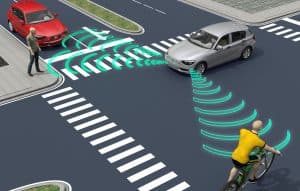
self driving electronic computer cars on road, 3d illustration
Self-driving vehicles could alleviate congestion by the instalment of a new traffic light, which would allow AVs to control the flow of traffic.
A new fourth traffic light has been proposed by transportation engineers at North Carolina State University as a way for self-driving vehicles to alleviate traffic flow issues.
The light, which the researchers have suggested should be white, will signal human drivers to follow the car in front of them. In simulated tests, it has led to improvements in travel time in intersections, and overall less fuel consumption.
See Also: Self-Driving AI Model Bundles Perception and Control
“This concept we’re proposing for traffic intersections, which we call a ‘white phase,’ taps into the computing power of autonomous vehicles themselves,” said Ali Hajbabaie, associate professor of civil, construction and environmental engineering at NC State. “The white phase concept also incorporates a new traffic signal, so that human drivers know what they are supposed to do. Red lights will still mean stop. Green lights will still mean go. And white lights will tell human drivers to simply follow the car in front of them.”
Self-driving vehicles can, in theory, talk to each other and indicate what is happening ahead of them. This can make the vehicle aware of issues on the road before its own cameras see them, thus reducing the likelihood of an accident.
Using this close-range communication system, the self-driving vehicles use a sort of distributed computing channel to fix intersection build-up and other traffic jams. In a previous iteration of this research, the engineers proposed a centralized system that worked through the traffic lights, but communication failures led them to this new distributed system.
“Granting some of the traffic flow control to the AVs is a relatively new idea, called the mobile control paradigm,” said Hajbabaie. “It can be used to coordinate traffic in any scenario involving AVs. But we think it is important to incorporate the white light concept at intersections because it tells human drivers what’s going on, so that they know what they are supposed to do as they approach the intersection.”
Whether this ever makes it to the streets is difficult to say at this time, when self-driving vehicles are still very limited and some manufacturers seem unwilling or uninterested in pooling computation resources to allow cars to communicate on the road. The willingness and awareness of human drivers is another factor to consider, as self-driving cars are far quicker at making a decision than humans.
David is a technology writer with several years experience covering all aspects of IoT, from technology to networks to security.

 Best Practices for Deploying and Scaling Industrial AIArtificial Intelligence (AI) is transforming industrial operations, helping organizations optimize workflows, reduce downtime, and enhance productivity. Different industry verticals leverage AI in unique ways.Link to The Center for Adaptive Edge Intelligence
 The Center for Adaptive Edge IntelligenceAdaptive edge intelligence brings real-time decision-making to the point of data creation, whether from sensors, machines, or cameras.Link to The Value of Vehicle Electrification
 The Value of Vehicle ElectrificationElectric vehicles (EVs) present automakers with many design, engineering, and manufactu ring challenges.Link to Accelerating Manufacturing Digital Transformation with Industrial Connectivity and IoT
 Accelerating Manufacturing Digital Transformation with Industrial Connectivity and IoTDigital transformation is empowering industrial organizations to deliver sustainable innovation, disruption-proof products and services, and continuous operational improvement.Link to Smart Manufacturing for Automotive
 Smart Manufacturing for AutomotiveLeading a transportation revolution in autonomous, electric, shared mobility and connectivity with the next generation of design and development tools.Link to Center for Data Pipeline Automation
 Center for Data Pipeline AutomationAs businesses become data-driven and rely more heavily on analytics to operate, getting high-quality, trusted data to the right data user at the right time is essential.Link to Center for Automated Integration
 Center for Automated IntegrationThe goal of automated integration is to enable applications and systems that were built separately to easily share data and work together, resulting in new capabilities and efficiencies that cut costs, uncover insights, and much more.Link to Continuous Intelligence: Insights
 Continuous Intelligence: InsightsDigital transformation requires continuous intelligence (CI). Today’s digital businesses are leveraging this new category of software which includes real-time analytics and insights from a single, cloud-native platform across multiple use cases to speed decision-making, and drive world-class customer experiences.