Efforts to introduce intelligence and data-driven capabilities into today’s far-flung but disjointed supply chains have been underway for a number of years now. Lately, however, next-generation data initiatives – IoT and digital twins – have promised substantial returns.
Companies are pouring more budget money into technology investments to support their supply chains, according to a survey published by MHI, a supply-chain industry trade association. Three in four executives, 74%, indicate they are increasing technology investments, with 58%, upping artificial intelligence spending, and 54% boosting investments in their industrial IoT deployments.
Both IoT and digital twins of supply chains can deliver improved efficiency, reduced costs, and improved customer satisfaction, according to Shyam Nath of Deloitte, writing in a paper published by the IoT Industry Consortium. “In recent years, the supply chain has become increasingly digitalized, using IoT and digital twins,” says Nath. “IoT sensors data such as location of goods in transit and the temperature of refrigerated goods can be used to identify potential quality issues as well as improve the design, operation and performance of the supply chain processes.”
See also: Can Real-Time Analytics Solve the Supply Chain Crisis?
Leveraging IoT in supply chains
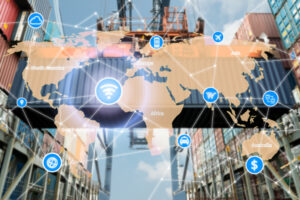
Supply chain management faces several challenges that can impact operational efficiency and customer satisfaction,” Nath continues. “The lack of real-time visibility, suboptimal routing and scheduling, and vulnerability to disruptions pose significant hurdles for companies. However, the integration of IoT sensors, IoT platform-based applications and use of digital twin and digital thread, provide a promising solution to these challenges.”
By harnessing real-time data and leveraging advanced analytics, “companies can gain better visibility into their supply chains, optimize routing and scheduling, and effectively mitigate disruptions,” Nath adds. “Embracing IoT-enabled supply chain systems, powered by digital twins, can lead to improved operational efficiency, cost savings, and enhanced customer service, ultimately positioning companies for success in a rapidly evolving business landscape.”
IoT and digital twins can transform many aspects of supply chain operations when implemented
together. Some of the key use cases and benefits include the following:
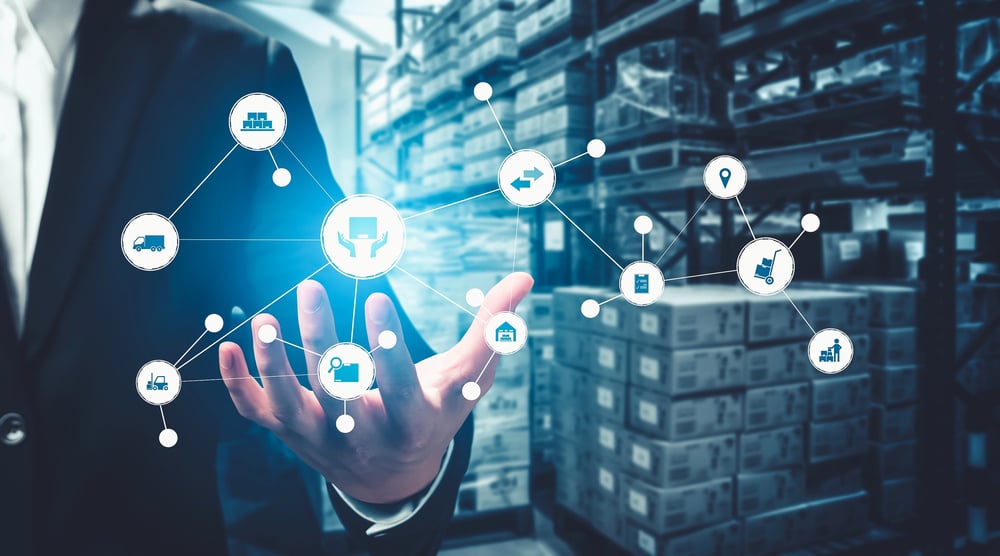
- Location tracking for real-time visibility: “IoT sensors could be used to track the location and condition of goods in transit. This would provide real-time visibility into the supply chain, which could help to identify and resolve problems early on.”
- Supply chain process models: “Digital twins can provide virtual representations of the supply chain processes. They can be used to simulate the behavior of the logistics operations and movement of goods, and to test different scenarios. This could be used to test different routing and scheduling options, and to identify potential bottlenecks in the supply chain.”
- Inventory management: “IoT sensors can be used to track the location and condition of inventory in real time. This information can be used to prevent stockouts, improve planning, and reduce waste.”
- Logistics monitoring: “IoT sensors can be used to track the location and movement of goods in transit. This information can be used to optimize routing, improve delivery times, and reduce costs.”
- Warehouse operations: “IoT sensors can be used to monitor the temperature, humidity, and other conditions in warehouses. This information can be used to prevent spoilage, damage, and other problems.”
- Quality control: “IoT sensors can be used to monitor the condition of products during manufacturing and transportation. This information can be used to identify problems early and prevent defects. The IIC’s Industrial Digital Thread is one such example.”

 Best Practices for Deploying and Scaling Industrial AIArtificial Intelligence (AI) is transforming industrial operations, helping organizations optimize workflows, reduce downtime, and enhance productivity. Different industry verticals leverage AI in unique ways.Link to The Center for Adaptive Edge Intelligence
 The Center for Adaptive Edge IntelligenceAdaptive edge intelligence brings real-time decision-making to the point of data creation, whether from sensors, machines, or cameras.Link to The Value of Vehicle Electrification
 The Value of Vehicle ElectrificationElectric vehicles (EVs) present automakers with many design, engineering, and manufactu ring challenges.Link to Accelerating Manufacturing Digital Transformation with Industrial Connectivity and IoT
 Accelerating Manufacturing Digital Transformation with Industrial Connectivity and IoTDigital transformation is empowering industrial organizations to deliver sustainable innovation, disruption-proof products and services, and continuous operational improvement.Link to Smart Manufacturing for Automotive
 Smart Manufacturing for AutomotiveLeading a transportation revolution in autonomous, electric, shared mobility and connectivity with the next generation of design and development tools.Link to Center for Data Pipeline Automation
 Center for Data Pipeline AutomationAs businesses become data-driven and rely more heavily on analytics to operate, getting high-quality, trusted data to the right data user at the right time is essential.Link to Center for Automated Integration
 Center for Automated IntegrationThe goal of automated integration is to enable applications and systems that were built separately to easily share data and work together, resulting in new capabilities and efficiencies that cut costs, uncover insights, and much more.Link to Continuous Intelligence: Insights
 Continuous Intelligence: InsightsDigital transformation requires continuous intelligence (CI). Today’s digital businesses are leveraging this new category of software which includes real-time analytics and insights from a single, cloud-native platform across multiple use cases to speed decision-making, and drive world-class customer experiences.