Best Practices for Deploying and Scaling Industrial AI
Artificial Intelligence (AI) is transforming industrial operations, helping organizations optimize workflows, reduce downtime, and enhance productivity. Different industry verticals leverage AI in unique ways.
Accelerating Manufacturing Digital Transformation with Industrial Connectivity and IoT
Digital transformation is empowering industrial organizations to deliver sustainable innovation, disruption-proof products and services, and continuous operational improvement.
Leading a transportation revolution in autonomous, electric, shared mobility and connectivity with the next generation of design and development tools.
As businesses become data-driven and rely more heavily on analytics to operate, getting high-quality, trusted data to the right data user at the right time is essential.
The goal of automated integration is to enable applications and systems that were built separately to easily share data and work together, resulting in new capabilities and efficiencies that cut costs, uncover insights, and much more.
Digital transformation requires continuous intelligence (CI). Today’s digital businesses are leveraging this new category of software which includes real-time analytics and insights from a single, cloud-native platform across multiple use cases to speed decision-making, and drive world-class customer experiences.
Best Practices for Deploying and Scaling Industrial AI
Artificial Intelligence (AI) is transforming industrial operations, helping organizations optimize workflows, reduce downtime, and enhance productivity. Different industry verticals leverage AI in unique ways.
Accelerating Manufacturing Digital Transformation with Industrial Connectivity and IoT
Digital transformation is empowering industrial organizations to deliver sustainable innovation, disruption-proof products and services, and continuous operational improvement.
Leading a transportation revolution in autonomous, electric, shared mobility and connectivity with the next generation of design and development tools.
As businesses become data-driven and rely more heavily on analytics to operate, getting high-quality, trusted data to the right data user at the right time is essential.
The goal of automated integration is to enable applications and systems that were built separately to easily share data and work together, resulting in new capabilities and efficiencies that cut costs, uncover insights, and much more.
Digital transformation requires continuous intelligence (CI). Today’s digital businesses are leveraging this new category of software which includes real-time analytics and insights from a single, cloud-native platform across multiple use cases to speed decision-making, and drive world-class customer experiences.
The urban waste collection process is very complex and requires a significant amount of resources. City municipalities spend around $300 million per capita annually to collect and manage waste. Most high-income cities cover a fraction of this expense by charging fees to the citizens. The rest is compensated from the tax revenue, which creates a financial burden on the local governments.
Waste management companies and municipalities have barely used technological innovations to improve operational efficiency. What they’ve done so far is the improvement in route efficiencies. Even with excellent route optimization, the waste collection trucks must check the trash level of every dumpster physically. The manual process results in wastage of both time and money because trucks often visit dumpsters that don’t need emptying.
The growing use of the Internet of Things (IoT), smart
devices and sensors, and machine-to-machine (M2M) connectivity has the
potential to reduce unnecessary expenses that occur due to operational
inefficiencies in trash collection processes.
For example, waste generation patterns differ by area or
season; dumpsters do not need to be emptied on a fixed schedule. Visiting every
empty dumpster increases unnecessary expenses. So, how does technological
advancement help in improving waste collection efficiencies?
IoT: The Response to Inefficiencies
IoT-powered smart waste management solutions focus on improving the total efficiency of waste collection and recycling. The most common IoT use case in waste management is route optimization, which reduces fuel consumption while emptying the dumpsters throughout the city.
Most popular and feasible smart waste management solutions consist of endpoints (sensors), gateways, IoT platforms, and web and mobile applications. A sensor is attached to a dumpster to measure its fill level. Gateways play the role of bridging the gap between the IoT platform and sensor, sending data from the sensor to the cloud. Some edge-processing capable gateways are also needed. These devices process the raw data. The IoT platform does the job of transforming the raw data into information. Most of the time, the IoT platforms are hosted on clouds (private, as well as shared), but sometimes due to high data security requirement, they can be hosted on-premises, as well.
Different sensors can be used to perform different tasks. Ultrasonic
level sensors are the most commonly used sensors in smart waste management IoT
solutions. Other sensors include motion sensors, GPS sensors, light sensors, and
vibration sensors to monitor various parameters, including location,
temperature, and theft.
Benefits of using IoT in Smart Waste Management
Using such sensors and IoT
platforms, companies and cuties can realize several advantages, including:
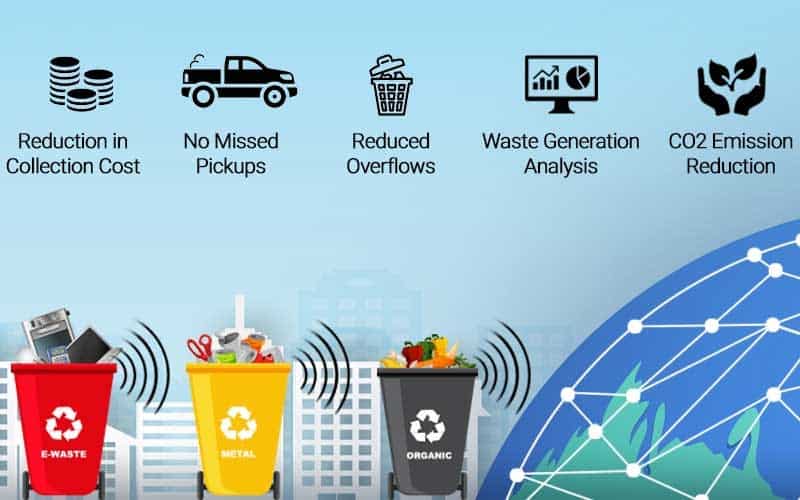
Reduction in collection costs: Smart dumpsters transmit their real-time fill level information to waste collectors. The IoT solution uses the data and selects optimum routes for waste collection trucks. This leads to a pickup process which doesn’t consider empty trash bins, saving fuel as well as manpower.
No missed pickups: Unlike
traditional collection methods, the smart waste management process eliminates the
overflowing of trash bins. When a trash bin is about to get full, the
authorities are immediately notified. And collection trucks can be scheduled
for a pickup even before the pre-scheduled time.
Waste generation analysis: Smart waste management is
not just about route optimization. It is said that the real value of IoT lies
in data analysis. Most of the IoT solutions available in the market are coupled
with data analytics feature. Such capabilities can help waste management
companies predict future waste generation.
CO2 emission reduction: There has been a lot of discussion and debate about the carbon footprint of waste management and recycling. Optimized routes lead to less fuel consumption, which ultimately reduces the carbon footprint, making the waste management process eco-friendlier.
Waste management services providers and cities can benefit
from IoT-powered smart waste management solutions. Using the technology, waste
management companies can increase their operational efficiency, cut costs, and
enhance customer satisfaction by making sure no dumpster overflows. The
implementation cost of wireless technologies is decreasing, and there are
plenty of wireless technologies available in the market to make smart waste
management solutions implementation possible. So, stop throwing cash in the
trash and start saving time and money.
Sanjeev Verma is the Chief Executive Officer (CEO) of Biz4group, a leading AI development company based in Orlando, Florida. He is responsible for leading Biz4group’s global business strategy and operations. Sanjeev is an AI enthusiast and has been involved in the development of AI and IoT solutions for over 20 years. He is passionate about using technology to solve real-world problems and loves to read and write about disruptive technologies.
In this week’s real-time analytics news: Sovereign Cloud efforts in the EU are heating up. SUSE launched a Cloud Sovereignty Framework Self Assessment to help businesses understand gaps in their digital strategy.
The concept of “data in motion” is transforming the way organizations think about their technology stack and will determine which organizations can actually execute on AI and which are left drowning in endless streams of data.
The industry’s movement toward sovereign AI reflects a maturation of the market and an acknowledgment that AI at scale requires the same rigor in governance and infrastructure design that enterprises have long applied to other mission-critical technologies.
Analysis and market insights on real-time analytics including Big Data, the IoT, and cognitive computing. Business use cases and technologies are discussed.
Advertiser Disclosure: Some of the products that appear on
this site are from companies from which TechnologyAdvice
receives compensation. This compensation may impact how and
where products appear on this site including, for example,
the order in which they appear. TechnologyAdvice does not
include all companies or all types of products available in
the marketplace.

 Best Practices for Deploying and Scaling Industrial AIArtificial Intelligence (AI) is transforming industrial operations, helping organizations optimize workflows, reduce downtime, and enhance productivity. Different industry verticals leverage AI in unique ways.Link to The Center for Adaptive Edge Intelligence
 The Center for Adaptive Edge IntelligenceAdaptive edge intelligence brings real-time decision-making to the point of data creation, whether from sensors, machines, or cameras.Link to The Value of Vehicle Electrification
 The Value of Vehicle ElectrificationElectric vehicles (EVs) present automakers with many design, engineering, and manufactu ring challenges.Link to Accelerating Manufacturing Digital Transformation with Industrial Connectivity and IoT
 Accelerating Manufacturing Digital Transformation with Industrial Connectivity and IoTDigital transformation is empowering industrial organizations to deliver sustainable innovation, disruption-proof products and services, and continuous operational improvement.Link to Smart Manufacturing for Automotive
 Smart Manufacturing for AutomotiveLeading a transportation revolution in autonomous, electric, shared mobility and connectivity with the next generation of design and development tools.Link to Center for Data Pipeline Automation
 Center for Data Pipeline AutomationAs businesses become data-driven and rely more heavily on analytics to operate, getting high-quality, trusted data to the right data user at the right time is essential.Link to Center for Automated Integration
 Center for Automated IntegrationThe goal of automated integration is to enable applications and systems that were built separately to easily share data and work together, resulting in new capabilities and efficiencies that cut costs, uncover insights, and much more.Link to Continuous Intelligence: Insights
 Continuous Intelligence: InsightsDigital transformation requires continuous intelligence (CI). Today’s digital businesses are leveraging this new category of software which includes real-time analytics and insights from a single, cloud-native platform across multiple use cases to speed decision-making, and drive world-class customer experiences.