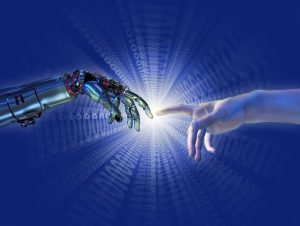
Robot and human hands almost touching with a binary burst of light - 3D render with digital painting. A modern take on the famous Michelangelo painting in the Sistine Chapel; titled, "The Creation of Adam".
Digital delivery and data movement simply won’t happen without fully engaged staff. That’s why digital employee experience, or digital EX, is vital to today’s real-time digital operations.
Today’s real-time digital enterprises may be highly automated, and guided by artificial intelligence, but the human side matters more than ever. While there has been endless effort to establish digital flows between enterprises and their customers, there is another area, just as crucial, that needs addressing: employees. Digital delivery and data movement simply won’t happen without fully engaged staff. That’s why digital employee experience, or digital EX, is vital to today’s real-time digital operations. .
Most enterprises recognize this, and have been increasingly supporting digital EX, a recent survey of 200 executives by 1E finds. At least 74% of knowledge workers surveyed say their business has a fully implemented digital EX strategy and 16% say they are in the process of implementing a strategy.
See also: Why Digital Transformation Drives the Need for AIOps
This is a far cry from pre-pandemic workplace levels, the survey’s authors observe.
Still, improving digital EX has it’s challenges. Seventy-five percent of executives say the bulk of their workforces are inhibited by “digital friction,” and two-thirds report that “there needs to be a complete overhaul or significant improvement” to current digital EX arrangements. At least 74% place connectivity issues in the top three most common types of digital friction. “In the hybrid workplace, where devices are our main link to the enterprise, this problem cannot be overstated. If an employee can’t connect to their team, they can’t do their job. It’s a similar story when looking at hardware and identity-based issues.”
Additional top challenges to improving digital EX include meeting security or regulatory policies (37%), overwhelmed IT departments (37%), lack of proper talent within IT departments (35%), and the shift to remote or hybrid work (34%). “Challenges are inevitable, especially when we consider that a year ago many of these programs didn’t exist,” the survey’s authors point out. “But as enterprises settle into the new normal of hybrid work, it’s time to level up.”
For starters, enterprise systems tend to be slower and more cumbersome than the consumer-facing apps to which employees are now accustomed. “Failure to meet these changing expectations could see your workforce jump ship. And with hybrid work set to stay, demands for speed and convenience will intensify. This is especially true with younger, digital-native employees now joining the workforce. More than two-thirds of respondents (67%) say that “digital experiences outside of work are better.”
The survey’s authors advocate for greater automation to take on a lot of the headaches associated with technical problem remediation. “Although many organizations use automation to some extent, its use is relatively limited.” IT executives say that only 26% of IT issues are resolved with automation, on average. This indicates that enterprises need to increase investment in technologies to support digital EX, and there’s considerable room for improvement when it comes to automation. Automation improves IT proactivity and directly contributes to a better digital experience for employees. For example, just some of the positive outcomes seen when automation is used include higher employee productivity (41%) and an improved relationship between IT and non-IT employees (41%).

 Best Practices for Deploying and Scaling Industrial AIArtificial Intelligence (AI) is transforming industrial operations, helping organizations optimize workflows, reduce downtime, and enhance productivity. Different industry verticals leverage AI in unique ways.Link to The Center for Adaptive Edge Intelligence
 The Center for Adaptive Edge IntelligenceAdaptive edge intelligence brings real-time decision-making to the point of data creation, whether from sensors, machines, or cameras.Link to The Value of Vehicle Electrification
 The Value of Vehicle ElectrificationElectric vehicles (EVs) present automakers with many design, engineering, and manufactu ring challenges.Link to Accelerating Manufacturing Digital Transformation with Industrial Connectivity and IoT
 Accelerating Manufacturing Digital Transformation with Industrial Connectivity and IoTDigital transformation is empowering industrial organizations to deliver sustainable innovation, disruption-proof products and services, and continuous operational improvement.Link to Smart Manufacturing for Automotive
 Smart Manufacturing for AutomotiveLeading a transportation revolution in autonomous, electric, shared mobility and connectivity with the next generation of design and development tools.Link to Center for Data Pipeline Automation
 Center for Data Pipeline AutomationAs businesses become data-driven and rely more heavily on analytics to operate, getting high-quality, trusted data to the right data user at the right time is essential.Link to Center for Automated Integration
 Center for Automated IntegrationThe goal of automated integration is to enable applications and systems that were built separately to easily share data and work together, resulting in new capabilities and efficiencies that cut costs, uncover insights, and much more.Link to Continuous Intelligence: Insights
 Continuous Intelligence: InsightsDigital transformation requires continuous intelligence (CI). Today’s digital businesses are leveraging this new category of software which includes real-time analytics and insights from a single, cloud-native platform across multiple use cases to speed decision-making, and drive world-class customer experiences.