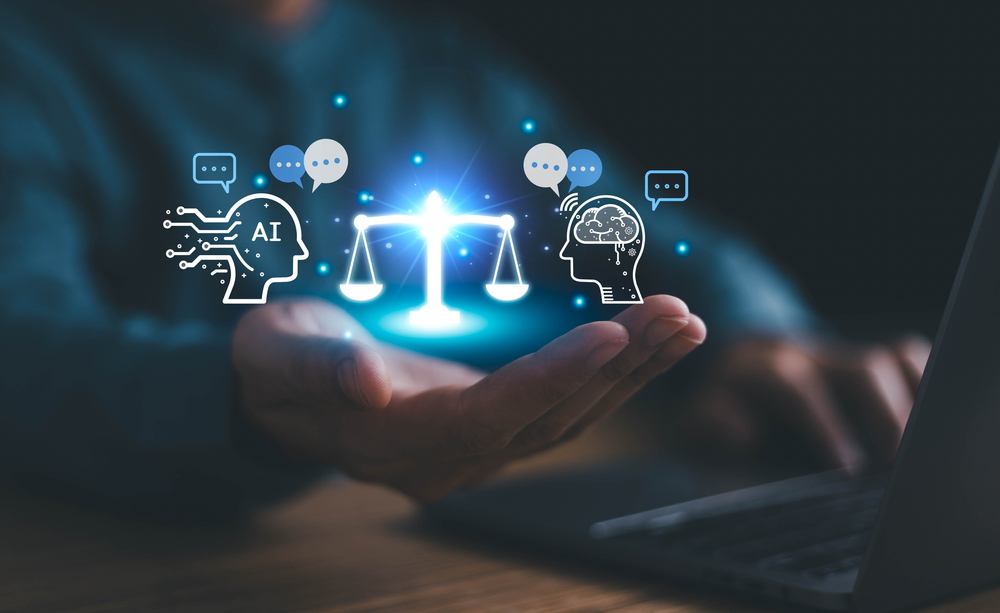
Questions of business ethics always arise when organizations encounter gray areas. When laws and regulations exist, it’s easy to know when you are breaking them. But when practices outpace governance, as can often happen when advanced technology is involved, organizations must wrestle with what is ethical.
AI integration takes business into a gray area. The AI-related regulations that have emerged to date have focused primarily on consumer issues — privacy and security — rather than operational issues. Consequently, businesses that bring AI in-house to help address their efficiency, productivity, and scalability issues also open the door to ethical concerns.
Workforce optimization is one of the top areas where AI integration raises ethical questions. Experts have warned for years that AI would have the capability to replace human workers in a wide range of industries. As those predictions have become a reality, business leaders face the challenge of mapping an ethical path forward.
Why should businesses take the ethical path as they integrate AI?
Throughout history, very few technological innovations have raised the type of ethical concerns that AI has. AI’s outputs can be marked by biases, its training and deployment can compromise consumer privacy, and the processes it facilitates often lack transparency. Any of those issues alone would be enough to raise ethical concerns. Together, they bring a perfect storm to the business world.
As businesses adopt AI, it is absolutely crucial that their integration strategies focus largely on ethics. Having a framework for ethical AI is very important for building trust in the marketplace and developing and maintaining a positive reputation. Businesses that implement AI responsibly, fairly, transparently, and with constant monitoring and assessment will earn consumer, investor, and employee loyalty. Those who don’t risk reputational damage that can lead to serious business loss.
Why should AI ethics be applied to workforce optimization?
Whether or not AI has the capacity to replace human workers is no longer a question. The debate over AI and workforce optimization now centers on whether AI should replace human workers.
From a societal perspective, this will be the biggest talking point. The culture has voiced fears that using AI to replace human workers will cause mass unemployment, affect community wellbeing, and drive an increase in income inequality. For businesses, it’s an issue that needs to be carefully considered.
As businesses seek ethical adoption of AI, long-term impacts must be considered early on. Quick automations without long-term vision can lead to significant societal and organizational consequences.
From a purely operational perspective, rushing to replace human workers requires trusting technology that is still in the emergent phase. Betting on an unproven tool could lead to a situation where the talent who was let go suddenly needs to be brought back into the workplace to address performance shortcomings. Alternatively, if AI automations prove to be reliable, they could trigger growth that results in an overwhelming workload for the workforce that remains.
Embracing AI automations can also trigger morale issues. Employees who retain their jobs can easily assume they have no long-term future with the company, which can negatively impact their engagement and output. If left unaddressed, such moral issues can ruin the company’s culture, damage its corporate image, and reduce its productivity.
Zooming out, businesses also need to consider how their contributions to rising unemployment levels impact their opportunities in the marketplace. Looking to the future reveals that replacing workers with AI automations leaves consumers with less money to spend, potentially leading to a downward economic spiral. Once again, ethics demands that companies resist short-term business gains that could result in long-term societal losses.
These factors indicate that, in the current landscape, taking an ethical approach to AI adoption is most easily achieved by using AI as a co-pilot for your workforce rather than a replacement.
See also: RPA vs. AI Automation: Is Robotic Process Automation Being Replaced?
What steps can businesses take to integrate AI as a co-pilot?
Developing a framework in which AI can serve as a co-pilot to your current employees begins with focusing on how automation can amplify human strengths. Rather than focusing on how automating tasks can reduce headcount, leverage AI-driven automations to give employees more time for high-level tasks. With AI handling repetitive, time-consuming tasks, employees gain time and energy to get creative and focus on big-picture issues. Companies that embrace this approach will see that humans were never meant to do repetitive tasks but to use their creativity to constantly innovate.
The second step toward unleashing AI co-pilots is upskilling with a vision for the future. Start planning one to two years in advance and considering what type of team you’ll need to get where you want to go. Then bring your current employees to the table to explore what automations will help to give them the time they need to develop the skills you feel they’ll need.
As you invite employees to contribute ideas on how to best integrate AI for future growth, you also help them perform better in the present. Once they understand that you are using AI to help them grow in their roles, you remove the fear that AI is being brought to the company to replace them.
The third step is implementing effective governance that demands human sign-offs. An ethical AI framework can’t exist without human oversight. Companies committed to ethical AI must set clear guidelines on usage, AI-aided decision-making, and oversight sign-offs.
AI is developing at a rapid pace, which means governance strategies will need to be regularly updated. Audits and surveys help to ensure not only that governance is still doing its job, but also that employees are continuing to play by the rules. Keeping pace with AI development can feel like racing Usain Bolt, but the commitment to staying up to date is not something that should be taken lightly.
When used to power workplace automations, AI has already shown that it has the capability to replace human workers, but the long-term implications of deploying AI in that way could mean businesses only get to enjoy short-term gains. Ethical adoption keeps the two forces in balance, creating a workplace where human performance can be enhanced by AI and remain central to business success.

 Best Practices for Deploying and Scaling Industrial AIArtificial Intelligence (AI) is transforming industrial operations, helping organizations optimize workflows, reduce downtime, and enhance productivity. Different industry verticals leverage AI in unique ways.Link to The Center for Adaptive Edge Intelligence
 The Center for Adaptive Edge IntelligenceAdaptive edge intelligence brings real-time decision-making to the point of data creation, whether from sensors, machines, or cameras.Link to The Value of Vehicle Electrification
 The Value of Vehicle ElectrificationElectric vehicles (EVs) present automakers with many design, engineering, and manufactu ring challenges.Link to Accelerating Manufacturing Digital Transformation with Industrial Connectivity and IoT
 Accelerating Manufacturing Digital Transformation with Industrial Connectivity and IoTDigital transformation is empowering industrial organizations to deliver sustainable innovation, disruption-proof products and services, and continuous operational improvement.Link to Smart Manufacturing for Automotive
 Smart Manufacturing for AutomotiveLeading a transportation revolution in autonomous, electric, shared mobility and connectivity with the next generation of design and development tools.Link to Center for Data Pipeline Automation
 Center for Data Pipeline AutomationAs businesses become data-driven and rely more heavily on analytics to operate, getting high-quality, trusted data to the right data user at the right time is essential.Link to Center for Automated Integration
 Center for Automated IntegrationThe goal of automated integration is to enable applications and systems that were built separately to easily share data and work together, resulting in new capabilities and efficiencies that cut costs, uncover insights, and much more.Link to Continuous Intelligence: Insights
 Continuous Intelligence: InsightsDigital transformation requires continuous intelligence (CI). Today’s digital businesses are leveraging this new category of software which includes real-time analytics and insights from a single, cloud-native platform across multiple use cases to speed decision-making, and drive world-class customer experiences.