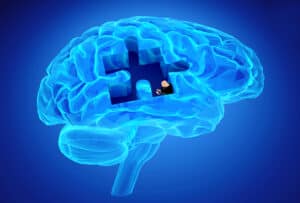
Human brain research and memory loss as symbol of alzheimer's concept with missing pieces of the puzzle
The AI model leverages a neural network to access risk by noninvasively analyzing breathing patterns while a person sleeps.
The typical, diagnosable symptoms of Parkinson’s – tremors and slowness – happen years after the onset of the disease itself. A new AI model could help healthcare providers detect the disease much earlier, simply by reading a person’s pattern of breathing. The work is part of a study presented in Nature Medicine that, according to the researchers, “demonstrates the feasibility of objective, noninvasive, at-home assessment of Parkinson’s Disease, and also provides initial evidence that the model may be useful for risk assessment at home and before clinical diagnosis.
The model leverages a neural network, analyzing breathing patterns while a person sleeps. The model was trained at MIT and can assess the severity of the disease and track its ongoing development through these patterns alone, even without the usual physical symptoms.
The device works without touching the patient’s body. It emits radio signals and analyzes the resulting patterns bouncing off surfaces where the patient sleeps. It’s able to extract the subject’s breathing patterns, making it possible for patients to test every night without the discomfort of the usual overnight test methods. Testing is entirely passive and requires no intervention from the patient or caregiver.
See also: FDA Clears Aneurysm Detecting Artificial Intelligence Tool
Early detection AI model could improve treatments and speed development
With accurate, cost-effective early detection, the device promises to bridge a gap between when traditional symptoms arise and the actual onset of the disease. In addition, it could offer underserved areas better screening, as well as screening for patients with limited mobility or cognitive impairments.
Testing might also enable faster treatment development – essentially enabling shorter clinical trials without sacrificing accuracy. The model was tested on 7,687 individuals, including 757 Parkinson’s patients. The MIT team is hopeful that it will offer less invasive ways not only to diagnose but also continually monitor the progression of the disease as patients seek treatment.
Researchers from Rutgers University, the University of Rochester Medical Center, the Mayo Clinic, Massachusetts General Hospital, and the Boston University College of Health and Rehabilitation join senior author Dina Katabi from MIT and model trainers Yuzhe Yang and Yuan Yuan (also from MIT).
Elizabeth Wallace is a Nashville-based freelance writer with a soft spot for data science and AI and a background in linguistics. She spent 13 years teaching language in higher ed and now helps startups and other organizations explain - clearly - what it is they do.

 Best Practices for Deploying and Scaling Industrial AIArtificial Intelligence (AI) is transforming industrial operations, helping organizations optimize workflows, reduce downtime, and enhance productivity. Different industry verticals leverage AI in unique ways.Link to The Center for Adaptive Edge Intelligence
 The Center for Adaptive Edge IntelligenceAdaptive edge intelligence brings real-time decision-making to the point of data creation, whether from sensors, machines, or cameras.Link to The Value of Vehicle Electrification
 The Value of Vehicle ElectrificationElectric vehicles (EVs) present automakers with many design, engineering, and manufactu ring challenges.Link to Accelerating Manufacturing Digital Transformation with Industrial Connectivity and IoT
 Accelerating Manufacturing Digital Transformation with Industrial Connectivity and IoTDigital transformation is empowering industrial organizations to deliver sustainable innovation, disruption-proof products and services, and continuous operational improvement.Link to Smart Manufacturing for Automotive
 Smart Manufacturing for AutomotiveLeading a transportation revolution in autonomous, electric, shared mobility and connectivity with the next generation of design and development tools.Link to Center for Data Pipeline Automation
 Center for Data Pipeline AutomationAs businesses become data-driven and rely more heavily on analytics to operate, getting high-quality, trusted data to the right data user at the right time is essential.Link to Center for Automated Integration
 Center for Automated IntegrationThe goal of automated integration is to enable applications and systems that were built separately to easily share data and work together, resulting in new capabilities and efficiencies that cut costs, uncover insights, and much more.Link to Continuous Intelligence: Insights
 Continuous Intelligence: InsightsDigital transformation requires continuous intelligence (CI). Today’s digital businesses are leveraging this new category of software which includes real-time analytics and insights from a single, cloud-native platform across multiple use cases to speed decision-making, and drive world-class customer experiences.