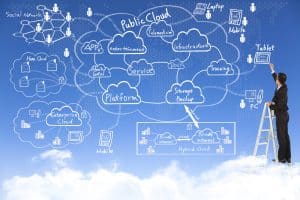
As more companies embrace cloud and service-based IT to drive innovation and transformation, and as everything-as-a-service providers multiply, more work will be needed this year to manage the technical and operational complexities of hybrid, multi-cloud approaches.

That is the conclusion of the Deloitte 2022 Technology Industry Outlook. And it has great implications for the way businesses address cloud application performance and manage their extended infrastructure. The outlook noted:
” Workforce challenges and changing IT demands spurred by the pandemic are accelerating the shift to services: software-as-a-service, infrastructure-as-a-service, and platform-as-a-service will continue to gain popularity, and hardware-as-a-service will increasingly catch on as a way for businesses to provide integrated services to their hybrid workforces. What’s more, leaders view everything-as-a-service (XaaS) as critical to their digital transformation and key to creating new solutions and business models to thrive in the new normal.”
It further noted:
“Cloud is rapidly becoming the preferred platform for enabling XaaS and spurring innovation—powering AI capabilities, intelligent edge services, and advanced wireless connectivity. Many organizations are leveraging a hybrid, multi-cloud strategy to increase access to best-in-breed technologies, optimize costs, improve resilience and reliability, and minimize vendor lock-in. Moreover, distributing workloads—across multiple clouds and on-premises—can help enterprises satisfy requirements around performance, data security and privacy, regulation, and cost, which can vary by application and geography.”
See also: Why Observability is Needed in Cloud Migrations
Cloud complexities abound
The complexity of the now normal multi-cloud, multi-vendor approach to delivering IT services means organizations will need to rethink the way they manage and monitor applications. Traditional tools often prove ineffective. They do not scale well and are siloed solutions that make it hard to share their insights across different environments and with other tools.
What’s needed is an observability solution that delivers data insights to keep a cloud application or service running. Any such solution must include multi-cloud monitoring and application observability, as well as high scalability.
Such tools allow teams to investigate and debug their systems actively. They let IT management and site reliability engineers get a sense of the collective information in metrics, traces, events, and logs that impacts cloud application performance.
Complementing those tools is the need for more help by the providers. Why? One of the biggest challenges in setting up these monitoring/observability tools is interoperability. Collecting data from all the disparate sources is one problem, but so too are the proprietary data storage formats that many of these tools use. If IT and SRE teams can’t easily integrate data between different tools, then they’ll never get the single-pane-of-glass dashboards they demand.
There is some action on this front. Notably, there is Opentelemetry, which is a new framework, born through the merger of OpenCensus and OpenTracing, which aims to be an all-in-one solution for all telemetry needs.
Related: What is Continuous Intelligence?
Opentelemetry is an incubating project managed by the Cloud Native Computing Foundation (CNCF). One of OpenTelemetry’s key objectives is the standardization of the collection and transmission of telemetry data to cloud-native platforms. This will improve the portability of the data, especially as OpenTelemetry is supported by a wide range of cloud providers and vendors through its backward compatibility.
And this, in turn, will help businesses better manage their increasingly complex cloud environments.

 Best Practices for Deploying and Scaling Industrial AIArtificial Intelligence (AI) is transforming industrial operations, helping organizations optimize workflows, reduce downtime, and enhance productivity. Different industry verticals leverage AI in unique ways.Link to The Center for Adaptive Edge Intelligence
 The Center for Adaptive Edge IntelligenceAdaptive edge intelligence brings real-time decision-making to the point of data creation, whether from sensors, machines, or cameras.Link to The Value of Vehicle Electrification
 The Value of Vehicle ElectrificationElectric vehicles (EVs) present automakers with many design, engineering, and manufactu ring challenges.Link to Accelerating Manufacturing Digital Transformation with Industrial Connectivity and IoT
 Accelerating Manufacturing Digital Transformation with Industrial Connectivity and IoTDigital transformation is empowering industrial organizations to deliver sustainable innovation, disruption-proof products and services, and continuous operational improvement.Link to Smart Manufacturing for Automotive
 Smart Manufacturing for AutomotiveLeading a transportation revolution in autonomous, electric, shared mobility and connectivity with the next generation of design and development tools.Link to Center for Data Pipeline Automation
 Center for Data Pipeline AutomationAs businesses become data-driven and rely more heavily on analytics to operate, getting high-quality, trusted data to the right data user at the right time is essential.Link to Center for Automated Integration
 Center for Automated IntegrationThe goal of automated integration is to enable applications and systems that were built separately to easily share data and work together, resulting in new capabilities and efficiencies that cut costs, uncover insights, and much more.Link to Continuous Intelligence: Insights
 Continuous Intelligence: InsightsDigital transformation requires continuous intelligence (CI). Today’s digital businesses are leveraging this new category of software which includes real-time analytics and insights from a single, cloud-native platform across multiple use cases to speed decision-making, and drive world-class customer experiences.