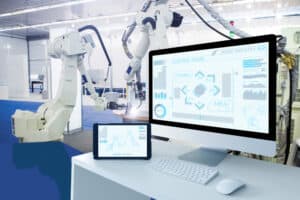
To keep up in a hypercompetitive global economy, manufacturers of all stripes have been aggressively ramping up their adoption of real-time technology – from production data analytics to edge sensors. However, there’s still a growing feeling among manufacturers that they are falling behind. A recent survey of 1,350 manufacturers finds while 97% intend to leverage “smart” technology in their processes., twice as many feel they lack the technology to outpace the competition as they did just a year ago. In addition, there’s a recognition that blazing the path to smart manufacturing requires data, and the right kind of data.
The survey, published by Rockwell Automation, reveals manufacturing executives are looking to cloud and advanced technologies to help minimize disruption from workforce or supply issues (53%) and to ensure better cybersecurity protection and business continuity (50%). Technology is also seen as the best hedge against external risks such as inflation, supply chain, and workforce shortages, cited by 44%. Similarly, 45% believe a push for higher quality is creating the need to accelerate digital transformation in their organizations.
Eighty-four percent of respondents have adopted smart manufacturing or are actively evaluating solutions with the intention to invest in the coming year. The study’s authors define smart manufacturing as “the intelligent, real-time orchestration and optimization of business, physical, and digital processes within factories and across the entire value chain. Resources and processes are automated, integrated, monitored, and continuously evaluated based on all available information as close to real time as possible.”
See also: 3 Smart Manufacturing Use Cases That Improve
Leading areas of smart manufacturing identified in the survey include the following:
- Process Automation – 63%
- Cloud/SaaS – 63%
- Machine Integration – 58%
- Machine Learning/Artificial Intelligence – 55%
- Industrial Internet of Things (IIoT)/Internet of Things (IoT) – 52%
- Cameras/Scanners/Drones – 52%
- 5G – 52%
- Generative Design – 43%
While supply chain disruptions have made headlines over the past two years, four out of five manufacturers, 79%, still lack end-to-end supply chain planning. At the same time, 50% are either not using a supply chain planning process or are using manual tools – such as spreadsheets – or cobbled-together solutions.
One-third of manufacturers are hampered by “technology paralysis,” the report’s authors claim, This is manifested as an “inability to decide between solutions.” Either way, 97% of participants reported plans to use smart manufacturing technology that enables “more agile, resilient production processes, empower the workforce, manage risk, drive sustainability, and accelerate transformation.”
One technology that is catching on at a rapid pace among manufacturers is artificial intelligence and machine learning. More than 50% more manufacturers are using AI and machine learning over last year, the survey shows. “This number will continue to rise as manufacturers see the impact that accessible machine learning/artificial intelligence can have on their business,” the survey report’s authors predict.
“Improved quality, productivity, and engaging talent to use data driven insights for decision making are some of the benefits.” AI will most likely have the greatest impact on quality as it pertains to closed-loop control, in-line quality, the survey shows. Other areas that will see greater AI adoption include automation, forecasting, tracking, and compliance
Data is the other concern manufacturers, who already collect large volumes from production environments, processes, and related transactions, seek to address. The number-one priority at this point is to increase adoption of data analytics. However, much of this data is either unavailable to analytics systems because it is siloed, or companies lack the skills to extract, manage, and properly leverage such data.
The percentage of manufacturers who believe they lack the ability to use data to make decisions to outpace the competition increased by 40% over last year, the survey shows.

 Best Practices for Deploying and Scaling Industrial AIArtificial Intelligence (AI) is transforming industrial operations, helping organizations optimize workflows, reduce downtime, and enhance productivity. Different industry verticals leverage AI in unique ways.Link to The Center for Adaptive Edge Intelligence
 The Center for Adaptive Edge IntelligenceAdaptive edge intelligence brings real-time decision-making to the point of data creation, whether from sensors, machines, or cameras.Link to The Value of Vehicle Electrification
 The Value of Vehicle ElectrificationElectric vehicles (EVs) present automakers with many design, engineering, and manufactu ring challenges.Link to Accelerating Manufacturing Digital Transformation with Industrial Connectivity and IoT
 Accelerating Manufacturing Digital Transformation with Industrial Connectivity and IoTDigital transformation is empowering industrial organizations to deliver sustainable innovation, disruption-proof products and services, and continuous operational improvement.Link to Smart Manufacturing for Automotive
 Smart Manufacturing for AutomotiveLeading a transportation revolution in autonomous, electric, shared mobility and connectivity with the next generation of design and development tools.Link to Center for Data Pipeline Automation
 Center for Data Pipeline AutomationAs businesses become data-driven and rely more heavily on analytics to operate, getting high-quality, trusted data to the right data user at the right time is essential.Link to Center for Automated Integration
 Center for Automated IntegrationThe goal of automated integration is to enable applications and systems that were built separately to easily share data and work together, resulting in new capabilities and efficiencies that cut costs, uncover insights, and much more.Link to Continuous Intelligence: Insights
 Continuous Intelligence: InsightsDigital transformation requires continuous intelligence (CI). Today’s digital businesses are leveraging this new category of software which includes real-time analytics and insights from a single, cloud-native platform across multiple use cases to speed decision-making, and drive world-class customer experiences.