Best Practices for Deploying and Scaling Industrial AI
Artificial Intelligence (AI) is transforming industrial operations, helping organizations optimize workflows, reduce downtime, and enhance productivity. Different industry verticals leverage AI in unique ways.
Accelerating Manufacturing Digital Transformation with Industrial Connectivity and IoT
Digital transformation is empowering industrial organizations to deliver sustainable innovation, disruption-proof products and services, and continuous operational improvement.
Leading a transportation revolution in autonomous, electric, shared mobility and connectivity with the next generation of design and development tools.
As businesses become data-driven and rely more heavily on analytics to operate, getting high-quality, trusted data to the right data user at the right time is essential.
The goal of automated integration is to enable applications and systems that were built separately to easily share data and work together, resulting in new capabilities and efficiencies that cut costs, uncover insights, and much more.
Digital transformation requires continuous intelligence (CI). Today’s digital businesses are leveraging this new category of software which includes real-time analytics and insights from a single, cloud-native platform across multiple use cases to speed decision-making, and drive world-class customer experiences.
Best Practices for Deploying and Scaling Industrial AI
Artificial Intelligence (AI) is transforming industrial operations, helping organizations optimize workflows, reduce downtime, and enhance productivity. Different industry verticals leverage AI in unique ways.
Accelerating Manufacturing Digital Transformation with Industrial Connectivity and IoT
Digital transformation is empowering industrial organizations to deliver sustainable innovation, disruption-proof products and services, and continuous operational improvement.
Leading a transportation revolution in autonomous, electric, shared mobility and connectivity with the next generation of design and development tools.
As businesses become data-driven and rely more heavily on analytics to operate, getting high-quality, trusted data to the right data user at the right time is essential.
The goal of automated integration is to enable applications and systems that were built separately to easily share data and work together, resulting in new capabilities and efficiencies that cut costs, uncover insights, and much more.
Digital transformation requires continuous intelligence (CI). Today’s digital businesses are leveraging this new category of software which includes real-time analytics and insights from a single, cloud-native platform across multiple use cases to speed decision-making, and drive world-class customer experiences.
Enhancing Collaborative Application Development For Databases
Managing database access can be a bane of many organizations developing modern applications. RHODA simplifies the process while offering the visibility, agility, and flexibility needed by ITOps, database administrators, and application developers.
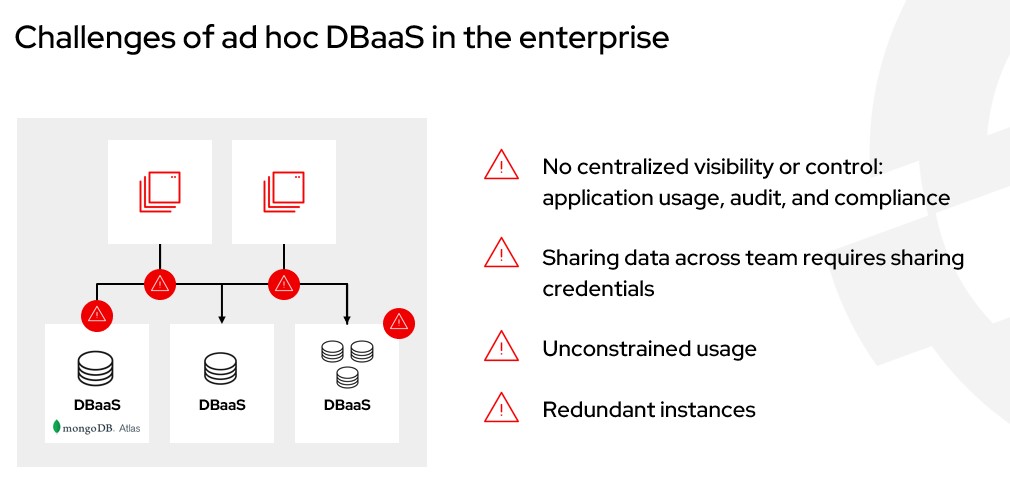
Typical processes for providing access to databases often break down in modern development environments. Throughout an application’s lifecycle, there is a proliferation of different DB instances, each for various groups, including Dev, test, QA, production, and more. Database administrators are overwhelmed with requests for access credentials, application developers are frustrated due to the delay in getting started, and ITOps lacks the visibility into the processes needed for governance.
What sometimes happens is that application developers, frustrated with the wait times for access, share their credentials with team members once access is granted. That raises security issues and leads to redundant and unconstrained use of database resources.
Why that’s the worst of all worlds
While there are many challenges to implementing databases and DBaaS for modern, cloud-native applications, one that continually pops up is handling access credentials.
All groups involved, including database administrators, IT Ops, and application developers, have different issues when it comes to providing and managing access. For example, database admins need to gain control over which developers access various database services. Developers need to create unique access configurations for each application and database they work on. And IT Ops needs control and visibility across all database offerings. These issues persist throughout the entire application lifecycle, including early-stage development, testing, deployment, and app updates.
Traditional approaches to providing access worked well when there were few new applications and updates, and development cycles were not so fast-paced. Today that is not the case, and there are additional complications. For instance, databases are no longer only on-premises and company-managed; in some instances, multiple databases are involved in an application development environment. Each of these factors makes database access a management nightmare.
Why? The common approach to providing database access is for each person or group that needs access to request credentials and privileges from that database’s administrator. What often happens is that people do not want to wait for the DB admin to address their requests. In many cases, those who have access share their credentials with colleagues. That is obviously a security protocol breach. But it also results in unconstrained and redundant use of DB resources. And there is no centralized visibility or control of app usage or compliance.
How Red Hat OpenShift Database Access can help
There are many ways a company might set out to implement a simpler database access solution to meet the needs of modern application requirements. But the last thing most companies need today is another do-it-yourself development effort.
Increasingly, an alternative is to work with a technology partner with a proven solution and expertise in the market. Enter Red Hat and Red Hat OpenShift Database Access (RHODA), which is designed to simplify and standardize how organizations provision, monitor, and connect to cloud-hosted partner database services across their environment.
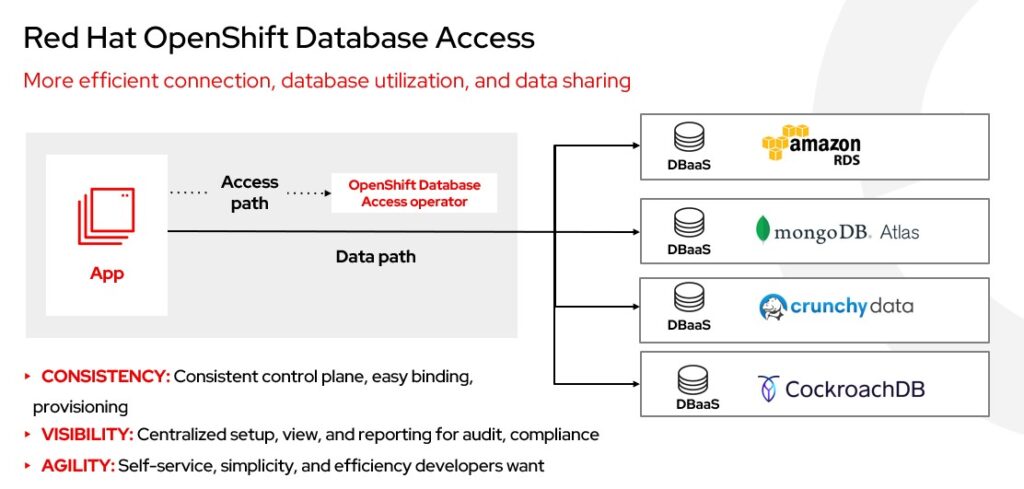
Red Hat OpenShift already supports many databases, from self-managed cloud-native databases to DBaaS offerings from database vendors and cloud providers. RHODA simplifies access to managed cloud databases directly from OpenShift cloud services to help developers bring database-centric applications to production.
RHODA lets administrators of OpenShift cloud services set up connections to DBaaS offerings from different providers in managed OpenShift Kubernetes environments. Developers get access via a self-service process. And administrators gain the centralized view and access control needed to manage many connections at scale.
Red Hat OpenShift Database Access leverages the Kubernetes construct of operators to bind applications to database instances. IT operations can launch a database discovery process based on resource permissions to identify the database instances that can be accessed. Once established by operations, developers can see those new database services from the catalog on their OpenShift developer console, represented as a UI tile for each database registered with the system. After selecting a database service instance, the developer can drag and drop a binding connector on the OpenShift developer UI to establish database connectivity to a Kubernetes pod. Self-service by developers from the free tier?
Red Hat OpenShift Database Access is a cloud service that is an extension to two OpenShift cloud services: OpenShift Dedicated and OpenShift Service on AWS. Initially, it supports a number of database cloud vendor offerings, including MongoDB Atlas, Crunchy Data’s Crunchy Bridge, Amazon RDS, and CockroachDB Dedicated.
These RHODA capabilities offer different benefits to different groups within an organization.
The value of using RHODA for ITOps leaders is that it centralizes database access visibility and control for all apps across multiple clusters, clouds, and vendors; increases developer productivity and reduces gatekeeping; reduces sprawl across DBs, clusters, apps, and processes; and improves performance while increasing speed to market.
Database administrators can monitor hosted DB access with consistent, standard, and simple connection information distribution across clouds and DBs in multicloud and hybrid cloud environments. RHODA also improves monitoring, governance, and control, all of which are needed to support compliance and audit requirements. And it helps avoid inefficient and redundant usage of database instances.
Application developers get self-service agility. RHODA lets them quickly, efficiently, and consistently connect to any database. They have the flexibility to experiment and access different databases. That allows them to focus on their code and on building apps, not on DB connections and credentials.
In summary, managing database access can be a bane of many organizations developing modern applications. RHODA simplifies the process while offering the visibility, agility, and flexibility needed by ITOps, database administrators, and application developers.
Salvatore Salamone is a physicist by training who writes about science and information technology. During his career, he has been a senior or executive editor at many industry-leading publications including High Technology, Network World, Byte Magazine, Data Communications, LAN Times, InternetWeek, Bio-IT World, and Lightwave, The Journal of Fiber Optics. He also is the author of three business technology books.
Data immediacy goes beyond the concepts of streaming data and data-in-motion. It adds the dimension that data has a very specific time value. The less recent the data is, the less valuable it is. Here are the issues you should consider to implement data immediacy and realize its benefits.
Tomer Shiran, Co-Founder of Dremio, provides an insider’s perspective about Apache Iceberg, its emergence as a standard table format, and how AI is optimizing query performance.
Traditional cyberattacks typically involve one of two strategies: bypassing authentication or exploiting software vulnerabilities. MCP-based systems introduce a different category of risk.
The expansion of smart cities and industrial deployments means infrastructure must be built to withstand harsh, evolving environments while maintaining reliable connectivity and power.
Time synchronization rarely gets much attention in cybersecurity, but it should. It underpins the security functions that teams rely on every day, from trustworthy logs and threat detection to forensic review and compliance reporting. In Zero Trust environments, trusted time helps keep those systems aligned and plays a growing role in resilience and compliance. A […]
AI-powered NaaS represents a foundational shift toward self-managed, adaptive infrastructure built to support the data-intensive demands of modern organizations.
Analysis and market insights on real-time analytics including Big Data, the IoT, and cognitive computing. Business use cases and technologies are discussed.
Advertiser Disclosure: Some of the products that appear on
this site are from companies from which TechnologyAdvice
receives compensation. This compensation may impact how and
where products appear on this site including, for example,
the order in which they appear. TechnologyAdvice does not
include all companies or all types of products available in
the marketplace.

 Best Practices for Deploying and Scaling Industrial AIArtificial Intelligence (AI) is transforming industrial operations, helping organizations optimize workflows, reduce downtime, and enhance productivity. Different industry verticals leverage AI in unique ways.Link to The Center for Adaptive Edge Intelligence
 The Center for Adaptive Edge IntelligenceAdaptive edge intelligence brings real-time decision-making to the point of data creation, whether from sensors, machines, or cameras.Link to The Value of Vehicle Electrification
 The Value of Vehicle ElectrificationElectric vehicles (EVs) present automakers with many design, engineering, and manufactu ring challenges.Link to Accelerating Manufacturing Digital Transformation with Industrial Connectivity and IoT
 Accelerating Manufacturing Digital Transformation with Industrial Connectivity and IoTDigital transformation is empowering industrial organizations to deliver sustainable innovation, disruption-proof products and services, and continuous operational improvement.Link to Smart Manufacturing for Automotive
 Smart Manufacturing for AutomotiveLeading a transportation revolution in autonomous, electric, shared mobility and connectivity with the next generation of design and development tools.Link to Center for Data Pipeline Automation
 Center for Data Pipeline AutomationAs businesses become data-driven and rely more heavily on analytics to operate, getting high-quality, trusted data to the right data user at the right time is essential.Link to Center for Automated Integration
 Center for Automated IntegrationThe goal of automated integration is to enable applications and systems that were built separately to easily share data and work together, resulting in new capabilities and efficiencies that cut costs, uncover insights, and much more.Link to Continuous Intelligence: Insights
 Continuous Intelligence: InsightsDigital transformation requires continuous intelligence (CI). Today’s digital businesses are leveraging this new category of software which includes real-time analytics and insights from a single, cloud-native platform across multiple use cases to speed decision-making, and drive world-class customer experiences.


![Featured Resource: Simplifying Managed Database Access on OpenShift [Read Now]](https://no-cache.hubspot.com/cta/default/8019034/d144b842-ff5d-4d77-bcf6-54bb444f2d79.png)