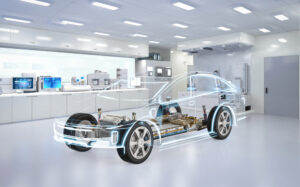
Designing and producing electric vehicles (EVs) bring new challenges to auto manufacturers. As with their internal combustion engine (ICE) counterparts, there is a need to compress the time from concept to having cars available to sell. However, both the design of an EV and its production require new thinking, new technology, and new processes. As such, EV automakers are turning to digital twins for help.
Specifically, automakers are using two types of digital twins to help speed up and improve design and production. They frequently use a digital twin of the vehicle itself and digital twins of the production environment. Separately, they each deliver their own benefits. When combined, there are multiple synergistic benefits that make 1 + 1 = 3.
Synergies abound with multiple digital twins
Let’s look at some of the ways this duo-digital twin approach is being employed in the design and manufacturing processes of electric vehicles (EVs).
Design, development, and testing
The auto industry has long been a user of computer-aided design (CAD), computational fluid dynamics (CFD), and other software to design and test the mechanical and aerodynamic properties of their vehicles.
Digital twin technology complements that work by allowing engineers to create and test vehicle components in a virtual environment before physical prototypes are built. This speeds up the iteration process, reduces costs, and allows for more experiments.
Virtual simulations with digital twins can subject EV designs to various environmental and operational conditions, helping to optimize performance and safety without the need for expensive real-world testing.
Additionally, digital twins can be used to customize vehicles according to customer preferences by simulating different configurations and their impacts on performance. This encourages innovative designs by allowing the exploration of different ideas and technologies in a virtual environment before committing to physical prototypes.
See also: Smart Manufacturing Essential for the Transition to EVs
Battery design and management
One of the main (obvious) differences between developing ICE cars and EVs is the battery system and management.
By modeling and simulating battery designs, digital twins help in improving energy density, longevity, and safety. This leads to more efficient and reliable battery systems.
Digital twins are also being used to help develop advanced thermal management strategies to enhance battery performance and lifespan, both of which are crucial for EVs.
Manufacturing process optimization
Digital twins are being used to model the entire manufacturing process, identifying bottlenecks and inefficiencies. They enable manufacturers to optimize production lines for higher efficiency, worker safety, integration of new technology (e.g., intelligent robots), lower costs, and more.
In many cases, the digital twin is provided with real-time data from the production line to help in monitoring the manufacturing process. Analysis of that data can be used to predict equipment failures, ensure quality control, reduce waste, and ensure consistency.
A final word on the use of digital twins for EV manufacturers
Digital twins thus offer a comprehensive framework for enhancing the design, efficiency, and production of electric vehicles. By bridging the gap between the virtual and physical, they enable a more sustainable, efficient, and customer-centric approach to vehicle manufacturing.

 Best Practices for Deploying and Scaling Industrial AIArtificial Intelligence (AI) is transforming industrial operations, helping organizations optimize workflows, reduce downtime, and enhance productivity. Different industry verticals leverage AI in unique ways.Link to The Center for Adaptive Edge Intelligence
 The Center for Adaptive Edge IntelligenceAdaptive edge intelligence brings real-time decision-making to the point of data creation, whether from sensors, machines, or cameras.Link to The Value of Vehicle Electrification
 The Value of Vehicle ElectrificationElectric vehicles (EVs) present automakers with many design, engineering, and manufactu ring challenges.Link to Accelerating Manufacturing Digital Transformation with Industrial Connectivity and IoT
 Accelerating Manufacturing Digital Transformation with Industrial Connectivity and IoTDigital transformation is empowering industrial organizations to deliver sustainable innovation, disruption-proof products and services, and continuous operational improvement.Link to Smart Manufacturing for Automotive
 Smart Manufacturing for AutomotiveLeading a transportation revolution in autonomous, electric, shared mobility and connectivity with the next generation of design and development tools.Link to Center for Data Pipeline Automation
 Center for Data Pipeline AutomationAs businesses become data-driven and rely more heavily on analytics to operate, getting high-quality, trusted data to the right data user at the right time is essential.Link to Center for Automated Integration
 Center for Automated IntegrationThe goal of automated integration is to enable applications and systems that were built separately to easily share data and work together, resulting in new capabilities and efficiencies that cut costs, uncover insights, and much more.Link to Continuous Intelligence: Insights
 Continuous Intelligence: InsightsDigital transformation requires continuous intelligence (CI). Today’s digital businesses are leveraging this new category of software which includes real-time analytics and insights from a single, cloud-native platform across multiple use cases to speed decision-making, and drive world-class customer experiences.