Best Practices for Deploying and Scaling Industrial AI
Artificial Intelligence (AI) is transforming industrial operations, helping organizations optimize workflows, reduce downtime, and enhance productivity. Different industry verticals leverage AI in unique ways.
Accelerating Manufacturing Digital Transformation with Industrial Connectivity and IoT
Digital transformation is empowering industrial organizations to deliver sustainable innovation, disruption-proof products and services, and continuous operational improvement.
Leading a transportation revolution in autonomous, electric, shared mobility and connectivity with the next generation of design and development tools.
As businesses become data-driven and rely more heavily on analytics to operate, getting high-quality, trusted data to the right data user at the right time is essential.
The goal of automated integration is to enable applications and systems that were built separately to easily share data and work together, resulting in new capabilities and efficiencies that cut costs, uncover insights, and much more.
Digital transformation requires continuous intelligence (CI). Today’s digital businesses are leveraging this new category of software which includes real-time analytics and insights from a single, cloud-native platform across multiple use cases to speed decision-making, and drive world-class customer experiences.
Best Practices for Deploying and Scaling Industrial AI
Artificial Intelligence (AI) is transforming industrial operations, helping organizations optimize workflows, reduce downtime, and enhance productivity. Different industry verticals leverage AI in unique ways.
Accelerating Manufacturing Digital Transformation with Industrial Connectivity and IoT
Digital transformation is empowering industrial organizations to deliver sustainable innovation, disruption-proof products and services, and continuous operational improvement.
Leading a transportation revolution in autonomous, electric, shared mobility and connectivity with the next generation of design and development tools.
As businesses become data-driven and rely more heavily on analytics to operate, getting high-quality, trusted data to the right data user at the right time is essential.
The goal of automated integration is to enable applications and systems that were built separately to easily share data and work together, resulting in new capabilities and efficiencies that cut costs, uncover insights, and much more.
Digital transformation requires continuous intelligence (CI). Today’s digital businesses are leveraging this new category of software which includes real-time analytics and insights from a single, cloud-native platform across multiple use cases to speed decision-making, and drive world-class customer experiences.
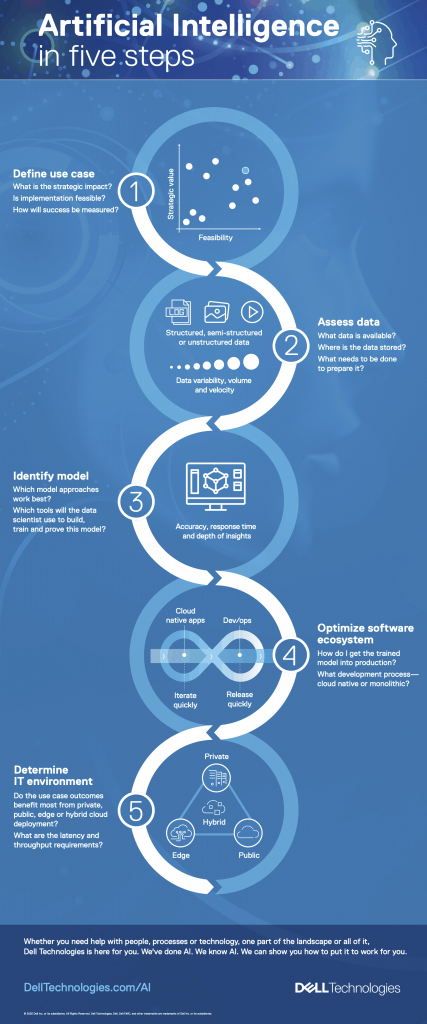
Five Steps To Guarantee Successful AI Development (Infographic)
Many AI projects encounter problems that can derail the effort or not meet the business objects. Check out this five-step plan for undertaking successful artificial intelligence implementations.
Business leaders in almost every industry are looking for ways to integrate artificial intelligence, but many struggle to hire talent, understand the benefits, or identify use cases necessary for AI success.
In a research study on AI adoption, Gartner said finding use cases and not understanding benefits were two of the main challenges highlighted by executives.
To ensure that an AI project delivers, businesses need to have a defined use case before approving it. This needs to be both feasible and of strategic value to the company, such as improving their product versus their competition or increasing their own productivity.
Once a use case has been found, another challenge regularly faced is data management, quality, and governance. In a Gartner webinar, director analyst Peter Krensky said data scope and quality is the biggest challenge to overcome to have successful AI deployment.
A lot of businesses have a limited understanding of their data and its usefulness. That can lead to a project not meeting its intended goals because the program is being fed inaccurate, outdated, or fragmentary data, Krensky explained in the webinar.
Building the right team for AI Success
To avoid such issues of data inaccuracy and messiness and achieve AI success, PWC recommends organizations take proactive steps, including determining the right AI investment path and nurturing their AI talent and culture.
Organizations should also recognize and address the fears and risks relating to AI in an organization to generate support among employees and potentially create new opportunities for them, according to PWC.
On the technical side, the choice between private, public, or hybrid is another consideration to make, as each one has different benefits and drawbacks. Each AI project is unique, and all have different latency, throughput, and security requirements.
Check out the five-step plan and recommendations below for undertaking successful artificial intelligence implementations.
Data immediacy is not a buzzword; it’s a capability that separates leaders from laggards in the modern enterprise. The Data Immediacy Readiness Scale provides both a diagnostic and a roadmap for modern organizations.
As innovative technologies redefine the sporting goods industry, companies that hesitate risk falling behind more agile, digitally empowered competitors.
Building a real-time visual intelligence system requires the tight integration of multiple architectural elements, including those that perform edge processing, visual analytics, and more.
As AI continues to transform capital markets, the importance of multimodal data integration will only increase. The competitive advantage will increasingly shift to firms that can not only integrate diverse signals but do so with minimal latency and maximum accuracy.
Analysis and market insights on real-time analytics including Big Data, the IoT, and cognitive computing. Business use cases and technologies are discussed.
Advertiser Disclosure: Some of the products that appear on
this site are from companies from which TechnologyAdvice
receives compensation. This compensation may impact how and
where products appear on this site including, for example,
the order in which they appear. TechnologyAdvice does not
include all companies or all types of products available in
the marketplace.

 Best Practices for Deploying and Scaling Industrial AIArtificial Intelligence (AI) is transforming industrial operations, helping organizations optimize workflows, reduce downtime, and enhance productivity. Different industry verticals leverage AI in unique ways.Link to The Center for Adaptive Edge Intelligence
 The Center for Adaptive Edge IntelligenceAdaptive edge intelligence brings real-time decision-making to the point of data creation, whether from sensors, machines, or cameras.Link to The Value of Vehicle Electrification
 The Value of Vehicle ElectrificationElectric vehicles (EVs) present automakers with many design, engineering, and manufactu ring challenges.Link to Accelerating Manufacturing Digital Transformation with Industrial Connectivity and IoT
 Accelerating Manufacturing Digital Transformation with Industrial Connectivity and IoTDigital transformation is empowering industrial organizations to deliver sustainable innovation, disruption-proof products and services, and continuous operational improvement.Link to Smart Manufacturing for Automotive
 Smart Manufacturing for AutomotiveLeading a transportation revolution in autonomous, electric, shared mobility and connectivity with the next generation of design and development tools.Link to Center for Data Pipeline Automation
 Center for Data Pipeline AutomationAs businesses become data-driven and rely more heavily on analytics to operate, getting high-quality, trusted data to the right data user at the right time is essential.Link to Center for Automated Integration
 Center for Automated IntegrationThe goal of automated integration is to enable applications and systems that were built separately to easily share data and work together, resulting in new capabilities and efficiencies that cut costs, uncover insights, and much more.Link to Continuous Intelligence: Insights
 Continuous Intelligence: InsightsDigital transformation requires continuous intelligence (CI). Today’s digital businesses are leveraging this new category of software which includes real-time analytics and insights from a single, cloud-native platform across multiple use cases to speed decision-making, and drive world-class customer experiences.