Best Practices for Deploying and Scaling Industrial AI
Artificial Intelligence (AI) is transforming industrial operations, helping organizations optimize workflows, reduce downtime, and enhance productivity. Different industry verticals leverage AI in unique ways.
Accelerating Manufacturing Digital Transformation with Industrial Connectivity and IoT
Digital transformation is empowering industrial organizations to deliver sustainable innovation, disruption-proof products and services, and continuous operational improvement.
Leading a transportation revolution in autonomous, electric, shared mobility and connectivity with the next generation of design and development tools.
As businesses become data-driven and rely more heavily on analytics to operate, getting high-quality, trusted data to the right data user at the right time is essential.
The goal of automated integration is to enable applications and systems that were built separately to easily share data and work together, resulting in new capabilities and efficiencies that cut costs, uncover insights, and much more.
Digital transformation requires continuous intelligence (CI). Today’s digital businesses are leveraging this new category of software which includes real-time analytics and insights from a single, cloud-native platform across multiple use cases to speed decision-making, and drive world-class customer experiences.
Best Practices for Deploying and Scaling Industrial AI
Artificial Intelligence (AI) is transforming industrial operations, helping organizations optimize workflows, reduce downtime, and enhance productivity. Different industry verticals leverage AI in unique ways.
Accelerating Manufacturing Digital Transformation with Industrial Connectivity and IoT
Digital transformation is empowering industrial organizations to deliver sustainable innovation, disruption-proof products and services, and continuous operational improvement.
Leading a transportation revolution in autonomous, electric, shared mobility and connectivity with the next generation of design and development tools.
As businesses become data-driven and rely more heavily on analytics to operate, getting high-quality, trusted data to the right data user at the right time is essential.
The goal of automated integration is to enable applications and systems that were built separately to easily share data and work together, resulting in new capabilities and efficiencies that cut costs, uncover insights, and much more.
Digital transformation requires continuous intelligence (CI). Today’s digital businesses are leveraging this new category of software which includes real-time analytics and insights from a single, cloud-native platform across multiple use cases to speed decision-making, and drive world-class customer experiences.
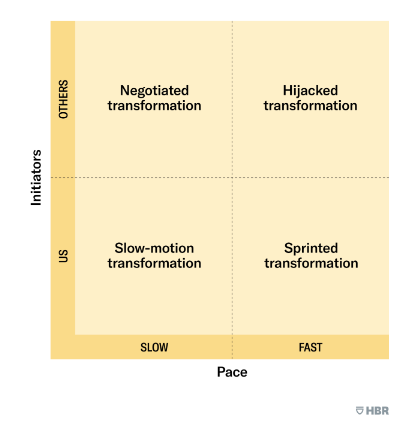
A new study published in Harvard Business Review highlights four types of business transformation, providing further clarity for business leaders who are aiming to transition.
Business transformations are highly variable, depending on the needs of the organization and the time they have to transition. As such, there is not a one-fits-all strategy for how to navigate a transformation, and business leaders need to be aware of the unique challenges their organization faces.
Copenhagen Business School Professor Thomas Ritter and IT University of Copenhagen Associate Professor Carsten Lund Pedersen have developed a typology for business leaders for clarity on the four different types of business transformation.
“Business transformations can take many forms and often occur at the same time,” said Ritter and Pedersen in a Harvard Business Review article. “To understand which approach you’ll need to take, ask yourself two questions: 1) Is your transformation driven by internal needs or external forces? 2) Does it need to happen quickly, or do you have more time to transform?”
Slow-motion transformation
A slow-motion transformation is implemented over a long period of time with managerial and cultural changes happening over several years or a decade. Businesses conducting this type of transformation have plenty of time to oversee the various changes to operations, which should, in theory, enable them to make more astute decisions on the path forward, although that is not always the case.
Microsoft transformation since CEO Satya Nadella was installed in 2014 may be considered a slow-motion transformation. Under Nadella’s guidance the culture at Microsoft has changed significantly, shifting away from the hardball negotiation tactics and rejection of open-source technologies that Microsoft was known for pre-Nadella.
Businesses aiming for a slow-motion transformation need to have a long-term view of the future and patience, even if things don’t fall into place at once.
Sprinted transformation
While a slow-motion transformation can provide security for the executive team and business by taking things one step at a time and discussing each change with stakeholders, some business leaders may want a faster transition to surpass competitors or claim a first-mover advantage.
That was the case with Meta Platforms transformation in 2021, previously known as Facebook. CEO Mark Zuckerberg announced the name change in October 2021, and quickly got the memo out that virtual and augmented reality were the key areas of focus for the next few years. Internally, workers were told to apply for new jobs in these fields, while also stating they would hire 10,000 metaverse workers in Europe.
Zuckerberg’s shift has been considered by some to be impractical and more of a deterrent against bad press than a long-term view, however, it has pushed Meta Platforms firmly into the driving seat when it comes to metaverse development.
Negotiated transformation
A negotiated transformation is a long-term response to external demands, typically changes in national or international laws that require internal adjustments to an organization or its content. These take place over several years and businesses of influence are able to negotiate the new rules, and work with those crafting the rules to ensure as minimal disruption as possible.
The European Union’s GDPR is referenced by Ritter and Pedersen as a time when several businesses, including global publishers, were in a negotiated transformation with the EU. Since enacting the law, the EU has listened to some of the demands of publishers and others businesses in regards to updating the law, to make websites based in the US and other countries operable in the EU.
Hijacked transformation
Sometimes, when dealing with a national or international legislative body, there is no recourse from the decisions made by the legislature. This is considered a hijacked transformation, where an organization must quickly deal with external issues and align the business with new realities.
As seen with the US-China trade war, organizations were given a short amount of time to remove all Huawei products from their infrastructure, or face heavy fines for breaking trading laws. Almost all businesses that operate in the US and Europe quickly removed Huawei infrastructure.
When Russia invaded Ukraine, many Ukrainian businesses were forced into a hijacked transformation, having to quickly adjust to the new realities by removing their employees from the country. Businesses that worked with Russian-based companies had to quickly end partnerships, or face repercussions.
AI is quickly growing, and so must the enterprise environments that support it. Organizations that succeed will be those that pair innovation with governance, autonomy with accountability, and speed with structure.
The separation of front office and back-office functions goes back 300 years. While some believe AI will eliminate the divide, that business binary will remain in place no matter how many AI agents a company throws into the mix.
A unified semantic layer standardizes business definitions across systems, creating a shared contract for how metrics are defined, documented, and governed. That contract applies to dashboards, notebooks, APIs, and AI systems alike.
Domain-specific LLMs are how businesses move from AI curiosity to AI utility where outcomes are measurable, adoption actually sticks, and teams trust what the model tells them.
By treating unstructured data as a strategic asset rather than an operational byproduct, enterprises can resolve the tension between innovation and control.
AI is quickly growing, and so must the enterprise environments that support it. Organizations that succeed will be those that pair innovation with governance, autonomy with accountability, and speed with structure.
Analysis and market insights on real-time analytics including Big Data, the IoT, and cognitive computing. Business use cases and technologies are discussed.
Advertiser Disclosure: Some of the products that appear on
this site are from companies from which TechnologyAdvice
receives compensation. This compensation may impact how and
where products appear on this site including, for example,
the order in which they appear. TechnologyAdvice does not
include all companies or all types of products available in
the marketplace.

 Best Practices for Deploying and Scaling Industrial AIArtificial Intelligence (AI) is transforming industrial operations, helping organizations optimize workflows, reduce downtime, and enhance productivity. Different industry verticals leverage AI in unique ways.Link to The Center for Adaptive Edge Intelligence
 The Center for Adaptive Edge IntelligenceAdaptive edge intelligence brings real-time decision-making to the point of data creation, whether from sensors, machines, or cameras.Link to The Value of Vehicle Electrification
 The Value of Vehicle ElectrificationElectric vehicles (EVs) present automakers with many design, engineering, and manufactu ring challenges.Link to Accelerating Manufacturing Digital Transformation with Industrial Connectivity and IoT
 Accelerating Manufacturing Digital Transformation with Industrial Connectivity and IoTDigital transformation is empowering industrial organizations to deliver sustainable innovation, disruption-proof products and services, and continuous operational improvement.Link to Smart Manufacturing for Automotive
 Smart Manufacturing for AutomotiveLeading a transportation revolution in autonomous, electric, shared mobility and connectivity with the next generation of design and development tools.Link to Center for Data Pipeline Automation
 Center for Data Pipeline AutomationAs businesses become data-driven and rely more heavily on analytics to operate, getting high-quality, trusted data to the right data user at the right time is essential.Link to Center for Automated Integration
 Center for Automated IntegrationThe goal of automated integration is to enable applications and systems that were built separately to easily share data and work together, resulting in new capabilities and efficiencies that cut costs, uncover insights, and much more.Link to Continuous Intelligence: Insights
 Continuous Intelligence: InsightsDigital transformation requires continuous intelligence (CI). Today’s digital businesses are leveraging this new category of software which includes real-time analytics and insights from a single, cloud-native platform across multiple use cases to speed decision-making, and drive world-class customer experiences.