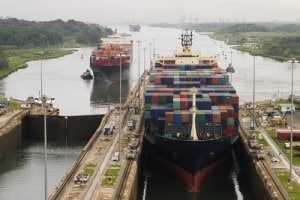
At any given time, thousands of ships are plying the world’s oceans. Tracking them in real-time, like with aircraft, has always been a challenge. Until now.
Just when you thought it was safe to go back in the water…
At any given moment, there are approximately 70,000 ships and boats now somewhere out among the world’s five oceans, all part of a vibrant commercial fishing industry. And it’s now possible to monitor every single one of them, in real-time.
Julie Cohen, a researcher with the University of California at Santa Barbara, recently published details about this immense big data project. “Using satellite tracking, machine learning and common ship-tracking technology, scientists from UC Santa Barbara teamed up with colleagues at Global Fishing Watch, National Geographic Society’s Pristine Sea project, Dalhousie University, SkyTruth, Google and Stanford University to illuminate the extent of global fishing—down to single vessel movements and hourly activity.”
See also: Could blockchain be the future of your supply chain?
In fact, Cohen adds, “70,000 vessels of the global fishing fleet traveled 460 million kilometers in 2016, equivalent to traveling to the moon and back 600 times.”
Real-time monitoring of commercial fishing is taking on other forms as well. For example, NOAA Fisheries had announced is moving it’s North Pacific Observer Program away from placing human observers on fishing boats to relying on electronic monitoring data collection, employing cameras and associated sensors to passively record and monitor fishing activities, Dorene Lorenz of KSRM Alaska reports.
The UC-Santa Barbara team is employing machine learning to analyze 22 billion messages publicly broadcasted from vessels’ AIS positions.
So, what’s the point of assembling all this real-time data? For starters, the researchers can establish patterns across nations and cultures. In addition, measures can be taken to address overfishing of certain regions of the sea. Now, researchers can spot the patterns at any time and location around the globe.
Joe McKendrick is RTInsights Industry Editor and industry analyst focusing on artificial intelligence, digital, cloud and Big Data topics. His work also appears in Forbes an Harvard Business Review. Over the last three years, he served as co-chair for the AI Summit in New York, as well as on the organizing committee for IEEE's International Conferences on Edge Computing. (full bio). Follow him on Twitter @joemckendrick.

 Best Practices for Deploying and Scaling Industrial AIArtificial Intelligence (AI) is transforming industrial operations, helping organizations optimize workflows, reduce downtime, and enhance productivity. Different industry verticals leverage AI in unique ways.Link to The Center for Adaptive Edge Intelligence
 The Center for Adaptive Edge IntelligenceAdaptive edge intelligence brings real-time decision-making to the point of data creation, whether from sensors, machines, or cameras.Link to The Value of Vehicle Electrification
 The Value of Vehicle ElectrificationElectric vehicles (EVs) present automakers with many design, engineering, and manufactu ring challenges.Link to Accelerating Manufacturing Digital Transformation with Industrial Connectivity and IoT
 Accelerating Manufacturing Digital Transformation with Industrial Connectivity and IoTDigital transformation is empowering industrial organizations to deliver sustainable innovation, disruption-proof products and services, and continuous operational improvement.Link to Smart Manufacturing for Automotive
 Smart Manufacturing for AutomotiveLeading a transportation revolution in autonomous, electric, shared mobility and connectivity with the next generation of design and development tools.Link to Center for Data Pipeline Automation
 Center for Data Pipeline AutomationAs businesses become data-driven and rely more heavily on analytics to operate, getting high-quality, trusted data to the right data user at the right time is essential.Link to Center for Automated Integration
 Center for Automated IntegrationThe goal of automated integration is to enable applications and systems that were built separately to easily share data and work together, resulting in new capabilities and efficiencies that cut costs, uncover insights, and much more.Link to Continuous Intelligence: Insights
 Continuous Intelligence: InsightsDigital transformation requires continuous intelligence (CI). Today’s digital businesses are leveraging this new category of software which includes real-time analytics and insights from a single, cloud-native platform across multiple use cases to speed decision-making, and drive world-class customer experiences.