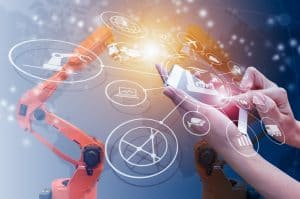
Industry 4.0 concept, intelligent factory with control over the Internet. Use smartphone to check status and order, with icon flow automation and data exchange in manufacturing technologies.
IoT-as-a-Service allows companies to quickly leverage the full power of connected devices, incorporate new technology, and speed the time to value.
IoT-as-a-Service may be one of the most interesting trends for 2021, and for good reason. The Internet of Things enables a vast network of seemingly disconnected services to act together, but a lack of consistency across device operating systems and protocols has hampered its adoption. And companies may be reluctant to update legacy systems and integrate old sensors with the new. Luckily, there could be a more straightforward answer — IoT-as-a-Service.
What is IoT-as-a-Service?
As-a-service models offer customers the resources they need to operate a process without investing in entirely new infrastructure. For IoT, this means gaining a structured, logical ecosystem designed to connect devices and maintain security.
As a business grows, it can add legacy models to the system or scale up new infrastructure without the heavy adoption cost associated with on-premises, in-house solutions. The platform is protocol-agnostic and offers the first solution for managing a suite of non-compatible devices.
Why businesses should be using it
IoT experienced rapid evolution — great for innovation, challenging for integration. IoT-as-a-service offers several benefits:
- Facilitates integration: For companies without a resident tech genius on staff, the chance to upload devices to a central system that configures and coordinates without knowledge of infrastructure is a significant time-saver.
- Troubleshoots compatibility: Organizations no longer fear upgrading devices or adding different types of sensors as necessary. The infrastructure handles the management.
- Provides scale: The biggest question of all when adopting any new technology: will it scale? With IoT-as-a-service, businesses utilize only what they need with room to expand in the future.
- Reduces overhead cost: The cost of adoption is a barrier for small to medium businesses without capital, as well as for enterprises with vast numbers of devices. With IoT-as-a-service, the infrastructure and back-end already exist. All that’s left is to plug in.
A competitive edge
Companies can adopt the technology with less risk and without frustrating trial and error. As is the case with other as-a-Service offerings, companies often can shift from a CapEx to an OpEx model. Specifically, rather than investing huge sums of money upfront for hardware and software, solutions are consumed and paid for as subscription services. Frequently, this opens access to IoT technology that some companies might have been reluctant to invest in due to high initial costs.
Additionally, an as-a-Service model helps companies get access to new technology faster. For example, the use of sophisticated data analysis or modeling such as applying predictive analytics or using machine learning models can enhance the usefulness of an IoT solution. Many companies do not have the expertise to evaluate, select, deploy, and use the best routines. An IoT-as-a-Service offering could provide the expertise, software, and best practices to successfully use modern analytics on a company’s IoT data.
IoT-as-a-service allows industry to leverage the full power of connected devices and edge computing with fewer compatibility issues. It offers a practical path for a technology generating tons of buzz and reduces the obstacles to adoption for everyone outside of the tech space.
Elizabeth Wallace is a Nashville-based freelance writer with a soft spot for data science and AI and a background in linguistics. She spent 13 years teaching language in higher ed and now helps startups and other organizations explain - clearly - what it is they do.

 Best Practices for Deploying and Scaling Industrial AIArtificial Intelligence (AI) is transforming industrial operations, helping organizations optimize workflows, reduce downtime, and enhance productivity. Different industry verticals leverage AI in unique ways.Link to The Center for Adaptive Edge Intelligence
 The Center for Adaptive Edge IntelligenceAdaptive edge intelligence brings real-time decision-making to the point of data creation, whether from sensors, machines, or cameras.Link to The Value of Vehicle Electrification
 The Value of Vehicle ElectrificationElectric vehicles (EVs) present automakers with many design, engineering, and manufactu ring challenges.Link to Accelerating Manufacturing Digital Transformation with Industrial Connectivity and IoT
 Accelerating Manufacturing Digital Transformation with Industrial Connectivity and IoTDigital transformation is empowering industrial organizations to deliver sustainable innovation, disruption-proof products and services, and continuous operational improvement.Link to Smart Manufacturing for Automotive
 Smart Manufacturing for AutomotiveLeading a transportation revolution in autonomous, electric, shared mobility and connectivity with the next generation of design and development tools.Link to Center for Data Pipeline Automation
 Center for Data Pipeline AutomationAs businesses become data-driven and rely more heavily on analytics to operate, getting high-quality, trusted data to the right data user at the right time is essential.Link to Center for Automated Integration
 Center for Automated IntegrationThe goal of automated integration is to enable applications and systems that were built separately to easily share data and work together, resulting in new capabilities and efficiencies that cut costs, uncover insights, and much more.Link to Continuous Intelligence: Insights
 Continuous Intelligence: InsightsDigital transformation requires continuous intelligence (CI). Today’s digital businesses are leveraging this new category of software which includes real-time analytics and insights from a single, cloud-native platform across multiple use cases to speed decision-making, and drive world-class customer experiences.