The Internet of Things and real-time data visibility is very exciting stuff.
But that’s all it will be – lots of stuff – unless it gets successfully applied to real business situations.
It’s just a question of how to get there – and there are many avenues, according to David Menninger, analyst with Ventana Research.
“Some see potential value in expanding their network infrastructure to support operational intelligence,” Menninger says. “Others are implementing event processing systems that employ new technology to detect meaningful patterns, anomalies and relationships among events. Increasingly, organizations are using dashboards, visualization and modeling to notify nontechnical people of events and enable them to understand their significance and take appropriate and immediate action.”
One thing is clear: to become analytics-driven, organizations need to get a handle on collecting, preparing and analyzing streaming, fragmented data. A new ebook published by Datameer, “Big Data Analytics and the Internet of Things: Exploring Enabling Technologies and Industry Opportunities,” provides some guidelines on adopting big data analytics capabilities.
“Data volumes can double every few months, and the data itself is complex – often in hundreds of different semi-structured and unstructured formats,” the book states. “Most importantly, to gain the big insights from streaming sensor data, you need to be able to manage and analyze all of your structured and unstructured data together, all at once.”
The Datameer book illustrates how forward-thinking companies in key industry groups are employing big data analytics in profound ways to successfully leverage the information coming out of IoT.
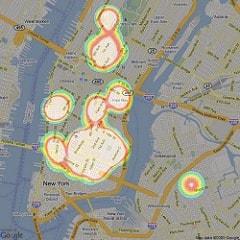 Telecommunications: A business generated network traffic heat maps from usage data across its far-flung network to help them better balance network demand across regions. The heat maps help them “visualize highly congested network areas and areas with excess network capacity.” Thanks to these heat maps, they can instantaneously “see where demand is very near to capacity – and thus where LTE rollouts should be prioritized and marketing efforts should be scaled back. Inversely, they can also identify geographic areas where excess capacity exists and marketing activities should be ramped up.”
Oil and gas: Planners can access and explore datasets that aggregate well sensor data, historical productivity data, and geospatial data, as well as publicly available data on the productivity of competitor wells, to determine sites best suited for additional investment for exploration. With this information, “production engineers can arrive at better production decisions faster, lowering well costs and increasing well performance.” For example, armed with real-time data from this array of sources, “business analysts were able to identify the highest performing wells, as well as what made them perform optimally. Using these insights, the production team developed a new and enhanced well design.”
Broadcasting and cable: Businesses are employing usage data to better predict and forecast future network capacity for increasing video player usage. Insights are based on automated analysis of terabytes of IPCDN session log data across a vast carrier network and performing predictive trend analysis of customer video viewing behavior patterns. The company is identifying “concurrency in player sessions and peak usage times and dates, and then clustering that customer-level information by usage patterns to forecast for future growth and network demands.” This helps guide new network investment decisions – which is critical, “as it costs billions of dollars and takes years to build out networks.”
Technical support: A major enterprise tech provider is pulling insights from customer purchase data, product support logs, and server logs, and then analyzing this data to predict events, “such as when a server might run out of storage or memory capacity or a failure may occur.” This asset data is doubling in volume every 15 months, so the ability to aggregate and standardize the data in one place was key to the ability to provide real-time customer service.
Smart homes: A large home automation company is constantly analyzing terabytes’ worth of streaming data to intelligently manage a streamlined network that connects all of its customers’ homes’ smart systems, including security, HVAC, energy management, lighting, small appliances, video, and other devices. By harnessing big data, customers’ homes are “smarter, safer, and more energy efficient.”

 Best Practices for Deploying and Scaling Industrial AIArtificial Intelligence (AI) is transforming industrial operations, helping organizations optimize workflows, reduce downtime, and enhance productivity. Different industry verticals leverage AI in unique ways.Link to The Center for Adaptive Edge Intelligence
 The Center for Adaptive Edge IntelligenceAdaptive edge intelligence brings real-time decision-making to the point of data creation, whether from sensors, machines, or cameras.Link to The Value of Vehicle Electrification
 The Value of Vehicle ElectrificationElectric vehicles (EVs) present automakers with many design, engineering, and manufactu ring challenges.Link to Accelerating Manufacturing Digital Transformation with Industrial Connectivity and IoT
 Accelerating Manufacturing Digital Transformation with Industrial Connectivity and IoTDigital transformation is empowering industrial organizations to deliver sustainable innovation, disruption-proof products and services, and continuous operational improvement.Link to Smart Manufacturing for Automotive
 Smart Manufacturing for AutomotiveLeading a transportation revolution in autonomous, electric, shared mobility and connectivity with the next generation of design and development tools.Link to Center for Data Pipeline Automation
 Center for Data Pipeline AutomationAs businesses become data-driven and rely more heavily on analytics to operate, getting high-quality, trusted data to the right data user at the right time is essential.Link to Center for Automated Integration
 Center for Automated IntegrationThe goal of automated integration is to enable applications and systems that were built separately to easily share data and work together, resulting in new capabilities and efficiencies that cut costs, uncover insights, and much more.Link to Continuous Intelligence: Insights
 Continuous Intelligence: InsightsDigital transformation requires continuous intelligence (CI). Today’s digital businesses are leveraging this new category of software which includes real-time analytics and insights from a single, cloud-native platform across multiple use cases to speed decision-making, and drive world-class customer experiences.