Cobot Collaborative robot Written on Green Key of Metallic Keyboard. Finger pressing key.
Manufacturers are eyeing 7-axis cobots, which are collaborative robots designed to interact directly with humans in a shared space, to help automate the textile industry.
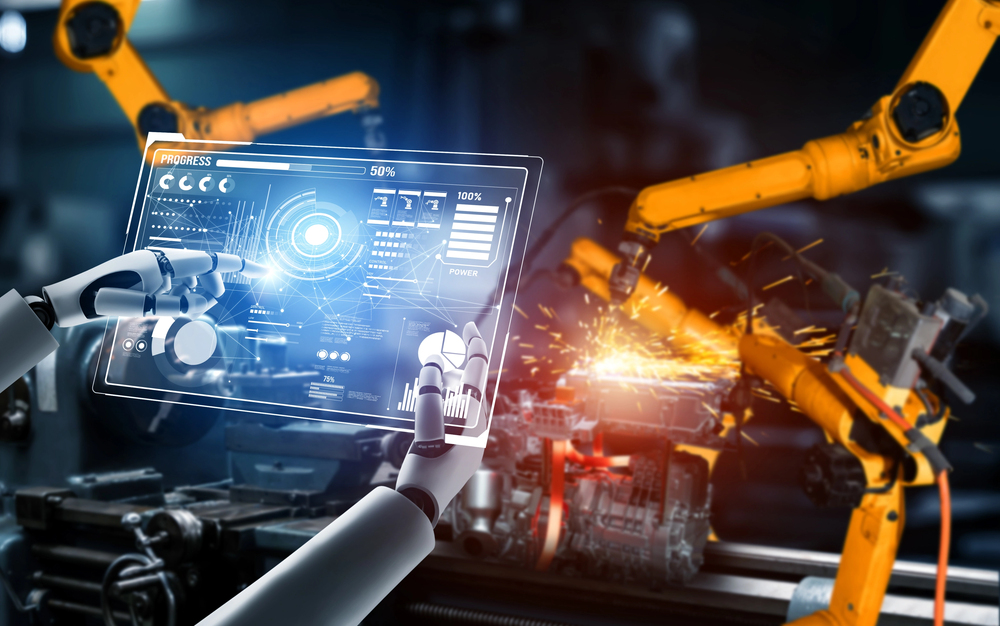
All industries are undergoing some form of digital transformation to create disruption proof operations. Kassow Robots will deploy its KR1018 7-axis cobot—a collaborative robot designed to interact directly with humans in a shared space— to help automate the textile industry. It’s designed specifically for smaller footprints and should bring greater productivity in a variety of factory tasks that haven’t been open to traditional robotics quite yet.
The seventh-axis choice enables continuous dispensing, welding, and material-removal applications thanks to increased mobility and access angles. The arm can actually reach around corners, providing greater flexibility for installation location and ensuring that the robot can be used in smaller operations where space is more confined.
In addition, it features an easy to use interface so that operations can begin without the aid of specialized robot engineers. It’s a plug-and-play concept intended for all company sizes. A long reach with up to 1800 mm of reach and payloads up to 18 kg and simple programming techniques help remove the obstacles to traditional robotics installations.
See also: Chip Shortage Solution: Enter the Robots
60 robots / cobots delivered in stages to the USA
The delivery will happen in stages, supplying the cobots to the factories of a particular textile client in the United States. The team acknowledges the potential for more and believes that demonstrations in real working environments will be the proof of concept needed to slowly expand delivery.
The use case is as follows: The cobot will mount on an AGV equipped with a magazine and a control system. The factory will use it to restock cabling machines. As a result, the company will be able to ensure seamless bobbin changes and improve its material tracking. There’s no need to reorient the arm, and the addition will help humans within the factory continue their tasks without unnecessary interruptions or troubleshooting.
Elizabeth Wallace is a Nashville-based freelance writer with a soft spot for data science and AI and a background in linguistics. She spent 13 years teaching language in higher ed and now helps startups and other organizations explain - clearly - what it is they do.

 Best Practices for Deploying and Scaling Industrial AIArtificial Intelligence (AI) is transforming industrial operations, helping organizations optimize workflows, reduce downtime, and enhance productivity. Different industry verticals leverage AI in unique ways.Link to The Center for Adaptive Edge Intelligence
 The Center for Adaptive Edge IntelligenceAdaptive edge intelligence brings real-time decision-making to the point of data creation, whether from sensors, machines, or cameras.Link to The Value of Vehicle Electrification
 The Value of Vehicle ElectrificationElectric vehicles (EVs) present automakers with many design, engineering, and manufactu ring challenges.Link to Accelerating Manufacturing Digital Transformation with Industrial Connectivity and IoT
 Accelerating Manufacturing Digital Transformation with Industrial Connectivity and IoTDigital transformation is empowering industrial organizations to deliver sustainable innovation, disruption-proof products and services, and continuous operational improvement.Link to Smart Manufacturing for Automotive
 Smart Manufacturing for AutomotiveLeading a transportation revolution in autonomous, electric, shared mobility and connectivity with the next generation of design and development tools.Link to Center for Data Pipeline Automation
 Center for Data Pipeline AutomationAs businesses become data-driven and rely more heavily on analytics to operate, getting high-quality, trusted data to the right data user at the right time is essential.Link to Center for Automated Integration
 Center for Automated IntegrationThe goal of automated integration is to enable applications and systems that were built separately to easily share data and work together, resulting in new capabilities and efficiencies that cut costs, uncover insights, and much more.Link to Continuous Intelligence: Insights
 Continuous Intelligence: InsightsDigital transformation requires continuous intelligence (CI). Today’s digital businesses are leveraging this new category of software which includes real-time analytics and insights from a single, cloud-native platform across multiple use cases to speed decision-making, and drive world-class customer experiences.