Best Practices for Deploying and Scaling Industrial AI
Artificial Intelligence (AI) is transforming industrial operations, helping organizations optimize workflows, reduce downtime, and enhance productivity. Different industry verticals leverage AI in unique ways.
Accelerating Manufacturing Digital Transformation with Industrial Connectivity and IoT
Digital transformation is empowering industrial organizations to deliver sustainable innovation, disruption-proof products and services, and continuous operational improvement.
Leading a transportation revolution in autonomous, electric, shared mobility and connectivity with the next generation of design and development tools.
As businesses become data-driven and rely more heavily on analytics to operate, getting high-quality, trusted data to the right data user at the right time is essential.
The goal of automated integration is to enable applications and systems that were built separately to easily share data and work together, resulting in new capabilities and efficiencies that cut costs, uncover insights, and much more.
Digital transformation requires continuous intelligence (CI). Today’s digital businesses are leveraging this new category of software which includes real-time analytics and insights from a single, cloud-native platform across multiple use cases to speed decision-making, and drive world-class customer experiences.
Best Practices for Deploying and Scaling Industrial AI
Artificial Intelligence (AI) is transforming industrial operations, helping organizations optimize workflows, reduce downtime, and enhance productivity. Different industry verticals leverage AI in unique ways.
Accelerating Manufacturing Digital Transformation with Industrial Connectivity and IoT
Digital transformation is empowering industrial organizations to deliver sustainable innovation, disruption-proof products and services, and continuous operational improvement.
Leading a transportation revolution in autonomous, electric, shared mobility and connectivity with the next generation of design and development tools.
As businesses become data-driven and rely more heavily on analytics to operate, getting high-quality, trusted data to the right data user at the right time is essential.
The goal of automated integration is to enable applications and systems that were built separately to easily share data and work together, resulting in new capabilities and efficiencies that cut costs, uncover insights, and much more.
Digital transformation requires continuous intelligence (CI). Today’s digital businesses are leveraging this new category of software which includes real-time analytics and insights from a single, cloud-native platform across multiple use cases to speed decision-making, and drive world-class customer experiences.
Enterprise automation is at an inflection point. For more than a decade, companies such as Automation Anywhere, Blue Prism (now SS&C Blue Prism), UiPath, and others have provided robotic process automation (RPA) solutions to help businesses reduce manual effort, improve consistency, and lower costs.
Today, however, the rapid rise of AI automation, particularly via autonomous AI agents, is forcing businesses to re-evaluate long-standing assumptions. A common question that now surfaces in boardrooms and operations reviews alike is: Does RPA have a role in the age of AI automation? The short answer is yes. But a longer, more important answer is that RPA’s role is changing.
The reason: AI automation represents a different type of automation altogether. For operations managers, understanding where RPA still fits, where it falls short, and how it can be combined with AI-driven automation is essential to building resilient, future-proof operational workflows.
To understand the market shift, it makes sense to examine what RPA really is.
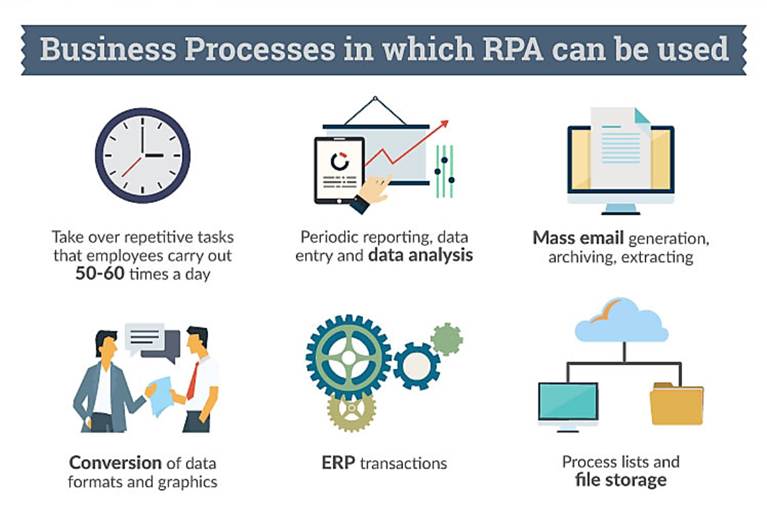
Robotic process automation refers to software bots designed to replicate human actions within digital systems. These bots trigger predefined workflows. RPA is most effective in high-volume, repetitive, rules-based processes where inputs and outputs are structured and predictable.
Common enterprise use cases include accounts payable processing, employee onboarding tasks, report generation, compliance checks, and data synchronization across legacy systems. One of RPA’s historic strengths is that it does not require deep system integration. Because bots operate at the UI layer, they can automate tasks across systems that lack modern APIs or are costly to modify.
However, RPA’s automation logic is explicitly scripted. Bots follow deterministic rules and lack contextual understanding. When workflows change or unexpected conditions arise, RPA typically requires human intervention.
Advertisement
Advertisement
How Is RPA Different from AI Automation?
The fundamental difference between RPA and AI automation lies in decision-making capability. RPA automates tasks; AI automation automates decisions and outcomes.
AI automation leverages machine learning models, natural language processing, and reasoning systems to interpret unstructured data, infer intent, and adapt to changing conditions. AI agents extend this further by acting autonomously. They can plan steps, select tools, evaluate results, and iterate toward a goal rather than simply execute a script.
Where robotic process automation requires explicit instructions for every step, AI automation can generalize across scenarios. For example, an AI system can process emails, documents, or chat interactions that vary widely in format and content.
For businesses, this means AI automation is better suited for dynamic, exception-heavy processes, while RPA excels in stable, predictable environments.
The most effective enterprise automation strategies treat RPA and AI as complementary layers, not competing solutions. Some industry experts have likened AI to the “brain” of automation, while RPA functions as the “hands.”
AI agents can analyze inputs, determine intent, decide next steps, and orchestrate workflows across systems. When execution requires interacting with legacy applications or UI-only systems, RPA bots perform the deterministic actions. Such a division of labor allows organizations to preserve existing robotic process automation investments while dramatically expanding the scope and resilience of automation.
For example, an AI agent might evaluate a service request, validate policy compliance, and decide on an outcome. An RPA bot then executes the approved action inside a legacy ERP or billing system. If conditions change, the AI agent adapts without requiring extensive re-scripting of bots.
Advertisement
Final Thoughts
RPA is being repositioned in the age of agentic AI. Standalone RPA initiatives that attempt to automate entire processes without intelligence are increasingly brittle. Conversely, AI-only approaches that ignore execution realities often struggle to integrate with enterprise systems.
For businesses, the goal should be intelligent automation, where AI handles reasoning and orchestration, and robotic process automation delivers reliable execution. Organizations that align these technologies strategically will gain an increasingly critical capability in today’s fast-changing enterprise environments.
Salvatore Salamone is a physicist by training who writes about science and information technology. During his career, he has been a senior or executive editor at many industry-leading publications including High Technology, Network World, Byte Magazine, Data Communications, LAN Times, InternetWeek, Bio-IT World, and Lightwave, The Journal of Fiber Optics. He also is the author of three business technology books.
The concept of “data in motion” is transforming the way organizations think about their technology stack and will determine which organizations can actually execute on AI and which are left drowning in endless streams of data.
The industry’s movement toward sovereign AI reflects a maturation of the market and an acknowledgment that AI at scale requires the same rigor in governance and infrastructure design that enterprises have long applied to other mission-critical technologies.
NVIDIA launched NVIDIA Nemotron 3 Super, a 120 billion parameter open model with 12 billion active parameters designed to run complex agentic AI systems at scale.
The concept of “data in motion” is transforming the way organizations think about their technology stack and will determine which organizations can actually execute on AI and which are left drowning in endless streams of data.
The industry’s movement toward sovereign AI reflects a maturation of the market and an acknowledgment that AI at scale requires the same rigor in governance and infrastructure design that enterprises have long applied to other mission-critical technologies.
Analysis and market insights on real-time analytics including Big Data, the IoT, and cognitive computing. Business use cases and technologies are discussed.
Advertiser Disclosure: Some of the products that appear on
this site are from companies from which TechnologyAdvice
receives compensation. This compensation may impact how and
where products appear on this site including, for example,
the order in which they appear. TechnologyAdvice does not
include all companies or all types of products available in
the marketplace.

 Best Practices for Deploying and Scaling Industrial AIArtificial Intelligence (AI) is transforming industrial operations, helping organizations optimize workflows, reduce downtime, and enhance productivity. Different industry verticals leverage AI in unique ways.Link to The Center for Adaptive Edge Intelligence
 The Center for Adaptive Edge IntelligenceAdaptive edge intelligence brings real-time decision-making to the point of data creation, whether from sensors, machines, or cameras.Link to The Value of Vehicle Electrification
 The Value of Vehicle ElectrificationElectric vehicles (EVs) present automakers with many design, engineering, and manufactu ring challenges.Link to Accelerating Manufacturing Digital Transformation with Industrial Connectivity and IoT
 Accelerating Manufacturing Digital Transformation with Industrial Connectivity and IoTDigital transformation is empowering industrial organizations to deliver sustainable innovation, disruption-proof products and services, and continuous operational improvement.Link to Smart Manufacturing for Automotive
 Smart Manufacturing for AutomotiveLeading a transportation revolution in autonomous, electric, shared mobility and connectivity with the next generation of design and development tools.Link to Center for Data Pipeline Automation
 Center for Data Pipeline AutomationAs businesses become data-driven and rely more heavily on analytics to operate, getting high-quality, trusted data to the right data user at the right time is essential.Link to Center for Automated Integration
 Center for Automated IntegrationThe goal of automated integration is to enable applications and systems that were built separately to easily share data and work together, resulting in new capabilities and efficiencies that cut costs, uncover insights, and much more.Link to Continuous Intelligence: Insights
 Continuous Intelligence: InsightsDigital transformation requires continuous intelligence (CI). Today’s digital businesses are leveraging this new category of software which includes real-time analytics and insights from a single, cloud-native platform across multiple use cases to speed decision-making, and drive world-class customer experiences.