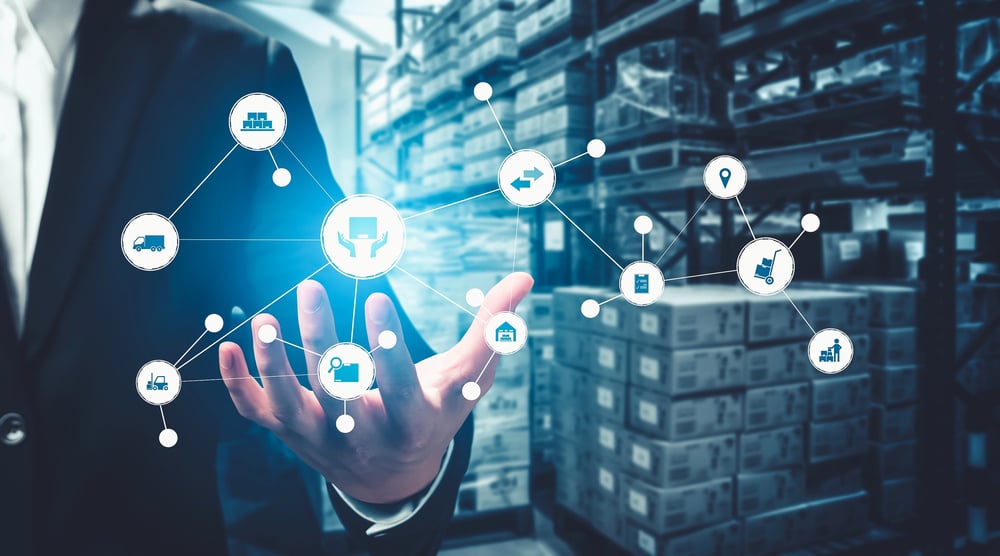
Within the scope of the Internet of Things (IoT), there has been significant progress in the viability of cameras, sensors, and technologies such as artificial intelligence (AI). This has made it possible for organizations with physical operations to capture more data from more assets and connect it to the cloud. Digitization is also enabling organizations to assess and respond to supply chain issues based on real-time data. This is making connected digital operations that have end-to-end visibility across their operations that are more efficient, sustainable, and safe.
These are some key takeaways from a survey of 1,525 companies from Samsara, which finds business resilience and profitability hinge on digital transformation, with 95% agreeing that digitizing their operations improves their ability to weather disruptions, and 91% reported that their investments in digital technology have increased net profit.
The most digitally mature organizations — “connected operations leaders” — outperform their peers across many of these areas. Compared to organizations in the early stages of digitization, connected operations leaders were nearly 2x more likely to exceed revenue goals. Connected operations leaders are also 10x more likely to rate their operational resilience as very high, and 3.6x more likely to report much higher revenue growth than competitors.
The report also reveals how applications of artificial intelligence (AI) and automation—such as AI cameras and automated workflows—have become vital for physical operations. 90% of respondents have implemented AI and automation technologies or plan to by 2023. These technologies are addressing the need for increased safety while empowering employees to spend less time on repetitive tasks. The vast majority (90%) of respondents said they expect these technologies to increase employee retention. Of those who have already implemented AI and automation, 95% reported it has increased employee retention.
See also: Connecting the Digital and Physical Worlds to Address Sustainability
Other top benefits of AI and automation include greater upskilling opportunities (43%), improved safety (42%), greater business agility (41%), and higher employee satisfaction (41%). More than half (51%) of Connected Operations Leaders reported higher employee satisfaction as a benefit of AI and automation, underscoring how these technologies are transforming the employee experience.
The new industrial workforce demands intelligent tools. The labor shortage has mandated a renewed focus on the employee experience. Respondents reported that the most influential factors for recruiting and retaining employees are improving workplace safety (56%) and implementing easy-to-use technology (54%).
The global economy’s most important industries have since faced historic levels of disruption. 89% of the operations leaders we surveyed agreed that disjointed technology and data negatively impact their bottom line, and 84% cited updating legacy tools as a high or critical priority for their organization this year.
Though technology has modernized the employee experience in nearly every other industry, the people that keep our physical operations running—drivers, field technicians, safety managers, warehouse supervisors, and beyond—have historically been underserved by technology. Today, the industrial workforce expects modern tools that improve safety, automate daily tasks, and are as easy to use as technology they rely on in their personal lives. The Great Resignation and extremely tight labor markets have brought this further into focus by underscoring the need to recruit and retain employees. Respondents reported that the most influential factors for recruiting and retaining employees are improving workplace safety (56%) and implementing easy-to-use technology (54%).
The era of remote work has left a lasting imprint on physical operations. Almost all respondents (91%) currently offer technology that enables at least some of their employees to perform work remotely. For example, many now use real-time diagnostics to complete asset inspections remotely, which increases safety and saves time.

 Best Practices for Deploying and Scaling Industrial AIArtificial Intelligence (AI) is transforming industrial operations, helping organizations optimize workflows, reduce downtime, and enhance productivity. Different industry verticals leverage AI in unique ways.Link to The Center for Adaptive Edge Intelligence
 The Center for Adaptive Edge IntelligenceAdaptive edge intelligence brings real-time decision-making to the point of data creation, whether from sensors, machines, or cameras.Link to The Value of Vehicle Electrification
 The Value of Vehicle ElectrificationElectric vehicles (EVs) present automakers with many design, engineering, and manufactu ring challenges.Link to Accelerating Manufacturing Digital Transformation with Industrial Connectivity and IoT
 Accelerating Manufacturing Digital Transformation with Industrial Connectivity and IoTDigital transformation is empowering industrial organizations to deliver sustainable innovation, disruption-proof products and services, and continuous operational improvement.Link to Smart Manufacturing for Automotive
 Smart Manufacturing for AutomotiveLeading a transportation revolution in autonomous, electric, shared mobility and connectivity with the next generation of design and development tools.Link to Center for Data Pipeline Automation
 Center for Data Pipeline AutomationAs businesses become data-driven and rely more heavily on analytics to operate, getting high-quality, trusted data to the right data user at the right time is essential.Link to Center for Automated Integration
 Center for Automated IntegrationThe goal of automated integration is to enable applications and systems that were built separately to easily share data and work together, resulting in new capabilities and efficiencies that cut costs, uncover insights, and much more.Link to Continuous Intelligence: Insights
 Continuous Intelligence: InsightsDigital transformation requires continuous intelligence (CI). Today’s digital businesses are leveraging this new category of software which includes real-time analytics and insights from a single, cloud-native platform across multiple use cases to speed decision-making, and drive world-class customer experiences.