Best Practices for Deploying and Scaling Industrial AI
Artificial Intelligence (AI) is transforming industrial operations, helping organizations optimize workflows, reduce downtime, and enhance productivity. Different industry verticals leverage AI in unique ways.
Accelerating Manufacturing Digital Transformation with Industrial Connectivity and IoT
Digital transformation is empowering industrial organizations to deliver sustainable innovation, disruption-proof products and services, and continuous operational improvement.
Leading a transportation revolution in autonomous, electric, shared mobility and connectivity with the next generation of design and development tools.
As businesses become data-driven and rely more heavily on analytics to operate, getting high-quality, trusted data to the right data user at the right time is essential.
The goal of automated integration is to enable applications and systems that were built separately to easily share data and work together, resulting in new capabilities and efficiencies that cut costs, uncover insights, and much more.
Digital transformation requires continuous intelligence (CI). Today’s digital businesses are leveraging this new category of software which includes real-time analytics and insights from a single, cloud-native platform across multiple use cases to speed decision-making, and drive world-class customer experiences.
Best Practices for Deploying and Scaling Industrial AI
Artificial Intelligence (AI) is transforming industrial operations, helping organizations optimize workflows, reduce downtime, and enhance productivity. Different industry verticals leverage AI in unique ways.
Accelerating Manufacturing Digital Transformation with Industrial Connectivity and IoT
Digital transformation is empowering industrial organizations to deliver sustainable innovation, disruption-proof products and services, and continuous operational improvement.
Leading a transportation revolution in autonomous, electric, shared mobility and connectivity with the next generation of design and development tools.
As businesses become data-driven and rely more heavily on analytics to operate, getting high-quality, trusted data to the right data user at the right time is essential.
The goal of automated integration is to enable applications and systems that were built separately to easily share data and work together, resulting in new capabilities and efficiencies that cut costs, uncover insights, and much more.
Digital transformation requires continuous intelligence (CI). Today’s digital businesses are leveraging this new category of software which includes real-time analytics and insights from a single, cloud-native platform across multiple use cases to speed decision-making, and drive world-class customer experiences.
According to the Industrial Internet Consortium: “the first three industrial revolutions
were powered by steam, electric energy, and electronics. Today’s Industrial
Revolution is powered by data. And that data comes from the “things” that fill
your factories and supply chains.”
Even though data-driven decisions enable great improvements,
manufacturers today are still faced with multiple and significant challenges:
Increased competition
both with traditional companies and new companies unrelated to your industry,
enabled by new technology and innovative solutions
Customers increasingly
want more flexibility and customization, lower costs, and higher quality with
shorter time-to-market demands
Regulations for reducing
waste and the emission footprint of your operations
A workforce without the
right skills and mindset needed to move your company forward
As production and supply
chain environments evolve, those relying on legacy systems and processes will
run into issues in the near and long-term.
Research firm McKinsey lists aftermarket service value and annual
services revenue as two vital drivers for success in the industrial
sector.
These new subscription and aftermarket revenues from services can
be a significant competitive advantage. To enable these, you will need to make
cultural and organizational changes, as well as rolling out advanced
technologies, like the industrial internet of things (IIoT), predictive
analytics, and capture data from assets in the field.
For many, this future will include new business models, like the
ability to offer Equipment-as-a-Service (EaaS) or outcome-based contracts.
What is EaaS, and what
does it mean for manufacturers?
Also known as
servitization, XaaS, or similar, EaaS is a financial model with the added
benefit of improving your customers’ operations.
Equipment-as-a-Service
is defined as a process in which machinery, equipment or production systems are
not purchased, but are provided by a third party for a period in exchange for a
fee to use the equipment. In other words, they’re paying per use.
By switching to EaaS,
the equipment manufacturer improves its customers’ experiences with less
unnecessary maintenance and downtime, while increasing their revenues. EaaS is
a try “win-win” scenario with aligned interests of equipment operators,
manufacturers, and servicers.
In this model, the EaaS supplier is responsible for any
maintenance, service, repairs, or replacements needed throughout the life of
the asset — the ability to predict any downtime before it occurs and adapt a
maintenance schedule are major elements of this business model. Businesses can
also benefit from moving from having the burden of hefty capital expenditures
(CAPEX) to more flexible and less costly operational expenditures
(OPEX).
While the technology that powers modern EaaS systems is advanced,
EaaS is not a new phenomenon.
In 1962 Rolls-Royce trademarked the term ‘power by the hour’ to
refer to the notion of selling a turbojet engine on a
fixed-cost-per-flying-hour basis. To this today, the company still offers a
similar package, now branded Rolls-Royce CorporateCare®, which includes additional features, like
engine health monitoring and an extensive network of support centers.
This idea of bundling offerings and accompanying services is
another crucial component of EaaS, giving organizations additional touchpoints
with customers, as well as opening up new revenue streams while improving
operational efficiencies.
Advertisement
Types of EaaS models
Servitization doesn’t mean you’ll have the same contract for every
customer. Nor does it mean you’ll implement one kind of arrangement.
Unlimited
subscription: This subscription
plan allows for an unlimited quantity of your services over a set time.
Consumption-based: You charge customers on a pay-per-use basis.
This model typically doesn’t include a set commitment.
Predefined
subscription: This model gives
your customers access to a set number of services over a defined period.
Outcome-based: In this model, you charge based on the value you
deliver to the customer.
Subscription
plus overages: This is a
subscription for a predefined amount and a specified period. Any overages are
billed based on actual usage.
Freemium: Customers get access to basic services for
free, and you charge a premium for advanced or full features.
The type of model you
decide on will be primarily determined by your current business relationships
with your customers.
Advertisement
Who wins with EaaS
contracts?
Industrial machinery typically involves hefty upfront investments,
putting a lot of pressure on equipment providers to reduce their costs.
Yet, when a customer purchases an asset, usually less than a
quarter of the total investment is spent on this transaction. The majority of
the cost is spent through operating and maintaining the equipment over
time.
Regardless of the type of EaaS model used, both equipment
manufacturers, as well as operating companies that use their assets, benefit
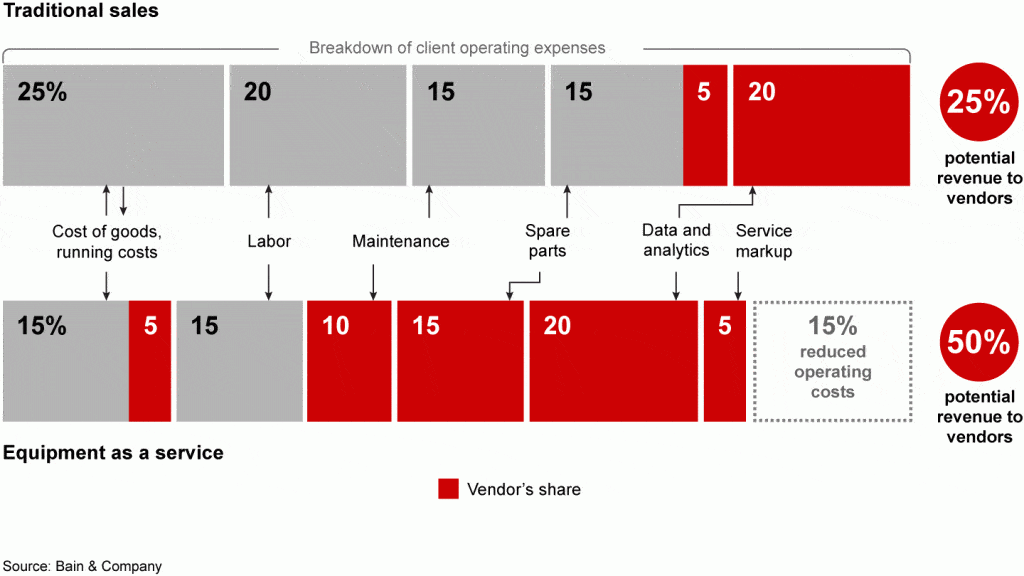
greatly. As demonstrated in the below graphic from Bain & Company, not only do operating costs get reduced, the
potential revenue doubles for equipment manufacturers.
Instead of a one-time charge, providers can expand revenue streams
through a recurring subscription payment. Meanwhile, operators can avoid huge
investments, as well as unpredictable maintenance fees over time, by paying for
usage when and where they need it.
Advertisement
Benefits for companies
that manufacture equipment
Firstly, equipment manufacturers sell something and then don’t
have another interaction with the customer unless there are issues. As a
result, aftermarket sales might not be as high as they should be, or customer
communications may not be set at a steady, ongoing basis, which is vital for
understanding their changing needs and pain points.
On the other hand, with EaaS, manufacturers can have continuous
engagement with the customer, allowing for better customer alignment and
engagement throughout the relationship.
The second advantage for manufacturers is the predictability of
subscription revenues. This model allows for better managed financial risks and
stable revenue streams, as well as access to new customer markets.
Thirdly, field service can be performed at lower costs when you
switch to EaaS, as you can detect and deploy service technicians and
specialists only when it’s needed, such as when a customer places an order or
if there is planned maintenance.
This setup leads to more revenue while keeping operating costs
down and helping you better align with them.
Other benefits include:
Custom financing,
integrated billing, and other services
EaaS models are attractive to operators for a variety of reasons.
Ongoing costs for maintenance and operating a machine are decreased, and
service costs are bundled into a monthly expense. In many cases, machine uptime
is guaranteed. In fact, the aforementioned Bain & Company example cites a 15% reduction in the cost of operating
equipment.
In addition to lowering the financial entry point for industrial
equipment, such as production systems, machines, and equipment, the operational
risk is also transferred to the manufacturer, as opposed to the customer
absorbing upfront costs.
With a “pay per use” model, your costs are aligned with
your usage, which is more attractive than a fixed monthly fee. Operators can
shift from capital expenditure (CAPEX) to operational expenditures (OPEX). This
shift can lead to benefits for taxes, support infrastructure, and the machine’s
lifecycle. More importantly, since EaaS covers the maintenance and service of
assets, your operations will become more efficient compared to traditional
processes, which include procurement, installation, testing, validation, and
servicing.
Advertisement
Ensuring a successful
transformation
What might be holding you back
Implementing technology and shifting revenue models can bring a
new set of challenges for some organizations. Whether it’s a lack of expertise
or skilled talent to manage the new model or analyze incoming data,
retrofitting legacy machinery and overcoming old workflows, or concerns around
potentially large upfront investment involved, all of these are common pain
points most companies face.
How to overcome common challenges
Equipment-as-a-Service revenue models require time spent in the
upfront to identify the right goals before jumping in, ensuring your resources
are aligned, and you have a trusted partner to help you through this journey.
The following are vital elements you should have in place before
moving forward with EaaS.
Gaining internal alignment
Implementing advanced technology to enable servitization isn’t an
initiative for your product or technology departments to manage alone.
Leadership from every department within your business should come together to
ensure logistics and finances, and everything in between is resolved.
Once you have stakeholder alignment, you need to put your desired
business outcomes in the context of what is feasible within the next six
months, 12 months, and the long-term opportunity.
Remember, you’re going from selling standalone pieces of equipment
to selling equipment-as-a-service. It has an impact on everything, and getting
everyone on board may take some time.
Do you have the right customers?
It’s essential to identify the types of customers that would be
the most open to an EaaS relationship. In my experience, those facing
macroeconomic headwinds or competitive pressures, and those looking to be more
efficient with the utilization of their assets, are the types of customers primed
for switching to EaaS arrangements.
Understanding the risks
A motto I like to use with customers is “slow down before you
speed up.” This saying means you need to understand the risks associated
with any digital business transformation. Ask yourself: Do you have the right
resources and expertise? What sort of investment in technology will you have to
make? What kind of data will you uncover? What will happen if I don’t keep pace
and remain competitive? One of the key elements of success is getting as smart
about the risks as you are the benefits.
Focus on more than the technology
Technology updates are indeed involved in any EaaS model; however,
they should all be implemented to achieve your desired business outcomes. Any
IIoT solution is customizable to remotely capture data based on your unique
scenario.
Therefore, it’s essential first to determine what business results
you want when considering an EaaS adoption. Technology is really just an
enabler, and when you approach it through the lens of the business outcomes it
can deliver, that’s when servitization shows its tremendous value.
Working with a partner
Even if you already have an infrastructure in place, working with
a trusted third-party partner that will walk with you along your business
transformation journey will be that much more beneficial. Make sure to select a
company that understands your business goals, will sit down with you to
discover what your business needs to reach those goals, and also someone that
will be with you throughout the process.
Advertisement
Getting started
With subscription-based contracts, you or your customers aren’t
buying the equipment so much as the uptime, outcome, and results. And it
involves a shift in your core business.
Participating in the subscription economy requires a sound
strategy and clear blueprint from the beginning. Having this will lead to
faster revenue growth and help mitigate financial risks.
For EaaS success, be sure to follow these basic approaches:
Conduct a risk assessment
Determine price points specific to your customers based on a realistic analysis of life cycle costs, including any management, admin, and overhead fees
Establish reasonable contracts taking all of the above into account
Institute criteria for withdrawal from services
Assess individual customers systematically before rolling out contracts
Implementing a
servitization model will improve your entire value chain. EaaS allows for
greater efficiency and productivity at a time when customers are demanding
more, and the competitive landscape is fierce. EaaS gives manufacturers
and asset operators financial benefits and guaranteed production and activity
targets while strengthening their business relationships.
Ultimately, combined
with a modern and intelligent IIoT ecosystem, EaaS offers the potential to
harness the current Industrial Revolution as an opportunity to fuel your
company’s growth.
Guneet Bedi, GM of the Americas for relayr, is a seasoned technology executive with an extensive background in enterprise software, IoT, and computer networking. His roles have spanned product management, strategy, business development, and software development at global tech companies, including Cisco, Symantec, and Oracle.
The next wave of product intelligence will be defined by solving the underlying operational and infrastructure challenges that allow AI to act intelligently in real time.
What ultimately differentiates high-performing manufacturers isn’t just the tools they use, but the mindset they cultivate. Leaders in these organizations emphasize proactive decision-making, accountability, and continuous improvement.
By treating unstructured data as a strategic asset rather than an operational byproduct, enterprises can resolve the tension between innovation and control.
AI is quickly growing, and so must the enterprise environments that support it. Organizations that succeed will be those that pair innovation with governance, autonomy with accountability, and speed with structure.
Analysis and market insights on real-time analytics including Big Data, the IoT, and cognitive computing. Business use cases and technologies are discussed.
Advertiser Disclosure: Some of the products that appear on
this site are from companies from which TechnologyAdvice
receives compensation. This compensation may impact how and
where products appear on this site including, for example,
the order in which they appear. TechnologyAdvice does not
include all companies or all types of products available in
the marketplace.

 Best Practices for Deploying and Scaling Industrial AIArtificial Intelligence (AI) is transforming industrial operations, helping organizations optimize workflows, reduce downtime, and enhance productivity. Different industry verticals leverage AI in unique ways.Link to The Center for Adaptive Edge Intelligence
 The Center for Adaptive Edge IntelligenceAdaptive edge intelligence brings real-time decision-making to the point of data creation, whether from sensors, machines, or cameras.Link to The Value of Vehicle Electrification
 The Value of Vehicle ElectrificationElectric vehicles (EVs) present automakers with many design, engineering, and manufactu ring challenges.Link to Accelerating Manufacturing Digital Transformation with Industrial Connectivity and IoT
 Accelerating Manufacturing Digital Transformation with Industrial Connectivity and IoTDigital transformation is empowering industrial organizations to deliver sustainable innovation, disruption-proof products and services, and continuous operational improvement.Link to Smart Manufacturing for Automotive
 Smart Manufacturing for AutomotiveLeading a transportation revolution in autonomous, electric, shared mobility and connectivity with the next generation of design and development tools.Link to Center for Data Pipeline Automation
 Center for Data Pipeline AutomationAs businesses become data-driven and rely more heavily on analytics to operate, getting high-quality, trusted data to the right data user at the right time is essential.Link to Center for Automated Integration
 Center for Automated IntegrationThe goal of automated integration is to enable applications and systems that were built separately to easily share data and work together, resulting in new capabilities and efficiencies that cut costs, uncover insights, and much more.Link to Continuous Intelligence: Insights
 Continuous Intelligence: InsightsDigital transformation requires continuous intelligence (CI). Today’s digital businesses are leveraging this new category of software which includes real-time analytics and insights from a single, cloud-native platform across multiple use cases to speed decision-making, and drive world-class customer experiences.