Best Practices for Deploying and Scaling Industrial AI
Artificial Intelligence (AI) is transforming industrial operations, helping organizations optimize workflows, reduce downtime, and enhance productivity. Different industry verticals leverage AI in unique ways.
Accelerating Manufacturing Digital Transformation with Industrial Connectivity and IoT
Digital transformation is empowering industrial organizations to deliver sustainable innovation, disruption-proof products and services, and continuous operational improvement.
Leading a transportation revolution in autonomous, electric, shared mobility and connectivity with the next generation of design and development tools.
As businesses become data-driven and rely more heavily on analytics to operate, getting high-quality, trusted data to the right data user at the right time is essential.
The goal of automated integration is to enable applications and systems that were built separately to easily share data and work together, resulting in new capabilities and efficiencies that cut costs, uncover insights, and much more.
Digital transformation requires continuous intelligence (CI). Today’s digital businesses are leveraging this new category of software which includes real-time analytics and insights from a single, cloud-native platform across multiple use cases to speed decision-making, and drive world-class customer experiences.
Best Practices for Deploying and Scaling Industrial AI
Artificial Intelligence (AI) is transforming industrial operations, helping organizations optimize workflows, reduce downtime, and enhance productivity. Different industry verticals leverage AI in unique ways.
Accelerating Manufacturing Digital Transformation with Industrial Connectivity and IoT
Digital transformation is empowering industrial organizations to deliver sustainable innovation, disruption-proof products and services, and continuous operational improvement.
Leading a transportation revolution in autonomous, electric, shared mobility and connectivity with the next generation of design and development tools.
As businesses become data-driven and rely more heavily on analytics to operate, getting high-quality, trusted data to the right data user at the right time is essential.
The goal of automated integration is to enable applications and systems that were built separately to easily share data and work together, resulting in new capabilities and efficiencies that cut costs, uncover insights, and much more.
Digital transformation requires continuous intelligence (CI). Today’s digital businesses are leveraging this new category of software which includes real-time analytics and insights from a single, cloud-native platform across multiple use cases to speed decision-making, and drive world-class customer experiences.
The Digital Floor Has Replaced the Digital Ceiling
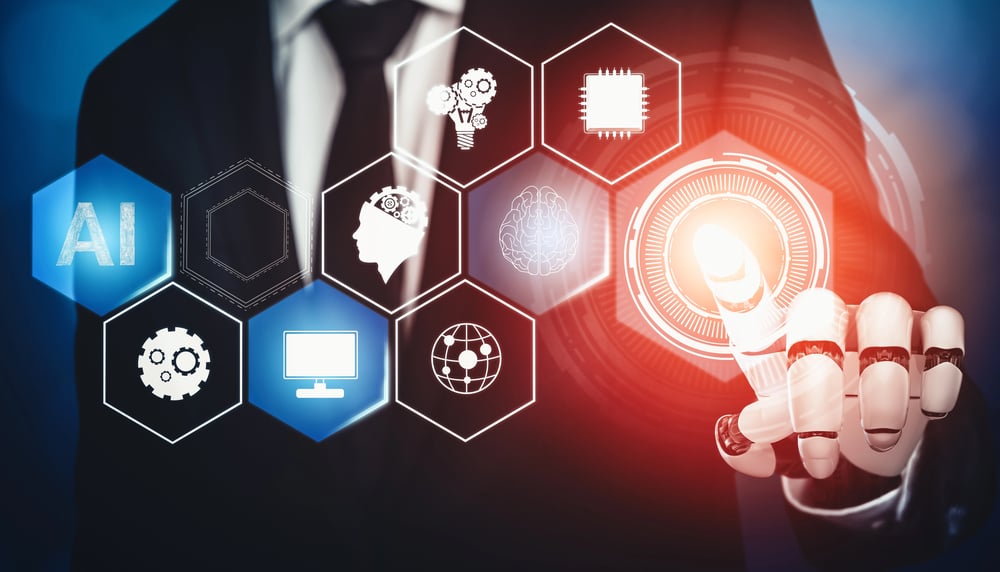
Hand pointing at creative polygonal lamp interface. Future and innovation concept. 3D Rendering
Companies are looking to transformative technologies to help with innovation, deliver better customer service, and detect fresh insights from the petabytes of data they have on hand.
The pandemic has upended so many of our expectations in the two and a half years since reports first emerged of a new respiratory virus in Wuhan, and nowhere more so than in the world of business.
Infosys’ Digital Radar has been studying the intersection of business and technology since 2018, each year examining what’s popular, what’s working, and what matters.
In our first study since the start of the pandemic, we have found one particularly notable shift: the “watchers” – the businesses taking a wait-and-see approach to technology – have vanished.
And we have also seen that where there was a digital ceiling that separated elite companies from those with mid-tier tech adoption, there is now a digital floor.
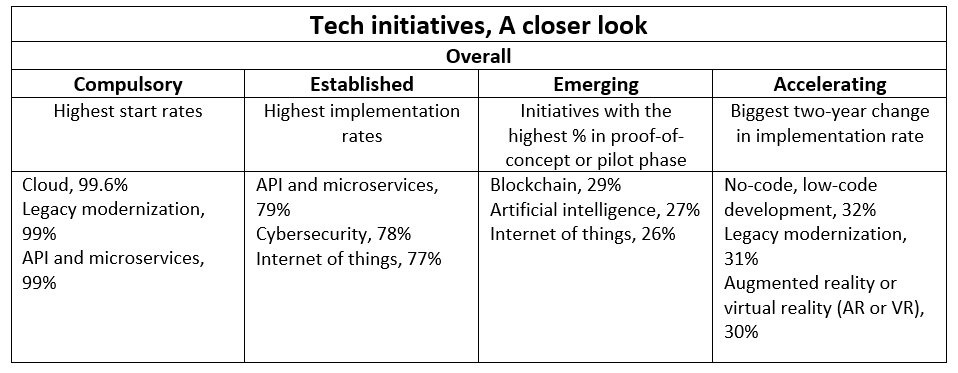
The digital floor is built on a foundation of baseline technologies that all large enterprises must adopt to remain relevant. Cloud computing and legacy modernization are the basis of this floor: this work is now mostly done. Fewer than 1% of the nearly 2,700 business executives surveyed said their companies had yet to start adopting these two digital initiatives, Digital Radar 2022 finds. In some industries, the digital floor includes additional components, but cloud and modernization are always essential. With this foundation established, companies can then move on to the next level and start using a diversity of digital tools.
Digital Radar 2022 asked about 19 different technologies, from open-source computing to augmented reality. Respondents told us their organizations have at least started adopting these initiatives 96% of the time. This held true across all industries, which is a sharp contrast to the state of things three years ago. In 2019, Digital Radar showed that companies in retail had begun pursuing tech initiatives 81% of the time, much more than the 59% underway in health care organizations. Now, those start rates have climbed to 97% for retailers and 98% for health care enterprises.
But even as start-rates have soared, the next stage, full implementation of these technologies, remains static. Respondents to Digital Radar 2022 say they have implemented these technologies in at least one unit 72% of the time, as compared with 70% of the time in 2019.
By technology, the discipline of application programming interfaces and microservices achieved the highest level of implementation in the survey. Some 79% of respondents have APIs and microservices implemented in at least one business unit. Cybersecurity ranked second overall at a close 78%, followed by the Internet of things at 77%.
To be sure, what it takes to implement a particular digital discipline varies from tech to tech, industry to industry, and region to region. And we found that top-performing companies constantly re-evaluate their modernization efforts and cloud strategies as part of their business plan. Good companies never finish implementing these things.
But while it’s a constant that good companies continually re-evaluate their digital transformation efforts, which technologies they focus on varies from region to region.
Technology adoption trends for U.S. companies
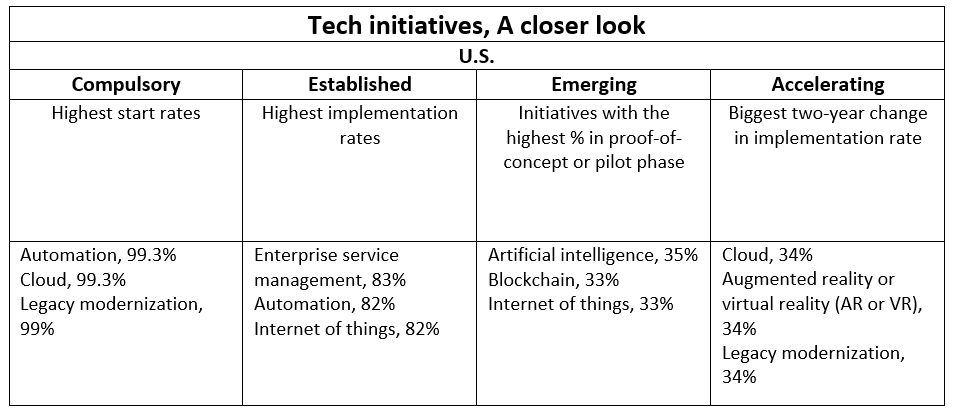
In the US, organizations have focused on enterprise service management, automation, and the Internet of Things, and in the past two years, they have accelerated their implementation of artificial intelligence, blockchain, and IoT.
American companies are also continuing to work on automation and APIs. These joined cloud and modernization with the highest start rates. US companies are focusing their tech efforts most heavily on cloud, modernization, and developing AR/VR.
Tech adoption that delivers faster results and better experiences is one thing, but we have also found that there’s more to it than simply the plug-and-play approach.
Emerging technologies are increasingly customizable. Working with such complex systems, it’s easy to lose sight of the people and the purpose the tech is meant to serve. An enterprise’s digital efforts have to function at a human level if they are to deliver as promised.
When we also consider what business and tech executives want from technology, this is an especially timely message. Early waves of digital adoption helped companies become more efficient: the foundational technologies of the digital floor are still delivering on this front.
Now, however, companies are seeking to use technology to deliver something else. Specifically, they want technology to help with innovation, deliver better customer service, and detect fresh insights from the petabytesof data they have at hand, Digital Radar found.
This shift is reflected in the emerging and accelerating technology companies are pursuing: Digital Radar 2022 found that companies have accelerated their implementations of blockchain, artificial intelligence, and the Internet of Things the most when compared with two years ago. The emerging digital efforts – initiatives most commonly in the works at proof-of-concept or pilot stage – include no-code, low-code development, augmented reality/virtual reality, and legacy modernization.
Legacy modernization is a critical part of the digital floor, and practically all businesses have made a good start here. However, digital transformation and moving up from the digital floor remains a work in progress in most organizations and likely will continue to be so.
NVIDIA launched NVIDIA Nemotron 3 Super, a 120 billion parameter open model with 12 billion active parameters designed to run complex agentic AI systems at scale.
Traditional cyberattacks typically involve one of two strategies: bypassing authentication or exploiting software vulnerabilities. MCP-based systems introduce a different category of risk.
The expansion of smart cities and industrial deployments means infrastructure must be built to withstand harsh, evolving environments while maintaining reliable connectivity and power.
Analysis and market insights on real-time analytics including Big Data, the IoT, and cognitive computing. Business use cases and technologies are discussed.
Advertiser Disclosure: Some of the products that appear on
this site are from companies from which TechnologyAdvice
receives compensation. This compensation may impact how and
where products appear on this site including, for example,
the order in which they appear. TechnologyAdvice does not
include all companies or all types of products available in
the marketplace.

 Best Practices for Deploying and Scaling Industrial AIArtificial Intelligence (AI) is transforming industrial operations, helping organizations optimize workflows, reduce downtime, and enhance productivity. Different industry verticals leverage AI in unique ways.Link to The Center for Adaptive Edge Intelligence
 The Center for Adaptive Edge IntelligenceAdaptive edge intelligence brings real-time decision-making to the point of data creation, whether from sensors, machines, or cameras.Link to The Value of Vehicle Electrification
 The Value of Vehicle ElectrificationElectric vehicles (EVs) present automakers with many design, engineering, and manufactu ring challenges.Link to Accelerating Manufacturing Digital Transformation with Industrial Connectivity and IoT
 Accelerating Manufacturing Digital Transformation with Industrial Connectivity and IoTDigital transformation is empowering industrial organizations to deliver sustainable innovation, disruption-proof products and services, and continuous operational improvement.Link to Smart Manufacturing for Automotive
 Smart Manufacturing for AutomotiveLeading a transportation revolution in autonomous, electric, shared mobility and connectivity with the next generation of design and development tools.Link to Center for Data Pipeline Automation
 Center for Data Pipeline AutomationAs businesses become data-driven and rely more heavily on analytics to operate, getting high-quality, trusted data to the right data user at the right time is essential.Link to Center for Automated Integration
 Center for Automated IntegrationThe goal of automated integration is to enable applications and systems that were built separately to easily share data and work together, resulting in new capabilities and efficiencies that cut costs, uncover insights, and much more.Link to Continuous Intelligence: Insights
 Continuous Intelligence: InsightsDigital transformation requires continuous intelligence (CI). Today’s digital businesses are leveraging this new category of software which includes real-time analytics and insights from a single, cloud-native platform across multiple use cases to speed decision-making, and drive world-class customer experiences.