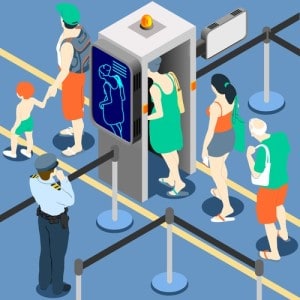
The Department for Homeland Security (DHS) and Transportation Security Administration (TSA) announced on Monday the eight winners of the Passenger Screening Algorithm Challenge.
TSA is acutely aware of the queues at most airports in the United States, due to the growing list of items that passengers aren’t allowed to take on an aircraft. Just last year, the administration added advanced screening for electronic devices, increasing the average screening time.
See also: Hadoop Data in the Dark? How Governance, Metadata Can Help
To hopefully improve the situation, DHS’ Science & Technology Directorate and TSA allowed startups to present unique automation methods for detecting small objects and other prohibited items. Using automated systems may reduce the number of pat-downs and excessive security measures.
The winner of the competition was Jeremy Walthers of DataLab, who won $500,000 for an algorithm that uses deep learning tools to process images from multiple viewpoints. Sergei Fotin, a research scientist, took the second place prize of $300,000 for an algorithm that meshes 2D and 3D data sources to make accurate location predictions.
David Odaibo, a senior system analyst at the University of Alabama and Thomas Anthony won the third place prize of $200,000 for a solution that uses specialized annotations to train identification models.
“By reaching beyond the screening equipment industry, we have an opportunity to discover new, non-traditional performers that might otherwise be overlooked,” said William N. Bryan, DHS Senior Official Performing the Duties of Under Secretary for Science and Technology.
“Working with algorithm developers to improve screening technologies directly serves S&T’s mission to deliver effective and innovative insight, methods and solutions for the critical needs of the Homeland Security Enterprise.”
$100,000 prizes were given to the other five projects, which included a solution that segments an image and runs it through a specific image library, a synthetic data and cross-image analyzer, and random image augmentation.
“The Passenger Screening Algorithm Challenge was an innovative way to challenge a broad community to solve a difficult problem,” said Dr. John Fortune, DHS S&T Apex Screening at Speed Program Manager.
“Better ATR algorithms directly contribute to the passenger experience, reducing the need for pat-downs and accelerating the screening process. Through the prize competition, we’re getting better results than we ordinarily might see, by connecting with very smart people who have great ideas but might not typically be part of a Government proposal process.”

 Best Practices for Deploying and Scaling Industrial AIArtificial Intelligence (AI) is transforming industrial operations, helping organizations optimize workflows, reduce downtime, and enhance productivity. Different industry verticals leverage AI in unique ways.Link to The Center for Adaptive Edge Intelligence
 The Center for Adaptive Edge IntelligenceAdaptive edge intelligence brings real-time decision-making to the point of data creation, whether from sensors, machines, or cameras.Link to The Value of Vehicle Electrification
 The Value of Vehicle ElectrificationElectric vehicles (EVs) present automakers with many design, engineering, and manufactu ring challenges.Link to Accelerating Manufacturing Digital Transformation with Industrial Connectivity and IoT
 Accelerating Manufacturing Digital Transformation with Industrial Connectivity and IoTDigital transformation is empowering industrial organizations to deliver sustainable innovation, disruption-proof products and services, and continuous operational improvement.Link to Smart Manufacturing for Automotive
 Smart Manufacturing for AutomotiveLeading a transportation revolution in autonomous, electric, shared mobility and connectivity with the next generation of design and development tools.Link to Center for Data Pipeline Automation
 Center for Data Pipeline AutomationAs businesses become data-driven and rely more heavily on analytics to operate, getting high-quality, trusted data to the right data user at the right time is essential.Link to Center for Automated Integration
 Center for Automated IntegrationThe goal of automated integration is to enable applications and systems that were built separately to easily share data and work together, resulting in new capabilities and efficiencies that cut costs, uncover insights, and much more.Link to Continuous Intelligence: Insights
 Continuous Intelligence: InsightsDigital transformation requires continuous intelligence (CI). Today’s digital businesses are leveraging this new category of software which includes real-time analytics and insights from a single, cloud-native platform across multiple use cases to speed decision-making, and drive world-class customer experiences.