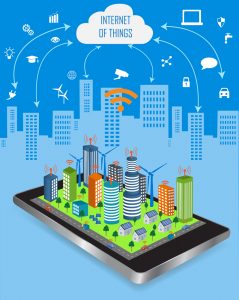
Internet of things concept and Cloud computing technology with different icon and elements. Internet of things cloud with apps.
The Army is examining how IoT and smart city tech can be used in combat situations.
Smart cities could help the military perform better on the battlefield. The Army Research Laboratories (ARL) is studying smart city infrastructure to learn its ability to enhance military capabilities in dense urban environments.
This investigation, a spin-off of the IoT — the IoBT (Internet of Battlefield Things) — analyzes the effectiveness of using sensors and other IoT technology. The IoBT aligns with the Army’s goal to modernize, which includes providing soldiers with access to the best communications and network technology.
Long-Range, Wide-Area Network (LoRaWAN) Capabilities
A popular networking protocol for smart cities, the LoRaWAN connects large deployments of IoT devices over long distances. ARL tested its power in cramped urban situations with tall, potentially signal-obstructing buildings.
Researchers configured various IoT devices to transmit at three LoRaWAN data transmission rates, sending various size messages using the 915MHz band — a band reserved for medical, industrial, and scientific priorities. Researchers attached the devices to a car’s roof and drove around Montreal, weaving among the various skyscrapers.
The team faced several challenges including inaccessibility of several roadways. To meet its objective of getting as much comprehensive coverage as possible, researchers spread data collection over multiple routes and urban terrains. Then researchers studied the data to evaluate coverage gaps and data rates.
One short-term goal involves developing urban terrain profiles to include buildings and natural terrains, which future research will apply to analyze network coverage and capability.
IoBT: Enhancing Military Capabilities
The IoBT and IoT show significant promise in assisting military operations. “IoT infrastructures may be deployed in a variety of settings,” says James Michaelis, ARL computer scientist. “One is Army installations, which can be viewed as cities in their own right and represent a target for modernization. Such modernizations will likely include smart infrastructure and intelligent systems that operate them.”
See also: Defense Department to Extend Predictive Maintenance to Navy
Sue Walsh is News Writer for RTInsights, and a freelance writer and social media manager living in New York City. Her specialties include tech, security and e-commerce. You can follow her on Twitter at @girlfridaygeek.

 Best Practices for Deploying and Scaling Industrial AIArtificial Intelligence (AI) is transforming industrial operations, helping organizations optimize workflows, reduce downtime, and enhance productivity. Different industry verticals leverage AI in unique ways.Link to The Center for Adaptive Edge Intelligence
 The Center for Adaptive Edge IntelligenceAdaptive edge intelligence brings real-time decision-making to the point of data creation, whether from sensors, machines, or cameras.Link to The Value of Vehicle Electrification
 The Value of Vehicle ElectrificationElectric vehicles (EVs) present automakers with many design, engineering, and manufactu ring challenges.Link to Accelerating Manufacturing Digital Transformation with Industrial Connectivity and IoT
 Accelerating Manufacturing Digital Transformation with Industrial Connectivity and IoTDigital transformation is empowering industrial organizations to deliver sustainable innovation, disruption-proof products and services, and continuous operational improvement.Link to Smart Manufacturing for Automotive
 Smart Manufacturing for AutomotiveLeading a transportation revolution in autonomous, electric, shared mobility and connectivity with the next generation of design and development tools.Link to Center for Data Pipeline Automation
 Center for Data Pipeline AutomationAs businesses become data-driven and rely more heavily on analytics to operate, getting high-quality, trusted data to the right data user at the right time is essential.Link to Center for Automated Integration
 Center for Automated IntegrationThe goal of automated integration is to enable applications and systems that were built separately to easily share data and work together, resulting in new capabilities and efficiencies that cut costs, uncover insights, and much more.Link to Continuous Intelligence: Insights
 Continuous Intelligence: InsightsDigital transformation requires continuous intelligence (CI). Today’s digital businesses are leveraging this new category of software which includes real-time analytics and insights from a single, cloud-native platform across multiple use cases to speed decision-making, and drive world-class customer experiences.