Best Practices for Deploying and Scaling Industrial AI
Artificial Intelligence (AI) is transforming industrial operations, helping organizations optimize workflows, reduce downtime, and enhance productivity. Different industry verticals leverage AI in unique ways.
Accelerating Manufacturing Digital Transformation with Industrial Connectivity and IoT
Digital transformation is empowering industrial organizations to deliver sustainable innovation, disruption-proof products and services, and continuous operational improvement.
Leading a transportation revolution in autonomous, electric, shared mobility and connectivity with the next generation of design and development tools.
As businesses become data-driven and rely more heavily on analytics to operate, getting high-quality, trusted data to the right data user at the right time is essential.
The goal of automated integration is to enable applications and systems that were built separately to easily share data and work together, resulting in new capabilities and efficiencies that cut costs, uncover insights, and much more.
Digital transformation requires continuous intelligence (CI). Today’s digital businesses are leveraging this new category of software which includes real-time analytics and insights from a single, cloud-native platform across multiple use cases to speed decision-making, and drive world-class customer experiences.
Best Practices for Deploying and Scaling Industrial AI
Artificial Intelligence (AI) is transforming industrial operations, helping organizations optimize workflows, reduce downtime, and enhance productivity. Different industry verticals leverage AI in unique ways.
Accelerating Manufacturing Digital Transformation with Industrial Connectivity and IoT
Digital transformation is empowering industrial organizations to deliver sustainable innovation, disruption-proof products and services, and continuous operational improvement.
Leading a transportation revolution in autonomous, electric, shared mobility and connectivity with the next generation of design and development tools.
As businesses become data-driven and rely more heavily on analytics to operate, getting high-quality, trusted data to the right data user at the right time is essential.
The goal of automated integration is to enable applications and systems that were built separately to easily share data and work together, resulting in new capabilities and efficiencies that cut costs, uncover insights, and much more.
Digital transformation requires continuous intelligence (CI). Today’s digital businesses are leveraging this new category of software which includes real-time analytics and insights from a single, cloud-native platform across multiple use cases to speed decision-making, and drive world-class customer experiences.
DALL-E: A Stepping Stone to Artificial General Intelligence
Silhouette of man head with electronic brain and business icons over dark blue background. Concept of artificial intelligence. 3d rendering toned image double exposure
DALL-E is already proving to be a stepping stone in AI research. Its novelty lies in the way it was trained – with both text and vision stimuli – unlocking promising new directions of research in a re-emerging field called multimodal AI.
Last January, OpenAI published its latest model DALL-E, a 12-billion parameter version of the natural language processing model GPT-3, generating images rather than text.
Recently DALL-E’s creators have been signaling they will soon open access to DALL-E’s API. Undeniably, this API release will produce various innovative applications. But even before that, DALL-E is already proving to be a stepping stone in AI research. Its novelty lies in the way it was trained – with both text and vision stimuli, unlocking promising new directions of research in a re-emerging field called multimodal AI.
Advanced neural network architecture
DALL-E
is built based on the transformers architecture, an easy-to-parallelize type of
neural network that can scale up and be trained on enormous datasets. The model
receives both the text and the image as a single stream of data and is trained
using maximum likelihood to generate all of the subsequent tokens (i.e.,
pixels), one after another. To train it, OpenAI created a dataset with 400
million image-text pairs of unlabeled data collected from the internet.
The
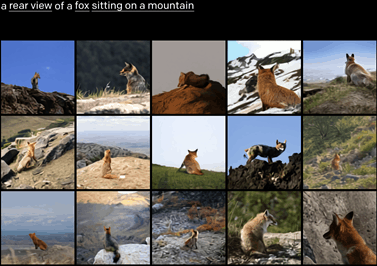
model demonstrated impressive capabilities. For example, based on the following
textual prompt, it was able to control the viewpoint of a scene and the 3D
style in which it was rendered:
Source: OpenAI Blog
In
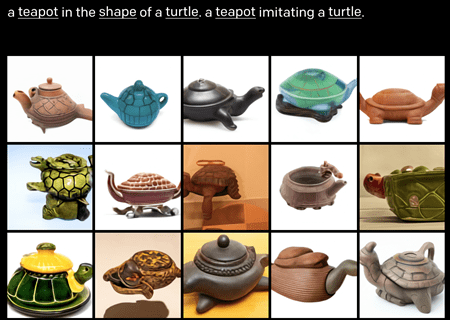
another example, it has generated objects synthesized from a variety of
unrelated ideas while respecting the shape and form of the object being
designed:
Source: OpenAI Blog
These images are 100% synthetical. Unfortunately, with
the lack of a standardized benchmark to measure its performance, it’s hard to
quantify how successful this model is in comparison to previous GANs and future
image generation models.
Advertisement
Not there, yet
The way DALL-E works is that it generates 512 images for each textual prompt. Then, these results are being ranked by another model from OpenAI called CLIP. In short, CLIP can automatically describe images based on their content. It also takes into account textual features, similar to how we humans do. Hence, if it sees an image of an apple with the written word ‘Orange,’ it might label it as an orange even though it’s an apple.
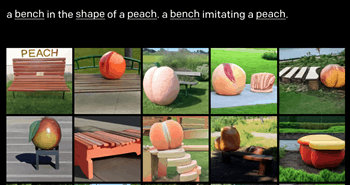
For the
following prompt of a “bench in the shape of a peach,” DALL-E
generated a picture of a bench with the word peach (top-left corner):
Source: OpenAI Blog
This shows multimodal models such as DALL-E are still prone to bias and typographic attacks. Both topics were explored in OpenAI’s follow-up blog post, where they described the promises and shortcomings of this technology.
Advertisement
Human-like intelligence
Today
there is a shared understanding in the AI community that using narrow AI will
not get us to human-like performance across different domains. For example,
even the state-of-the-art deep learning model for early-stage cancer detection
(vision) is limited in its performance when it is missing a patient’s charts
(text) from her electronic health records.
On the promise of combining language and vision, OpenAI’s Chief Scientist Ilya Sutskever stated that in 2021 OpenAI would strive to build and expose models to new stimuli: “Text alone can express a great deal of information about the world, but it’s incomplete because we live in a visual world as well.” He then adds, “this ability to process text and images together should make models smarter. Humans are exposed to not only what they read but also what they see and hear. If you can expose models to data similar to those absorbed by humans, they should learn concepts in a way that’s more similar to humans”.
Multimodality has been explored in the past and has been picking up interest once again in the last several years, with promising results such as Facebook’s AI Research lab recent paper in the field of automatic speech recognition (ASR), showcasing major progress by combining audio and text.
Advertisement
Final thoughts
In
just less than a year since GPT-3’s release, OpenAI is about to release DALL-E
as its next state-of-the-art API. This, along with the GPT and CLIP models,
gets OpenAI one step closer to its promise of building sustainable and safe
artificial general intelligence (AGI). It also creates endless new streams of
research surpassing the previous levels of AI performance.
One
thing is certain–once released, we can all expect our Twitter feed to be
filled with mind-blowing applications, just this time with artificially
generated images rather than artificially generated text.
Sahar Mor has 12 years of engineering and product management experience, both focused on products with AI in their core. Previously worked as an engineering manager in early-stage startups and at the elite Israeli intelligence unit - 8200. Currently, he is the founder of AirPaper, a document intelligence API powered by GPT-3. He was a founding Product Manager at Zeitgold, a B2B AI accounting software company. After Zeitgold, he joined as a founding PM/engineer to Levity.ai, a No-Code AutoML platform providing models for image, document, and text tasks.
The concept of “data in motion” is transforming the way organizations think about their technology stack and will determine which organizations can actually execute on AI and which are left drowning in endless streams of data.
The concept of “data in motion” is transforming the way organizations think about their technology stack and will determine which organizations can actually execute on AI and which are left drowning in endless streams of data.
Analysis and market insights on real-time analytics including Big Data, the IoT, and cognitive computing. Business use cases and technologies are discussed.
Advertiser Disclosure: Some of the products that appear on
this site are from companies from which TechnologyAdvice
receives compensation. This compensation may impact how and
where products appear on this site including, for example,
the order in which they appear. TechnologyAdvice does not
include all companies or all types of products available in
the marketplace.

 Best Practices for Deploying and Scaling Industrial AIArtificial Intelligence (AI) is transforming industrial operations, helping organizations optimize workflows, reduce downtime, and enhance productivity. Different industry verticals leverage AI in unique ways.Link to The Center for Adaptive Edge Intelligence
 The Center for Adaptive Edge IntelligenceAdaptive edge intelligence brings real-time decision-making to the point of data creation, whether from sensors, machines, or cameras.Link to The Value of Vehicle Electrification
 The Value of Vehicle ElectrificationElectric vehicles (EVs) present automakers with many design, engineering, and manufactu ring challenges.Link to Accelerating Manufacturing Digital Transformation with Industrial Connectivity and IoT
 Accelerating Manufacturing Digital Transformation with Industrial Connectivity and IoTDigital transformation is empowering industrial organizations to deliver sustainable innovation, disruption-proof products and services, and continuous operational improvement.Link to Smart Manufacturing for Automotive
 Smart Manufacturing for AutomotiveLeading a transportation revolution in autonomous, electric, shared mobility and connectivity with the next generation of design and development tools.Link to Center for Data Pipeline Automation
 Center for Data Pipeline AutomationAs businesses become data-driven and rely more heavily on analytics to operate, getting high-quality, trusted data to the right data user at the right time is essential.Link to Center for Automated Integration
 Center for Automated IntegrationThe goal of automated integration is to enable applications and systems that were built separately to easily share data and work together, resulting in new capabilities and efficiencies that cut costs, uncover insights, and much more.Link to Continuous Intelligence: Insights
 Continuous Intelligence: InsightsDigital transformation requires continuous intelligence (CI). Today’s digital businesses are leveraging this new category of software which includes real-time analytics and insights from a single, cloud-native platform across multiple use cases to speed decision-making, and drive world-class customer experiences.