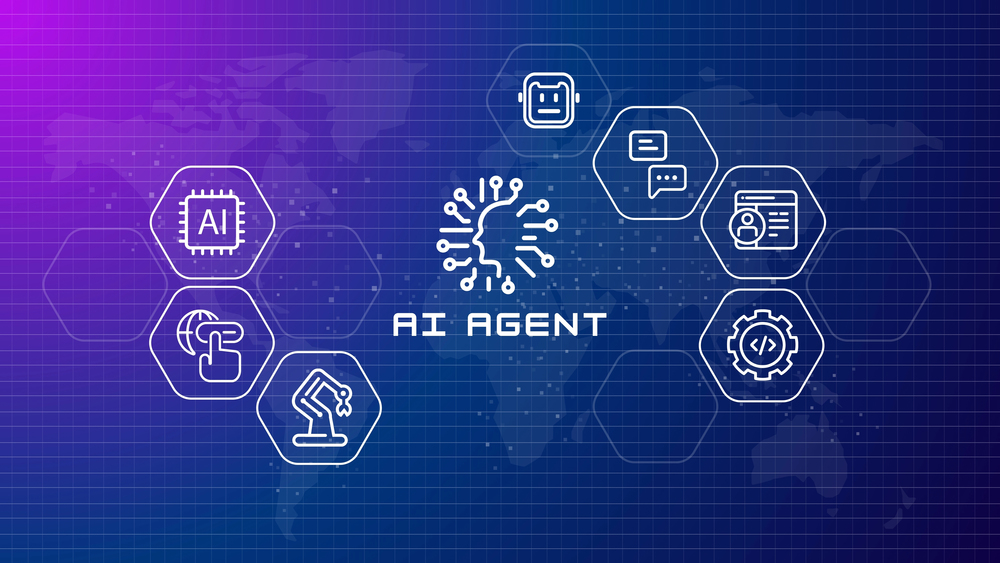
Industrial companies face mounting pressure to increase efficiency, reduce unplanned downtime, and optimize resources in increasingly complex operating environments. Traditional automation systems have delivered incremental gains, but a new paradigm is emerging based on agentic AI automation. Such efforts rely on AI agents that dynamically interpret data, collaborate across workflows, and initiate actions.
High-Value Use Cases for Agentic AI
Some of the most compelling industrial applications for AI agents build on long-standing operational pain points.
- Predictive maintenance: AI agents can continuously monitor streams of sensor data, contextualize anomalies with historical and engineering information, and trigger early interventions before failures occur. Instead of overwhelming teams with alarms, they surface the right signal at the right time, reducing downtime and extending asset life.
- Work-order creation and execution: Agents can move beyond detection by automatically drafting work orders, assigning them to the right teams, and linking them with inventory and scheduling systems. This reduces administrative bottlenecks and ensures operational continuity.
- Root cause analysis: By synthesizing data across OT, IT, and engineering systems, AI agents can accelerate investigations when problems occur. They can narrow the field of possible causes, recommend corrective actions, and capture learnings for future incidents.
- Turnaround planning: For major scheduled shutdowns, agents can help orchestrate the complex web of tasks, dependencies, and resources involved. By simulating scenarios, surfacing risks, and optimizing schedules, they can significantly reduce downtime and cost overruns.
These examples illustrate that agentic automation is not about replacing human expertise but about amplifying it. In other words, they make teams faster, more effective, and less burdened by repetitive coordination tasks.
See also: AI Agents in Industrial Operations: Build or Buy?
Use Case 1: Predicting Equipment Failure
A recent Cognite demo, “Predicting Equipment Failures with AI Agents,” showcased how industrial-scale, agentic AI systems can be layered into asset-reliability workflows to help domain experts more rapidly detect equipment degradation, root-cause anomalies, and impending failures.
Rather than relying purely on human-engineered alerts, these agents continuously monitor sensor streams, contextualize anomalies against historical patterns, surface alerts, and in some cases suggest or initiate investigative workflows. The framing is that AI agents can compress the time to insight, enabling faster decisions, reducing reactive maintenance, and improving uptime.
The demo emphasizes two core capabilities organizations must adopt to be successful. First, they must have a robust industrial data foundation. That provides agents with clean, contextualized, trustworthy input. And second, they must enable agent orchestration and guardrails so that recommendations are actionable and reliable.
Simply plugging in a predictive ML model isn’t enough. The AI agents must “reason” within an operational context, manage uncertainty, escalate appropriately, and integrate with maintenance systems.
Use Case 2: Optimizing Energy
A second demo, “Optimizing Energy with AI Agents,” focused on the role AI agents can play in reducing energy costs and improving operational efficiency across industrial and energy systems.
The key proposition is that AI agents can enable domain experts and operators to surface the right information and insights, without having to write code. Agents can ingest data from diverse sources (sensors, logs, historical performance, external inputs), contextualize it, and present actionable insights (e.g., about energy consumption trends, inefficiencies, or opportunities), helping operators target interventions more precisely.
Similar to the first demo, this walkthrough emphasizes that achieving these capabilities depends on having a solid data foundation and a flexible agent layer atop it. The data side must handle OT, IT, and engineering data, unify formats, and provide semantic consistency so that agents can reason across domains. The agent layer must be designed with guardrails, explainability, and the ability to integrate with operations systems (control, SCADA, maintenance) to make recommendations or trigger workflows.
Working with a Technology Partner
Realizing the potential of agentic automation requires a solid industrial data foundation that unifies and contextualizes diverse data sources, combined with tools to orchestrate and monitor AI agents at scale. Cognite provides both. With Cognite Data Fusion and its growing agentic ecosystem, industrial organizations can enable high-value use cases like predictive maintenance, work-order automation, and turnaround planning, while maintaining governance, safety, and trust.
The bottom line: AI agents represent an opportunity to go beyond isolated analytics projects and move toward self-improving, autonomous workflows that directly drive operational performance.

 Best Practices for Deploying and Scaling Industrial AIArtificial Intelligence (AI) is transforming industrial operations, helping organizations optimize workflows, reduce downtime, and enhance productivity. Different industry verticals leverage AI in unique ways.Link to The Center for Adaptive Edge Intelligence
 The Center for Adaptive Edge IntelligenceAdaptive edge intelligence brings real-time decision-making to the point of data creation, whether from sensors, machines, or cameras.Link to The Value of Vehicle Electrification
 The Value of Vehicle ElectrificationElectric vehicles (EVs) present automakers with many design, engineering, and manufactu ring challenges.Link to Accelerating Manufacturing Digital Transformation with Industrial Connectivity and IoT
 Accelerating Manufacturing Digital Transformation with Industrial Connectivity and IoTDigital transformation is empowering industrial organizations to deliver sustainable innovation, disruption-proof products and services, and continuous operational improvement.Link to Smart Manufacturing for Automotive
 Smart Manufacturing for AutomotiveLeading a transportation revolution in autonomous, electric, shared mobility and connectivity with the next generation of design and development tools.Link to Center for Data Pipeline Automation
 Center for Data Pipeline AutomationAs businesses become data-driven and rely more heavily on analytics to operate, getting high-quality, trusted data to the right data user at the right time is essential.Link to Center for Automated Integration
 Center for Automated IntegrationThe goal of automated integration is to enable applications and systems that were built separately to easily share data and work together, resulting in new capabilities and efficiencies that cut costs, uncover insights, and much more.Link to Continuous Intelligence: Insights
 Continuous Intelligence: InsightsDigital transformation requires continuous intelligence (CI). Today’s digital businesses are leveraging this new category of software which includes real-time analytics and insights from a single, cloud-native platform across multiple use cases to speed decision-making, and drive world-class customer experiences.