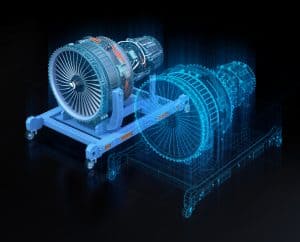
In recent years, digital twins have risen to the forefront as a way to digitally replicate, in real time, factory, corporate or government operations to simulate events and understand where things can be made more efficient. We’re only at the beginning of the drive to create digital twins, and the year ahead will be epic for these approaches.
The global digital twin market was valued at $7.53 billion in 2020, and it is expected to reach a value of $46.08 billion by 2026, registering a compounded annual growth rate of 35.01% over the next five years, according to projections from Mordor Intelligence. “The promise of digital twins lies in improving collaboration and workflows across different types of groups, like product design, sales, and maintenance teams, and engineering disciplines,” the report’s authors observe. “For example, the US Air Force has made extensive use of digital twins to design and build a new aircraft prototype in over a year, a process that traditionally drags on for decades. Further, IoT sensors have created a potential space for engineers to test and communicate with sensors integrated with the operating products, hence delivering real-time prescriptive system functioning and timely maintenance.”

Digital twin technology also will increasingly play a role “in improving physical product design for the entire product lifecycle through pre-analysis of the actual product in its development stage,” the Mordor analysts add. “In industrial IoT, digital twin technology will find errors and changes in large machinery equipment through its analytic software connected with IoT components such as smart sensors and networks.”
See also: Digital Twins and the City
There are many ways the use of digital twin technology will expend into our organizations, as predicted by George Lawton in VentureBeat. In fact, Lawton made 22 predictions on where digital twins will have their greatest impacts in the year ahead. Here are some of his most compelling predictions.
Cloud providers will expand digital twin support. “All the major cloud providers rolled out significant digital twin capabilities in 2021,” Lawton states. “Microsoft revealed a digital twin ontology for construction and building management. Google launched a digital twin service for logistics and manufacturing. AWS launched IoT TwinMaker and FleetWise to simplify digital twins of factories, industrial equipment, and vehicle fleets. Nvidia launched a metaverse for engineers as a subscription service across Nvidia’s partner network.”
Digital twins will be more interoperable. “Early digital twin designs focused on individual digital twins. The Digital Twins Consortium’s interoperability standards will make it easier to compose larger-scale digital twin assemblies from a library of designs. This will accelerate efforts to reuse digital twins components across multiple designs.”
Faster simulation will drive new use cases. “Simulation tool providers such as Altair, Ansys, Akselos, Cadence, Nnaisense, and Synopsis are discovering new simulation algorithms that provide performance gains in software at a much faster clip than Moore’s law. Hardware innovations from Nvidia and Cereberas can amplify these gains to enable a million-fold improvement in performance.”
There will be more digital twins of business processes themselves. Business process tools now “analyze ERP and CRM application logs to create a digital twin of business processes. Other task mining tools extend the reach of these tools using machine vision to watch over a user’s shoulder as they type and click their way across multiple apps. Process intelligence further extends these capabilities with sophisticated analytics and can automatically generate scripts to automate processes.”

 Best Practices for Deploying and Scaling Industrial AIArtificial Intelligence (AI) is transforming industrial operations, helping organizations optimize workflows, reduce downtime, and enhance productivity. Different industry verticals leverage AI in unique ways.Link to The Center for Adaptive Edge Intelligence
 The Center for Adaptive Edge IntelligenceAdaptive edge intelligence brings real-time decision-making to the point of data creation, whether from sensors, machines, or cameras.Link to The Value of Vehicle Electrification
 The Value of Vehicle ElectrificationElectric vehicles (EVs) present automakers with many design, engineering, and manufactu ring challenges.Link to Accelerating Manufacturing Digital Transformation with Industrial Connectivity and IoT
 Accelerating Manufacturing Digital Transformation with Industrial Connectivity and IoTDigital transformation is empowering industrial organizations to deliver sustainable innovation, disruption-proof products and services, and continuous operational improvement.Link to Smart Manufacturing for Automotive
 Smart Manufacturing for AutomotiveLeading a transportation revolution in autonomous, electric, shared mobility and connectivity with the next generation of design and development tools.Link to Center for Data Pipeline Automation
 Center for Data Pipeline AutomationAs businesses become data-driven and rely more heavily on analytics to operate, getting high-quality, trusted data to the right data user at the right time is essential.Link to Center for Automated Integration
 Center for Automated IntegrationThe goal of automated integration is to enable applications and systems that were built separately to easily share data and work together, resulting in new capabilities and efficiencies that cut costs, uncover insights, and much more.Link to Continuous Intelligence: Insights
 Continuous Intelligence: InsightsDigital transformation requires continuous intelligence (CI). Today’s digital businesses are leveraging this new category of software which includes real-time analytics and insights from a single, cloud-native platform across multiple use cases to speed decision-making, and drive world-class customer experiences.