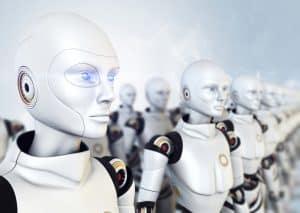
Army of robots
Demand for AI developers is fierce. High-level interdisciplinary projects help companies attract talent in the race against other tech companies.
Innovative applications that make use of artificial intelligence often need an interdisciplinary team for success. In today’s marketplace, where companies struggle to fill key technology positions, an interdisciplinary approach can bring some unexpected benefits.
A prime example is Tesla’s work on a bipedal robot for 2022. This project underscores the interdisciplinary reach of some of the most established tech companies. Elon Musk announced earlier this year that work on Optimus would take a more significant part of the company’s focus moving forward.
The robot isn’t out of left field. Much of the work completed in the race to become the first provider of truly autonomous vehicles can also be applied to other autonomous machines. Musk was clear that if Tesla didn’t do it, someone else would.
The goal is to have a working prototype by the end of 2022. If successful, Tesla has suggested that the first deployments for the robot would be at its factories, helping reduce the risk of certain jobs on humans and improving overall efficiency.
See also: A Talent Strategy for Artificial Intelligence
Attracting interdisciplinary talent
The robot isn’t shaping up to be Tesla’s main project, not yet anyway. However, the work required to get from development to a working prototype could benefit Tesla in two distinct ways.
- Attracting talent: The talent race for AI developers is fierce. Working on high-level projects such as this one could help Tesla remain competitive in the talent race against other tech companies.
- Addressing labor shortages and disruption: Tesla reprioritized the robot to help bolster labor supply.
Musk believes the robot will contribute significantly to making Artificial General Intelligence –robots that learn concepts and tasks the way humans do – a reality. For Tesla to get there first would cement the company’s contributions to the AI race.
The project seems to be gaining greater importance within the company’s product and development, although recent events on the global stage may once again shift the company’s priorities. However, there’s enough buzz around Optimus that we could see an unveiling of Tesla’s work later this year. We’ll be keeping watch.
Elizabeth Wallace is a Nashville-based freelance writer with a soft spot for data science and AI and a background in linguistics. She spent 13 years teaching language in higher ed and now helps startups and other organizations explain - clearly - what it is they do.

 Best Practices for Deploying and Scaling Industrial AIArtificial Intelligence (AI) is transforming industrial operations, helping organizations optimize workflows, reduce downtime, and enhance productivity. Different industry verticals leverage AI in unique ways.Link to The Center for Adaptive Edge Intelligence
 The Center for Adaptive Edge IntelligenceAdaptive edge intelligence brings real-time decision-making to the point of data creation, whether from sensors, machines, or cameras.Link to The Value of Vehicle Electrification
 The Value of Vehicle ElectrificationElectric vehicles (EVs) present automakers with many design, engineering, and manufactu ring challenges.Link to Accelerating Manufacturing Digital Transformation with Industrial Connectivity and IoT
 Accelerating Manufacturing Digital Transformation with Industrial Connectivity and IoTDigital transformation is empowering industrial organizations to deliver sustainable innovation, disruption-proof products and services, and continuous operational improvement.Link to Smart Manufacturing for Automotive
 Smart Manufacturing for AutomotiveLeading a transportation revolution in autonomous, electric, shared mobility and connectivity with the next generation of design and development tools.Link to Center for Data Pipeline Automation
 Center for Data Pipeline AutomationAs businesses become data-driven and rely more heavily on analytics to operate, getting high-quality, trusted data to the right data user at the right time is essential.Link to Center for Automated Integration
 Center for Automated IntegrationThe goal of automated integration is to enable applications and systems that were built separately to easily share data and work together, resulting in new capabilities and efficiencies that cut costs, uncover insights, and much more.Link to Continuous Intelligence: Insights
 Continuous Intelligence: InsightsDigital transformation requires continuous intelligence (CI). Today’s digital businesses are leveraging this new category of software which includes real-time analytics and insights from a single, cloud-native platform across multiple use cases to speed decision-making, and drive world-class customer experiences.