There’s no question as to the enormous business potential of the Internet of Things. As reported last year, the McKinsey Global Institute estimates that the Internet of Things (IoT) will add between $4 trillion and $11 trillion to the global economy by 2025.
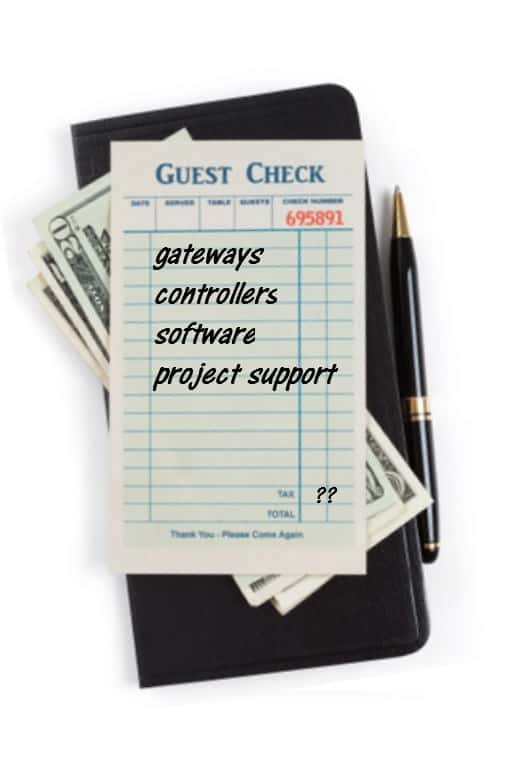
However, before reaping such bounties, enterprises face another, more micro conundrum – who pays for what? A marketing organization that benefits pulling data from devices may need to pony up for maintenance and occasional replacement of said devices, for example. Who signs the check isn’t so clear.
Bob O’Donnell, founder and chief analyst of Technalysis Research LLC, tackled the question of IoT funding in a recent post, asking who in the organization will pay for all these devices and the networks that support them. “Who pays?” he asks. “You can’t just assume that IT will be paying for all the new sensors, gateways, networking equipment, analytics hardware and software.”
IoT funding: dine and dash
 In surveys of IT economics I have helped design and publish over the years, we sought to follow the money when it came to funding online services and cloud. The answers we came up with were always murky, with funding for such services coming out of general corporate budgets, or from the hides of IT departments. Interestingly, the parts of enterprises that stood to benefit most from projects – again, I’ll pick on marketing – tended not to have these services as line items in their budgets. There was a lot of cross-subsidization taking place.
This may be the funding arrangement emerging with IoT networks as well, but since a good chunk of IoT is outside the walls of the enterprise, the costs of implementation and maintenance may be higher, especially if third-party firms are relied on.
In fact, IT may not even be directly involved in IoT at all, O’Donnell points out.
“Not all business IoT projects are being run by IT — in fact, the majority (two-thirds) of them are not. So you can’t just assume that IT will be paying for all the new sensors, gateways, networking equipment, analytics hardware and software — as well as any consultative help provided by VARs or other specialists to get it all up and running. In many organizations, operations specialists, manufacturing, business strategy or even sales and marketing might end up being stuck with the check.”
Time to value
O’Donnell also points out that while IoT’s value look great on paper, it’s going to take time for organizations to realize enough business value to justify what are often expensive up-front investments.
So who needs to foot the bill up front, before the payback begins trickling in? O’Donnell says this is something that is going to have to be worked through.
As with online services and cloud, it may be necessary to pull funding out of general corporate budgets, since benefits will be shared across enterprises. For many of the early pilots and implementations, it’s likely that such projects will fall under the purview of IT, which has the expertise and resources to tackle implementations on an end-to-end basis.
A great deal of IoT will be expressed through sensors and applications embedded within product lines, providing valuable information on usage and quality issues, so R&D, product development or engineering may need to have a financial stake in the effort.
In the long run, however, funding is a question that needs to be clarified as organizations rely on IoT to maintain real-time connectivity to customers and products.

 Best Practices for Deploying and Scaling Industrial AIArtificial Intelligence (AI) is transforming industrial operations, helping organizations optimize workflows, reduce downtime, and enhance productivity. Different industry verticals leverage AI in unique ways.Link to The Center for Adaptive Edge Intelligence
 The Center for Adaptive Edge IntelligenceAdaptive edge intelligence brings real-time decision-making to the point of data creation, whether from sensors, machines, or cameras.Link to The Value of Vehicle Electrification
 The Value of Vehicle ElectrificationElectric vehicles (EVs) present automakers with many design, engineering, and manufactu ring challenges.Link to Accelerating Manufacturing Digital Transformation with Industrial Connectivity and IoT
 Accelerating Manufacturing Digital Transformation with Industrial Connectivity and IoTDigital transformation is empowering industrial organizations to deliver sustainable innovation, disruption-proof products and services, and continuous operational improvement.Link to Smart Manufacturing for Automotive
 Smart Manufacturing for AutomotiveLeading a transportation revolution in autonomous, electric, shared mobility and connectivity with the next generation of design and development tools.Link to Center for Data Pipeline Automation
 Center for Data Pipeline AutomationAs businesses become data-driven and rely more heavily on analytics to operate, getting high-quality, trusted data to the right data user at the right time is essential.Link to Center for Automated Integration
 Center for Automated IntegrationThe goal of automated integration is to enable applications and systems that were built separately to easily share data and work together, resulting in new capabilities and efficiencies that cut costs, uncover insights, and much more.Link to Continuous Intelligence: Insights
 Continuous Intelligence: InsightsDigital transformation requires continuous intelligence (CI). Today’s digital businesses are leveraging this new category of software which includes real-time analytics and insights from a single, cloud-native platform across multiple use cases to speed decision-making, and drive world-class customer experiences.