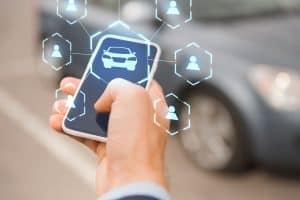
business, transportation and future technology concept - close up of businessman hand with smartphone and virtual car sharing icons
Researchers are exploring a new ridesharing model to maximize the availability of vehicles by optimally routing empty cars.
Ridesharing services like Uber and Lyft dispatch a car once
a rider requests a ride. Whether or not one is close by is a matter of chance.
Researchers are exploring a new model for rideshare companies. The model
focuses on maximizing the availability of rideshares by optimally routing empty
cars.
All rideshares start off waiting for a rider summons a car.
to initiate on a passenger. If an empty car is available, the passenger
occupies that car and travels to his or her destination. If no empty car is
available within a short period, the passenger abandons that order either
trying another rideshare service or an alternative form of transportation.
See also: How Real-Time ML Helps Google Maps Predict Bus Delays Worldwide
From the driver’s perspective, once a driver drops off a
passenger, should the driver stay in that area to hopefully find new passengers
immediately or relocate without a passenger to a different place, risking time
spent driving without a passenger and without getting paid?
So how does a rideshare company ensure a car is available?
New research published in the Institute for Operations Research and the Management Sciences (INFORMS) journal Operations Research offers a way to control the flow of empty cars to shorten wait times and make efficient use of the vehicles in service at any given time. The work was conducted by Anton Braverman of Kellogg School of Management at Northwestern University, Jim Dai of The Chinese University of Hong Kong, Shenzhen and Cornell University, Lei Ying of the University of Michigan and Xin Liu of Arizona State University.
Algorithms developed by the researchers direct an empty car
after it drops off a passenger to a different location instead of waiting at
the same location to match the geographic imbalance of passenger demands. In a
way, this mimics the way savvy baseball players use knowledge of a hitter’s
patterns and start moving before a ball is pitched to be in the right spot to
make a play.
Driving empty cars to a specific location after a passenger
has been dropped off seems to be a waste of resources. However, it turns out to
be necessary and imperative to maximize the availability of rideshare services
in the presence of the geographic imbalance of passengers.
“The new car flow control policy is based on historical data for time-dependent futurecast to anticipate route changes and direct cars accordingly,” said Braverman. “You can calculate the availability of empty cars when they are requested and find new passengers quickly once a driver reaches a destination.”
If such algorithms are one day deployed, one issue that will
need to be addressed is whether the driver is compensated for the gas and time
to get to the designated area. The researchers working on this project suggest
rideshare companies might include incentives like paying these costs or giving
the driver an hourly fee for moving from one place to another.
Salvatore Salamone is a physicist by training who writes about science and information technology. During his career, he has been a senior or executive editor at many industry-leading publications including High Technology, Network World, Byte Magazine, Data Communications, LAN Times, InternetWeek, Bio-IT World, and Lightwave, The Journal of Fiber Optics. He also is the author of three business technology books.

 Best Practices for Deploying and Scaling Industrial AIArtificial Intelligence (AI) is transforming industrial operations, helping organizations optimize workflows, reduce downtime, and enhance productivity. Different industry verticals leverage AI in unique ways.Link to The Center for Adaptive Edge Intelligence
 The Center for Adaptive Edge IntelligenceAdaptive edge intelligence brings real-time decision-making to the point of data creation, whether from sensors, machines, or cameras.Link to The Value of Vehicle Electrification
 The Value of Vehicle ElectrificationElectric vehicles (EVs) present automakers with many design, engineering, and manufactu ring challenges.Link to Accelerating Manufacturing Digital Transformation with Industrial Connectivity and IoT
 Accelerating Manufacturing Digital Transformation with Industrial Connectivity and IoTDigital transformation is empowering industrial organizations to deliver sustainable innovation, disruption-proof products and services, and continuous operational improvement.Link to Smart Manufacturing for Automotive
 Smart Manufacturing for AutomotiveLeading a transportation revolution in autonomous, electric, shared mobility and connectivity with the next generation of design and development tools.Link to Center for Data Pipeline Automation
 Center for Data Pipeline AutomationAs businesses become data-driven and rely more heavily on analytics to operate, getting high-quality, trusted data to the right data user at the right time is essential.Link to Center for Automated Integration
 Center for Automated IntegrationThe goal of automated integration is to enable applications and systems that were built separately to easily share data and work together, resulting in new capabilities and efficiencies that cut costs, uncover insights, and much more.Link to Continuous Intelligence: Insights
 Continuous Intelligence: InsightsDigital transformation requires continuous intelligence (CI). Today’s digital businesses are leveraging this new category of software which includes real-time analytics and insights from a single, cloud-native platform across multiple use cases to speed decision-making, and drive world-class customer experiences.