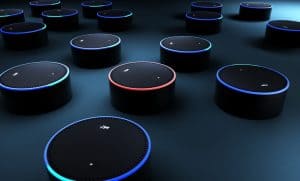
Just a few years ago, smart home assistants
were the latest “must-have” technology. Even though they had limited
functionality, their novelty, coupled with a relatively low price point (and
strategic price reductions during the holidays) made them near-irresistible to
consumers. Suddenly, tech companies had access to more personal information
than they knew what to do with. In fact, as of last year, there were smart
speakers in more than half a billion homes across the
world.
See also: Privacy a Key Issue Stalling Major Smart City Projects
More recently, though, these devices have
begun to fall out of favor with the public. Almost every week, there’s a new
data privacy scandal, and as a result, people are beginning to care more about
who has access to their personal information. For many, the idea of having an
always-on, always-listening assistant isn’t quite so appealing anymore.
Tech companies have lost the public’s trust,
but smart assistants still have plenty of potential, especially given how
useful they could become with future advances in machine learning. Moving
forward, the onus is on smart speaker manufacturers to prove that their
products deserve a second chance, and the best way to do this is with a
long-overdue examination of their approach to user privacy.
What kind of
information do smart assistants store?
The exact data that is collected varies based
on the device’s manufacturer and recording capabilities (a unit with a built-in
camera, for instance, might record video clips or report on ambient light
levels at different times of day). However, the main problem, at least for now,
is audio. Specifically, how much is recorded, why it’s recorded, and what is
done with the recording once it reaches the company servers.
Voice-activated assistants are technically
always listening, but they won’t process requests until they hear a specific
trigger word. These triggers are specifically chosen to be uncommon sequences
of syllables (for example, “OK, Google,” or “Alexa”) so that the speaker can
more easily identify them from day-to-day conversation.
The problem is that algorithms are not
infallible. As a result, smart assistants can mishear the trigger word and
begin recording audio without the owner’s knowledge. If the algorithm isn’t
sure whether a trigger word was said, it sends the audio clip to the company’s
verification staff, who make the final decision. In theory, this kind of
supervision helps reduce the number of false positives but in practice, it
means that, at any time, people could be listening to what occurred in your
home just moments before.
Your data’s journey doesn’t end there, though.
The recording is then transcribed (and possibly annotated by staff) before both
versions are stored on the company’s servers (where they remain indefinitely, even if you
delete conversations stored locally on your device). If you made a request, the
actions your assistant took in response may also be recorded.
Is it safer to
individually manage IoT devices than to use a smart assistant?
Hypothetically, controlling smart light bulbs,
sockets, and thermostats using their respective apps prevents your smart
assistant from collecting data about your other devices. That said, there’s a
good chance that these devices are also collecting some form of information,
and lesser-known brands are unlikely to make detailed privacy information publicly
available, so it’s difficult to know for sure which option is safer.
Let’s assume that your smart light bulb manufacturer can see basic information about your usage habits in real-time: what color the light is, its current color intensity, and whether the light is on or not. According to researchers from the University of Texas at San Antonio, this is enough to identify what song you’re listening to (assuming you have the kind of bulbs that change color in response to music). This experiment was fairly limited in scope, but if a multi-billion-dollar company with millions of hours of voice data decided to replicate it, it’s entirely possible that it could listen in on your conversations without even needing to use a microphone.
Even relatively simple devices like smart
sockets collect information. One of the most widely-recognized models records 45 days worth of data, including your
daily usage levels, Wi-Fi connection strength, how much your electricity costs
per kWh, and how long the device has been on standby. This is enough
information to make a reasonable guess at whether you are employed or not, how
many people with you, and (if you have multiple smart sockets), the rough
layout of your home. This specific model also includes a micro-USB port that
the manufacturer suggests could be used for additional sensors in the future.
Tech giants
must reconsider their approach to privacy
If the public is to continue to embrace smart assistants, they must feel that their privacy is respected. Organizations are beginning to take small steps in this direction, for instance, by adding camera covers to their devices, however token gestures like these miss the point: people aren’t worried about what their device might see, they’re concerned that it is watching at all.
The tech itself isn’t the problem: after all,
voice-activated assistants can be extremely useful, particularly for people
with limited mobility or vision. Instead, the issue is that the companies
creating these devices have a “collect everything” mindset that simply isn’t
compatible with user privacy. By adopting the three-step privacy-first approach
laid out below, tech giants can assuage user concerns in a meaningful way.
This, in turn, ensures that existing customers will continue to use the service
and may even encourage some to upgrade when newer models are released.
1. Dispense with the secrecy
People are so used to problematic privacy
policies that they just accept them automatically. After all, the alternative
is not using a device that you’ve already paid for. Going forward, smart
assistants should only collect data that is strictly required for a specific
task, and this information should be deleted (both locally and from the
manufacturer’s records) once it has served its purpose. Users should also be
able to opt-out of certain features if they don’t agree to provide the required
permissions, much as you can do with apps on a cell phone.
How would this work in practice? Let’s say you
wanted to get directions to a particular restaurant. Your assistant would need
to know both your current location and your destination. It may also ask for
your intended travel time in order to find public transport information and so
on, but this isn’t critical data, and should only be considered if the user
gives it voluntarily. Once the user arrives, their destination data is no
longer needed, and can safely be discarded (again, unless the user specifically
adds a location to an address book).
In the example above, the user manages to get
to their destination without any problems, despite providing minimal
information. In contrast, if you were to try this with present-day devices,
your smart assistant could find out not only where you’re going, but what kind
of establishment it is, how often you visit, and how popular it is with others
in your area. This functionality isn’t used to improve your experience; it’s
used to build an advertising profile and as such, can be dispensed with no
noticeable impact on the user.
Simply put, users should not be punished for being privacy-conscious. If people are to truly consent to give their personal information away, they first have to understand what this means. Companies should no longer obfuscate their data collection policies in dozens of pages of legal terminology; customers should be able to see exactly what kind of information is recorded. More importantly, this information should be in an easily understandable format, free from half-truths about metadata or anonymized datasets. Users should also be informed why each piece of data is recorded, and how they can delete it, if they so choose.
These days, it can take weeks to find out what
data a particular company holds on you. Certain websites make this process
easier than others, but you can still expect to wait at least a few hours after
finding the appropriate option in a maze of submenus.
Why shouldn’t viewing your personal information be as simple as possible? Users should be able to decide for themselves whether a company deserves access to their data or not. In the future, it needs to be far easier to view your data, but there’s no need to stop there.
For instance, at the moment, most smart
assistants do not allow users to delete voice recordings automatically or view
detailed statistics such as how often their audio clips were referred for
manual verification. These aren’t especially advanced features, but they would
go a long way towards regaining public trust and building a reputation as a
transparent, privacy-conscious tech company.
3. Reduce third-party intervention to a minimum
The best-known smart assistants have been
operating for years. Collectively, they have access to a wider range of voice
data than anyone else, ever, with all kinds of languages and accents
represented. If, after millions of dollars of investment and years of
fine-tuning the algorithm, staff are still frequently having to manually
intervene just to see if a trigger word was used, companies may have to accept
that the current methods just aren’t working.
There are plenty of other ways to reduce the
number of false positives without making users worry about who is listening.
For instance, by limiting the hours in which your assistant is operational, you
reduce the chance of background noise being misidentified as a trigger word.
Many smart speakers already allow users to create customized routines such as
playing music at a certain time each day; this tech could almost certainly be
extended to schedule “quiet times” (such as the early hours of the morning),
where the assistant simply won’t respond to verbal commands.
Some services have recently adopted individual
voice recognition, where the assistant will only respond to specific people.
However, this trains the assistant using only a handful of phrases (likely to
maximize convenience for the user). This could lead to situations where it
accepts commands from people who simply have a similar accent or tone as an
authorized user. In contrast, a larger number of training phrases should help
the assistant home in on what really makes a person’s voice unique, thereby
reducing the range of accepted inputs and in turn, the number of false
positives.
Finally, assistants in households with an
abnormally high number of false positives could offer a feature that records
background noise at several different times of the day. This could then be used
to adapt the speech-recognition model for particular homes so that it’s less
likely to be triggered by environmental factors such as the traffic outside,
planes overhead, or inaudible frequencies.
Current
data-collection practices cannot last
The only real issue people have with smart
home assistants is that they feel they’re being watched. The problem is that
they’re correct. Mass data-collection has been the norm for years, but the tide
is beginning to turn, with users adopting privacy-centric tools and services in
record numbers. Smart assistants have huge potential, but ultimately, if their
creators fail to adapt to this new, user-first attitude, they risk being left
behind.

 Best Practices for Deploying and Scaling Industrial AIArtificial Intelligence (AI) is transforming industrial operations, helping organizations optimize workflows, reduce downtime, and enhance productivity. Different industry verticals leverage AI in unique ways.Link to The Center for Adaptive Edge Intelligence
 The Center for Adaptive Edge IntelligenceAdaptive edge intelligence brings real-time decision-making to the point of data creation, whether from sensors, machines, or cameras.Link to The Value of Vehicle Electrification
 The Value of Vehicle ElectrificationElectric vehicles (EVs) present automakers with many design, engineering, and manufactu ring challenges.Link to Accelerating Manufacturing Digital Transformation with Industrial Connectivity and IoT
 Accelerating Manufacturing Digital Transformation with Industrial Connectivity and IoTDigital transformation is empowering industrial organizations to deliver sustainable innovation, disruption-proof products and services, and continuous operational improvement.Link to Smart Manufacturing for Automotive
 Smart Manufacturing for AutomotiveLeading a transportation revolution in autonomous, electric, shared mobility and connectivity with the next generation of design and development tools.Link to Center for Data Pipeline Automation
 Center for Data Pipeline AutomationAs businesses become data-driven and rely more heavily on analytics to operate, getting high-quality, trusted data to the right data user at the right time is essential.Link to Center for Automated Integration
 Center for Automated IntegrationThe goal of automated integration is to enable applications and systems that were built separately to easily share data and work together, resulting in new capabilities and efficiencies that cut costs, uncover insights, and much more.Link to Continuous Intelligence: Insights
 Continuous Intelligence: InsightsDigital transformation requires continuous intelligence (CI). Today’s digital businesses are leveraging this new category of software which includes real-time analytics and insights from a single, cloud-native platform across multiple use cases to speed decision-making, and drive world-class customer experiences.