Best Practices for Deploying and Scaling Industrial AI
Artificial Intelligence (AI) is transforming industrial operations, helping organizations optimize workflows, reduce downtime, and enhance productivity. Different industry verticals leverage AI in unique ways.
Accelerating Manufacturing Digital Transformation with Industrial Connectivity and IoT
Digital transformation is empowering industrial organizations to deliver sustainable innovation, disruption-proof products and services, and continuous operational improvement.
Leading a transportation revolution in autonomous, electric, shared mobility and connectivity with the next generation of design and development tools.
As businesses become data-driven and rely more heavily on analytics to operate, getting high-quality, trusted data to the right data user at the right time is essential.
The goal of automated integration is to enable applications and systems that were built separately to easily share data and work together, resulting in new capabilities and efficiencies that cut costs, uncover insights, and much more.
Digital transformation requires continuous intelligence (CI). Today’s digital businesses are leveraging this new category of software which includes real-time analytics and insights from a single, cloud-native platform across multiple use cases to speed decision-making, and drive world-class customer experiences.
Best Practices for Deploying and Scaling Industrial AI
Artificial Intelligence (AI) is transforming industrial operations, helping organizations optimize workflows, reduce downtime, and enhance productivity. Different industry verticals leverage AI in unique ways.
Accelerating Manufacturing Digital Transformation with Industrial Connectivity and IoT
Digital transformation is empowering industrial organizations to deliver sustainable innovation, disruption-proof products and services, and continuous operational improvement.
Leading a transportation revolution in autonomous, electric, shared mobility and connectivity with the next generation of design and development tools.
As businesses become data-driven and rely more heavily on analytics to operate, getting high-quality, trusted data to the right data user at the right time is essential.
The goal of automated integration is to enable applications and systems that were built separately to easily share data and work together, resulting in new capabilities and efficiencies that cut costs, uncover insights, and much more.
Digital transformation requires continuous intelligence (CI). Today’s digital businesses are leveraging this new category of software which includes real-time analytics and insights from a single, cloud-native platform across multiple use cases to speed decision-making, and drive world-class customer experiences.
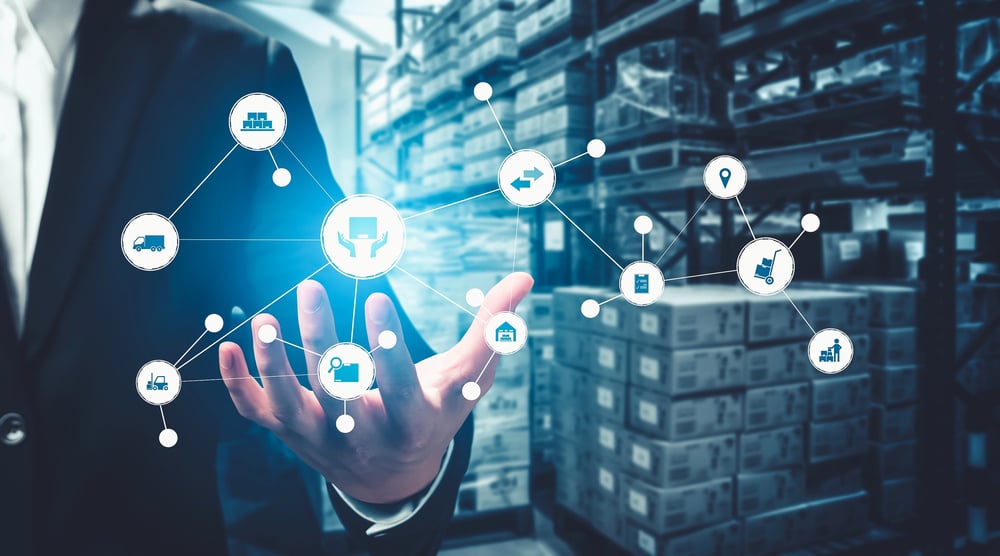
Businessman hand working with a Cloud Computing diagram on the new computer interface
Not all outages are the same. Given that most organizations do not have unlimited IT resources, the severity of an outage to the business must somehow be quantified.
As application complexity has grown, organizations increasingly rely on continuous intelligence (CI) to help reduce outages and speed time to restoration. CI helps assimilate and make sense of traces, logs, and telemetry data that provide insights into app performance. And most critically, they help prioritize issues to get to the root cause of problems that contributed to performance problems and outages.
But not all outages are the same. Certainly, with today’s high user and customer expectation levels, any performance degradation needs to be addressed as fast as possible. However, given that most organizations do not have unlimited IT resources, issues must be prioritized. But how?
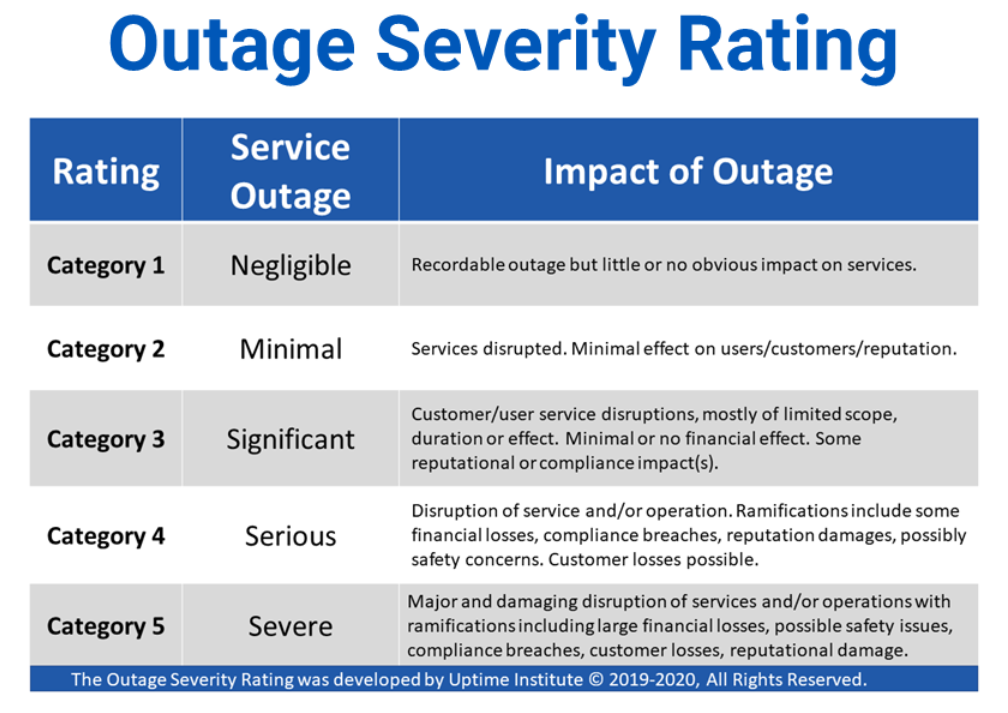
Those looking for guidance might look at the work of the Uptime Institute and its Outage Severity Rating classification methodology. The Outage Severity Rating (OSR) was developed by Uptime Institute to help distinguish between a service outage that threatens the business and an interruption that has little or no impact. According to the Uptime Institute, “the OSR provides infrastructure practitioners a common lexicon to use in forming their own service delivery capacity strategies and describing their own outages in terms of business impacts, rather than referencing outages based upon the number of physical infrastructure components involved.”
The institute noted that while there are different ways to categorize the mission criticality of various systems as a planning tool for disaster recovery and availability/redundancy investments, there is no single metric for measuring the severity or impact of outages.
Such a metric is needed to allocate resources and identify which systems and applications are essential to the business. For instance, the institute noted that while a two-week outage of a human resources system would be annoying, a 5-minute loss of a currency trading system could bring a business down.
Taking such considerations into account, the institute examined publicly reported outages and developed a severity scale. It defines five categories of outages and their impact on the business. It ranges from a Category 1 outage, which has little or no obvious impact, to a Category 5 outage that can result in financial losses, compliance breaches, customer losses, and more.
In announcing its findings, Andy Lawrence, Executive Director of Research at the Uptime Institute, said: “Public awareness of outages is becoming more pronounced as the number increases year over year. In most cases, we find it difficult to understand the true nature and magnitude of the outage since most practitioners still characterize the severity of an outage based on the amount of affected physical infrastructure equipment.”
A final word on outages
Many organizations use CI to prioritize alarms and alerts that impact application performance. They should also pair such insights with the relative impact of any potential problem on the business.
One way to start is to evaluate the impact an outage of a particular application or system would have on the business. The Uptime Institute’s Outage Severity Rating is one way to help organize thoughts and plan accordingly.
Salvatore Salamone is a physicist by training who writes about science and information technology. During his career, he has been a senior or executive editor at many industry-leading publications including High Technology, Network World, Byte Magazine, Data Communications, LAN Times, InternetWeek, Bio-IT World, and Lightwave, The Journal of Fiber Optics. He also is the author of three business technology books.
Successful service businesses understand that the best AI deployments are all about reliability and uptime. When your ultimate goal is to serve customers, failure is simply not an option.
The concept of the ticketless enterprise is a radical reinvention of IT service management. It’s a vision for a world where IT issues are anticipated and prevented before they occur, where systems heal and optimize themselves, and where human IT specialists have the time to focus on innovation and strategic projects.
As AI continues to mature, its integration into the enterprise network will not be optional. It will be foundational to deliver the performance, resilience, and agility that modern enterprises require.
The concept of “data in motion” is transforming the way organizations think about their technology stack and will determine which organizations can actually execute on AI and which are left drowning in endless streams of data.
The industry’s movement toward sovereign AI reflects a maturation of the market and an acknowledgment that AI at scale requires the same rigor in governance and infrastructure design that enterprises have long applied to other mission-critical technologies.
Analysis and market insights on real-time analytics including Big Data, the IoT, and cognitive computing. Business use cases and technologies are discussed.
Advertiser Disclosure: Some of the products that appear on
this site are from companies from which TechnologyAdvice
receives compensation. This compensation may impact how and
where products appear on this site including, for example,
the order in which they appear. TechnologyAdvice does not
include all companies or all types of products available in
the marketplace.

 Best Practices for Deploying and Scaling Industrial AIArtificial Intelligence (AI) is transforming industrial operations, helping organizations optimize workflows, reduce downtime, and enhance productivity. Different industry verticals leverage AI in unique ways.Link to The Center for Adaptive Edge Intelligence
 The Center for Adaptive Edge IntelligenceAdaptive edge intelligence brings real-time decision-making to the point of data creation, whether from sensors, machines, or cameras.Link to The Value of Vehicle Electrification
 The Value of Vehicle ElectrificationElectric vehicles (EVs) present automakers with many design, engineering, and manufactu ring challenges.Link to Accelerating Manufacturing Digital Transformation with Industrial Connectivity and IoT
 Accelerating Manufacturing Digital Transformation with Industrial Connectivity and IoTDigital transformation is empowering industrial organizations to deliver sustainable innovation, disruption-proof products and services, and continuous operational improvement.Link to Smart Manufacturing for Automotive
 Smart Manufacturing for AutomotiveLeading a transportation revolution in autonomous, electric, shared mobility and connectivity with the next generation of design and development tools.Link to Center for Data Pipeline Automation
 Center for Data Pipeline AutomationAs businesses become data-driven and rely more heavily on analytics to operate, getting high-quality, trusted data to the right data user at the right time is essential.Link to Center for Automated Integration
 Center for Automated IntegrationThe goal of automated integration is to enable applications and systems that were built separately to easily share data and work together, resulting in new capabilities and efficiencies that cut costs, uncover insights, and much more.Link to Continuous Intelligence: Insights
 Continuous Intelligence: InsightsDigital transformation requires continuous intelligence (CI). Today’s digital businesses are leveraging this new category of software which includes real-time analytics and insights from a single, cloud-native platform across multiple use cases to speed decision-making, and drive world-class customer experiences.