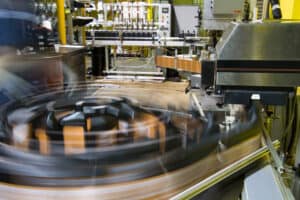
Turntable of bottling line at a lubricant manufacturing facility
The convergence of complementary technologies is making the machine economy and manufacturing as a service possible.
Just as Uber owns no vehicles, and Airbnb owns no properties, it’s possible the next generation of manufacturers will not own any production equipment. That’s because the emerging industrial economy will be built on ‘Manufacturing as a Service,’ in which machine time is leased over networks.
That’s the word from Xinxin Fan of IoTeX, along with Steeve Baudry and Saurabh Narayan Singh, both with Siemens AG, writing in the latest issue of Industry IoT Consortium Journal. With Manufacturing as a Service, companies will be able to tap into the resources they need without having to make huge capital investments in equipment or machinery. Combined with 3D printing – or additive manufacturing – it is poised to make manufacturing a cost-effective, adaptable process, and open up possibilities to smaller, domestic providers.
The convergence of complementary technologies making the machine economy possible include the internet of things, distributed ledger technology, and tokenization, according to Fan and his co-authors. “The combination of web2 companies with their significant footprint in the IoT markets and the vibrant, ultra-dynamic environment of web3 creates the perfect ground for significant disruption,” they continue. “While there are challenges to be addressed, we are undoubtedly entering a new era where IoT and machine economy will shake the status quo for both IoT manufacturers and IoT users.”
See also: Features-as-a-Service: Paywalls are Not Just for Content
Both existing manufacturers and tech-driven startups will be taking advantage of Manufacturing as a Service. The machine economy, as Fan and his co-authors describe it, will comprise “a network of smart, connected, and economically independent devices and machines acting as autonomous market participants, executing economic transactions and other activities with little to no human intervention.” Autonomy and lack of human participants, or course, suggest a growing role for artificial intelligence to sort through and manage the global machine resources that will be available to the next generation of manufacturers.
Fan and his co-authors describe what a machine economy will look like:
- Jointly building a machine network: “A group of machine owners could jointly build a machine network (e.g., a LoRaWAN or 5G network) in a decentralized manner to provide certain functionalities to the public. The machine owners will be paid based on the predefined rules whenever a customer uses the machine network.”
- Jointly owning a machine: “A group of people could form a machine decebtailized automonmous organization (DAO) and jointly own a an expensive industrial machine. The revenue generated by the machine will then be distributed to all the stakeholders based on the predefined rules as specified
in the machine DAO.”
- Sensing as a Service: “An IoT device’s most important utility is collecting data from the attached physical object. The collected data is typically sent to a centralized backend processing system for extracting insights that will help IoT business owners make decisions.”
- Decentralized marketplaces: “With the machine economy, the device owners could leverage DLT to create decentralized marketplaces to share data with interested third parties in a peer-to-peer manner. Such a business model enables device owners to earn passive income by sharing their device data via a decentralized marketplace, thereby having great potential for customer growth.”
- Pay-per-use: In process industries, many industrial sensors measure the raw material levels in silos. These sensors can be connected to the blockchain, automating the payment process altogether. The variation of raw material triggers a smart contract on the blockchain, which calculates the quantity consumed, retrieves the agreed price, and autonomously settles the transaction on the blockchain. The supplier does not wait for the end-of-the-month reconciliation to be paid, and the end-user does not bear any inventory-management-related costs. By synchronizing the goods and the financial flows, this application demonstrates how the machine economy improves cash flow by shortening the payment cycles, eliminating costly reconciliation processes, and sustainably optimizing the working capital.”
Joe McKendrick is RTInsights Industry Editor and industry analyst focusing on artificial intelligence, digital, cloud and Big Data topics. His work also appears in Forbes an Harvard Business Review. Over the last three years, he served as co-chair for the AI Summit in New York, as well as on the organizing committee for IEEE's International Conferences on Edge Computing. (full bio). Follow him on Twitter @joemckendrick.

 Best Practices for Deploying and Scaling Industrial AIArtificial Intelligence (AI) is transforming industrial operations, helping organizations optimize workflows, reduce downtime, and enhance productivity. Different industry verticals leverage AI in unique ways.Link to The Center for Adaptive Edge Intelligence
 The Center for Adaptive Edge IntelligenceAdaptive edge intelligence brings real-time decision-making to the point of data creation, whether from sensors, machines, or cameras.Link to The Value of Vehicle Electrification
 The Value of Vehicle ElectrificationElectric vehicles (EVs) present automakers with many design, engineering, and manufactu ring challenges.Link to Accelerating Manufacturing Digital Transformation with Industrial Connectivity and IoT
 Accelerating Manufacturing Digital Transformation with Industrial Connectivity and IoTDigital transformation is empowering industrial organizations to deliver sustainable innovation, disruption-proof products and services, and continuous operational improvement.Link to Smart Manufacturing for Automotive
 Smart Manufacturing for AutomotiveLeading a transportation revolution in autonomous, electric, shared mobility and connectivity with the next generation of design and development tools.Link to Center for Data Pipeline Automation
 Center for Data Pipeline AutomationAs businesses become data-driven and rely more heavily on analytics to operate, getting high-quality, trusted data to the right data user at the right time is essential.Link to Center for Automated Integration
 Center for Automated IntegrationThe goal of automated integration is to enable applications and systems that were built separately to easily share data and work together, resulting in new capabilities and efficiencies that cut costs, uncover insights, and much more.Link to Continuous Intelligence: Insights
 Continuous Intelligence: InsightsDigital transformation requires continuous intelligence (CI). Today’s digital businesses are leveraging this new category of software which includes real-time analytics and insights from a single, cloud-native platform across multiple use cases to speed decision-making, and drive world-class customer experiences.