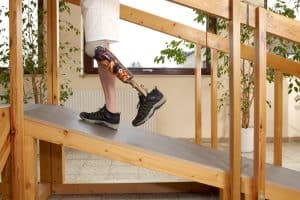
Male prosthesis wearer training to walk uphill on a wooden slope in a speical parcour or interior area where surfaces have been laid out to simulate realistic environmental situations
The AI in robotic prostheses predicts the type of terrain users will be stepping on, quantifies the uncertainties associated with that prediction, and then incorporates that uncertainty into its decision-making.
Researchers at North
Carolina State University have integrated computer vision and artificial
intelligence into off-the-shelf robotic prosthetics to improve walking on different
types of terrain.
The team built a device that attaches to the prosthetic limb to track movement and recognize different terrains. The AI is able to recognize six different terrains: downstairs, upstairs, cement, grass, tile, and concrete.
SEE ALSO: NC State Researchers Develop New Model For Inaccurate IoT Data Replacement
“Lower-limb robotic prosthetics need to execute different behaviors based on the terrain users are walking on,” said Edgar Lobaton, associate professor of computer engineering at North Carolina State University.
“The framework we’ve
created allows the AI in robotic prostheses to predict the type of terrain
users will be stepping on, quantify the uncertainties associated with that
prediction, and then incorporate that uncertainty into its decision-making.”
For the tests, cameras
were outfitted on both the leg and the head. Lobaton said that while the
headgear improves distance, the AI is able to recognize terrain changes within
a few feet, and should be able to manage without the headgear.
“If the degree of
uncertainty is too high, the AI isn’t forced to make a questionable decision –
it could instead notify the user that it doesn’t have enough confidence in its
prediction to act, or it could default to a ‘safe’ mode,” said Boxuan Zhong, lead
author and Ph.D. graduate from NC State.
The team is aiming to
trial the framework on a robotic device in the near future, to ascertain if
this AI system could be an advantage for people with prosthetic limbs.
“We are excited to
incorporate the framework into the control system for working robotic
prosthetics – that’s the next step,” said Helen Huang, co-author of the paper.
David is a technology writer with several years experience covering all aspects of IoT, from technology to networks to security.

 Best Practices for Deploying and Scaling Industrial AIArtificial Intelligence (AI) is transforming industrial operations, helping organizations optimize workflows, reduce downtime, and enhance productivity. Different industry verticals leverage AI in unique ways.Link to The Center for Adaptive Edge Intelligence
 The Center for Adaptive Edge IntelligenceAdaptive edge intelligence brings real-time decision-making to the point of data creation, whether from sensors, machines, or cameras.Link to The Value of Vehicle Electrification
 The Value of Vehicle ElectrificationElectric vehicles (EVs) present automakers with many design, engineering, and manufactu ring challenges.Link to Accelerating Manufacturing Digital Transformation with Industrial Connectivity and IoT
 Accelerating Manufacturing Digital Transformation with Industrial Connectivity and IoTDigital transformation is empowering industrial organizations to deliver sustainable innovation, disruption-proof products and services, and continuous operational improvement.Link to Smart Manufacturing for Automotive
 Smart Manufacturing for AutomotiveLeading a transportation revolution in autonomous, electric, shared mobility and connectivity with the next generation of design and development tools.Link to Center for Data Pipeline Automation
 Center for Data Pipeline AutomationAs businesses become data-driven and rely more heavily on analytics to operate, getting high-quality, trusted data to the right data user at the right time is essential.Link to Center for Automated Integration
 Center for Automated IntegrationThe goal of automated integration is to enable applications and systems that were built separately to easily share data and work together, resulting in new capabilities and efficiencies that cut costs, uncover insights, and much more.Link to Continuous Intelligence: Insights
 Continuous Intelligence: InsightsDigital transformation requires continuous intelligence (CI). Today’s digital businesses are leveraging this new category of software which includes real-time analytics and insights from a single, cloud-native platform across multiple use cases to speed decision-making, and drive world-class customer experiences.