Best Practices for Deploying and Scaling Industrial AI
Artificial Intelligence (AI) is transforming industrial operations, helping organizations optimize workflows, reduce downtime, and enhance productivity. Different industry verticals leverage AI in unique ways.
Accelerating Manufacturing Digital Transformation with Industrial Connectivity and IoT
Digital transformation is empowering industrial organizations to deliver sustainable innovation, disruption-proof products and services, and continuous operational improvement.
Leading a transportation revolution in autonomous, electric, shared mobility and connectivity with the next generation of design and development tools.
As businesses become data-driven and rely more heavily on analytics to operate, getting high-quality, trusted data to the right data user at the right time is essential.
The goal of automated integration is to enable applications and systems that were built separately to easily share data and work together, resulting in new capabilities and efficiencies that cut costs, uncover insights, and much more.
Digital transformation requires continuous intelligence (CI). Today’s digital businesses are leveraging this new category of software which includes real-time analytics and insights from a single, cloud-native platform across multiple use cases to speed decision-making, and drive world-class customer experiences.
Best Practices for Deploying and Scaling Industrial AI
Artificial Intelligence (AI) is transforming industrial operations, helping organizations optimize workflows, reduce downtime, and enhance productivity. Different industry verticals leverage AI in unique ways.
Accelerating Manufacturing Digital Transformation with Industrial Connectivity and IoT
Digital transformation is empowering industrial organizations to deliver sustainable innovation, disruption-proof products and services, and continuous operational improvement.
Leading a transportation revolution in autonomous, electric, shared mobility and connectivity with the next generation of design and development tools.
As businesses become data-driven and rely more heavily on analytics to operate, getting high-quality, trusted data to the right data user at the right time is essential.
The goal of automated integration is to enable applications and systems that were built separately to easily share data and work together, resulting in new capabilities and efficiencies that cut costs, uncover insights, and much more.
Digital transformation requires continuous intelligence (CI). Today’s digital businesses are leveraging this new category of software which includes real-time analytics and insights from a single, cloud-native platform across multiple use cases to speed decision-making, and drive world-class customer experiences.
New Dataset for AI-Enabled Sign Language Translation
Arrangement of outlines of human head, technological and fractal elements on the subject of artificial intelligence, computer science and future technologies
The dataset will allow more automatic sign language understanding and translation. These technologies could be applied to applications such as virtual assistants and robotics.
Artificial intelligence (AI) is helping humans save, parse, and learn language. With a new dataset, researchers and developers could get a massive boost developing technologies for the deaf community.
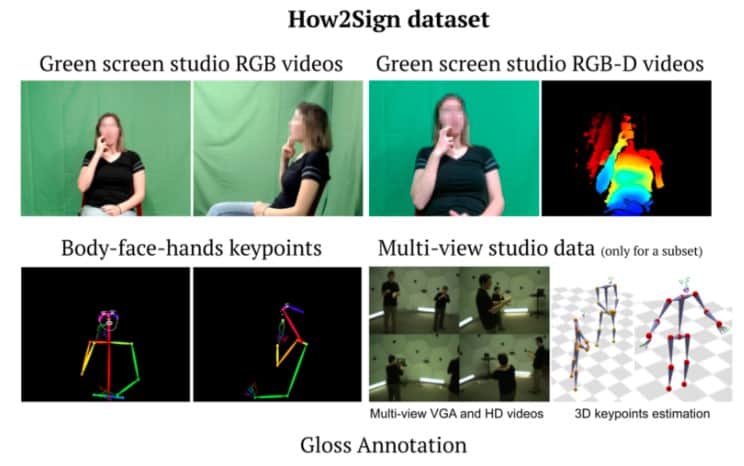
The How2Sign Dataset
The dataset
includes over 80 hours of videos showing sign language interpreters translating
a variety of tutorials. Amanda Duarte, a researcher in the Emerging
Technologies for Artificial Intelligence group at the Barcelona Supercomputing
Center (BSC), spent two years recording these videos and preparing the data.
Duarte also made
use of Carnegie’s Carnegie Mellon University’s Panoptic Studio, a
state-of-the-art dome-shaped studio that allowed researchers to video
translators and reconstruct their movements in 3D.
(Source: Barcelona Supercomputing Center)
Thanks to Duarte, How2Sign provides a public resource for researchers in natural language processing and computer vision, helping usher in a new era of deaf and hard of hearing enabled products and services. Making the internet more accessible is a huge goal, and one of the first applications is software that transfers signs from one user to another.
The dataset
provides a valuable resource for researchers and developers to design quality
technology that considers the needs of the deaf community. Artificial
intelligence requires computation and algorithms capability, but it also
requires data.
Future
accessibility projects
Duarte, INPhiNIT
doctoral student of the “la Caixa” Foundation, has received funding
from several sources — Facebook AI, the “la Caixa” Foundation, as
well as the collaboration of the Image Processing Group of the Universitat
Politècnica de Catalunya (UPC), Carnegie Mellon University and Gallaudet
University — to make this dataset happen.
The dataset will allow more automatic sign language understanding and translation. These technologies could expand to application areas such as virtual assistants, robotics, and other emerging technologies.
Duarte will
present the new resource at the CVPR 2021 conference later this summer. Her
work and the dataset are currently ongoing, expanding and improving the data
repository. The more the dataset expands, the more accessible technology will
become.
Elizabeth Wallace is a Nashville-based freelance writer with a soft spot for data science and AI and a background in linguistics. She spent 13 years teaching language in higher ed and now helps startups and other organizations explain - clearly - what it is they do.
Accepting that AI is being designed for machines rather than humans forces a shift in responsibility. The burden moves away from making systems intuitively understandable and toward making them structurally accountable.
The concept of “data in motion” is transforming the way organizations think about their technology stack and will determine which organizations can actually execute on AI and which are left drowning in endless streams of data.
Agentic AI changes where value is created in the software stack. When analysts discuss the “death of SaaS,” they rarely mean that cloud applications will disappear. Instead, they mean the SaaS model may lose its central role in enterprise computing.
Domain-specific LLMs are how businesses move from AI curiosity to AI utility where outcomes are measurable, adoption actually sticks, and teams trust what the model tells them.
The expansion of smart cities and industrial deployments means infrastructure must be built to withstand harsh, evolving environments while maintaining reliable connectivity and power.
Time synchronization rarely gets much attention in cybersecurity, but it should. It underpins the security functions that teams rely on every day, from trustworthy logs and threat detection to forensic review and compliance reporting. In Zero Trust environments, trusted time helps keep those systems aligned and plays a growing role in resilience and compliance. A […]
AI-powered NaaS represents a foundational shift toward self-managed, adaptive infrastructure built to support the data-intensive demands of modern organizations.
Accepting that AI is being designed for machines rather than humans forces a shift in responsibility. The burden moves away from making systems intuitively understandable and toward making them structurally accountable.
Analysis and market insights on real-time analytics including Big Data, the IoT, and cognitive computing. Business use cases and technologies are discussed.
Advertiser Disclosure: Some of the products that appear on
this site are from companies from which TechnologyAdvice
receives compensation. This compensation may impact how and
where products appear on this site including, for example,
the order in which they appear. TechnologyAdvice does not
include all companies or all types of products available in
the marketplace.

 Best Practices for Deploying and Scaling Industrial AIArtificial Intelligence (AI) is transforming industrial operations, helping organizations optimize workflows, reduce downtime, and enhance productivity. Different industry verticals leverage AI in unique ways.Link to The Center for Adaptive Edge Intelligence
 The Center for Adaptive Edge IntelligenceAdaptive edge intelligence brings real-time decision-making to the point of data creation, whether from sensors, machines, or cameras.Link to The Value of Vehicle Electrification
 The Value of Vehicle ElectrificationElectric vehicles (EVs) present automakers with many design, engineering, and manufactu ring challenges.Link to Accelerating Manufacturing Digital Transformation with Industrial Connectivity and IoT
 Accelerating Manufacturing Digital Transformation with Industrial Connectivity and IoTDigital transformation is empowering industrial organizations to deliver sustainable innovation, disruption-proof products and services, and continuous operational improvement.Link to Smart Manufacturing for Automotive
 Smart Manufacturing for AutomotiveLeading a transportation revolution in autonomous, electric, shared mobility and connectivity with the next generation of design and development tools.Link to Center for Data Pipeline Automation
 Center for Data Pipeline AutomationAs businesses become data-driven and rely more heavily on analytics to operate, getting high-quality, trusted data to the right data user at the right time is essential.Link to Center for Automated Integration
 Center for Automated IntegrationThe goal of automated integration is to enable applications and systems that were built separately to easily share data and work together, resulting in new capabilities and efficiencies that cut costs, uncover insights, and much more.Link to Continuous Intelligence: Insights
 Continuous Intelligence: InsightsDigital transformation requires continuous intelligence (CI). Today’s digital businesses are leveraging this new category of software which includes real-time analytics and insights from a single, cloud-native platform across multiple use cases to speed decision-making, and drive world-class customer experiences.