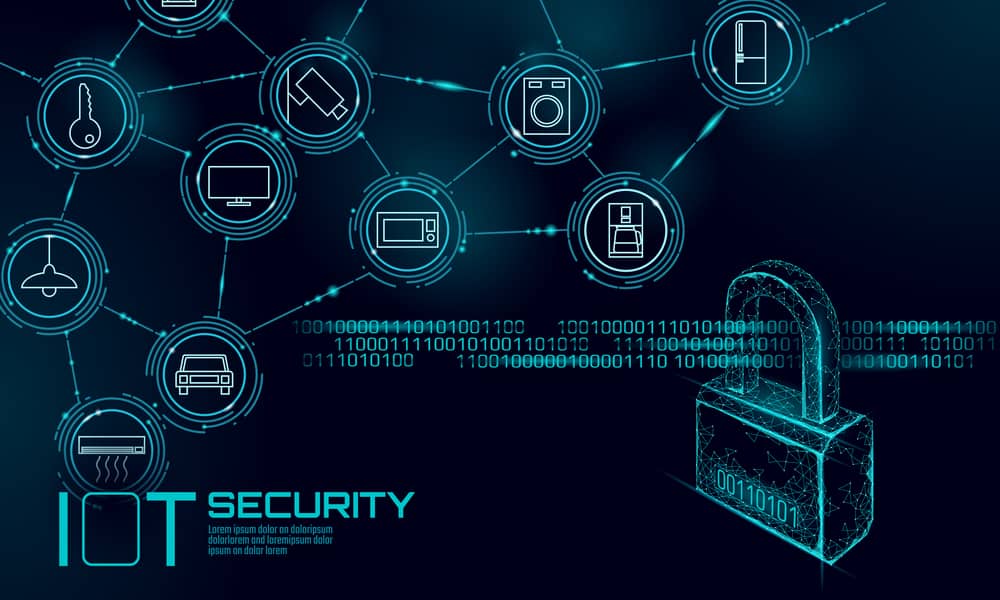
IOT cyber security padlock concept. Personal data safety Internet of Things smart home cyber attack. Hacker attack danger firewall innovation system vector illustration art
First in a series to help organizations understand and mitigate risks with the Internet of Things.
The National Insitute of Standards (NIST) has released new general guidelines that adapt principles from the federal agency’s Cybersecurity Framework to the IoT era.
Considerations for Managing Internet of Things (IoT) Cybersecurity and Privacy Risks (NIST IR 8228) spotlights three important factors that could affect security and risk management for IoT devices:
- Many IoT devices interact with the physical world in ways conventional IT devices usually do not. The potential impact of some IoT devices making changes to physical systems thus affecting the physical world needs to be explicitly recognized and addressed from cybersecurity and privacy perspectives. Also, operational requirements for performance, reliability, resilience, and safety may be at odds with common cybersecurity and privacy practices for conventional IT devices, the agency says.
- Many IoT devices
cannot be accessed, managed, or monitored in the same
ways conventional IT devices
can.
This can necessitate doing tasks manually for large numbers of IoT devices, expanding staff
knowledge and tools to include a much wider variety
of IoT device software, and addressing risks with manufacturers and other third parties
having remote access or control over
IoT devices.
- The availability, efficiency, and effectiveness of cybersecurity and privacy capabilities are often different for IoT devices than conventional IT devices. This means organizations may have to select, implement, and manage additional controls, as well as determine how to respond to risk when sufficient controls for mitigating risk are not available.
See also: Fresh Data: IoT Security Market Will Hit $9.88 Billion by 2025
The guidelines note that the IoT is constantly expanding and evolving, and combines information technology with operational technology. Cloud and mobile computing, big data and embedded systems are also in the mix, and the devices that make use of it all give equipment that was previously isolated network connectivity, data storage and computing functionality.
This breadth of IoT devices is substantial and spans sectors from transportation to healthcare and beyond. In fact, there are so many IoT devices in use that enterprises may not have a very good grasp on just how many they are using – itself a big risk.
Key Advice
According to the guidelines, three high-level risk mitigation goals should be kept in mind:
- Protect device security. Prevent a device from being used to conduct attacks, including participating in distributed denial of service (DDoS) attacks against other organizations, and eavesdropping on network traffic or compromising other devices on the same network segment.
- Protect data
security.
Protect the confidentiality, integrity, and/or availability of data (including personally identifiable
information [PII]) collected by, stored on, processed by, or transmitted to or from the IoT device. This goal
applies to each IoT device except those
without any data that needs protection.
- Protect individuals’ privacy. Protect
individuals’ privacy impacted
by PII processing beyond risks
managed through device and data security protection.
This goal applies to all IoT devices that process PII or that directly
or indirectly impact individuals.
Several recommendations aim to help companies reach these goals. They include: understanding IoT device risk and the challenges they may cause; adjusting polices to address these goals throughout the lifecycle of a device; and creating updated mitigation practices.
NIST says the new guidance is the first in a planned series addressing IoT security. Future publications, they emphasized, will go into greater detail and depth.
Sue Walsh is News Writer for RTInsights, and a freelance writer and social media manager living in New York City. Her specialties include tech, security and e-commerce. You can follow her on Twitter at @girlfridaygeek.

 Best Practices for Deploying and Scaling Industrial AIArtificial Intelligence (AI) is transforming industrial operations, helping organizations optimize workflows, reduce downtime, and enhance productivity. Different industry verticals leverage AI in unique ways.Link to The Center for Adaptive Edge Intelligence
 The Center for Adaptive Edge IntelligenceAdaptive edge intelligence brings real-time decision-making to the point of data creation, whether from sensors, machines, or cameras.Link to The Value of Vehicle Electrification
 The Value of Vehicle ElectrificationElectric vehicles (EVs) present automakers with many design, engineering, and manufactu ring challenges.Link to Accelerating Manufacturing Digital Transformation with Industrial Connectivity and IoT
 Accelerating Manufacturing Digital Transformation with Industrial Connectivity and IoTDigital transformation is empowering industrial organizations to deliver sustainable innovation, disruption-proof products and services, and continuous operational improvement.Link to Smart Manufacturing for Automotive
 Smart Manufacturing for AutomotiveLeading a transportation revolution in autonomous, electric, shared mobility and connectivity with the next generation of design and development tools.Link to Center for Data Pipeline Automation
 Center for Data Pipeline AutomationAs businesses become data-driven and rely more heavily on analytics to operate, getting high-quality, trusted data to the right data user at the right time is essential.Link to Center for Automated Integration
 Center for Automated IntegrationThe goal of automated integration is to enable applications and systems that were built separately to easily share data and work together, resulting in new capabilities and efficiencies that cut costs, uncover insights, and much more.Link to Continuous Intelligence: Insights
 Continuous Intelligence: InsightsDigital transformation requires continuous intelligence (CI). Today’s digital businesses are leveraging this new category of software which includes real-time analytics and insights from a single, cloud-native platform across multiple use cases to speed decision-making, and drive world-class customer experiences.