Best Practices for Deploying and Scaling Industrial AI
Artificial Intelligence (AI) is transforming industrial operations, helping organizations optimize workflows, reduce downtime, and enhance productivity. Different industry verticals leverage AI in unique ways.
Accelerating Manufacturing Digital Transformation with Industrial Connectivity and IoT
Digital transformation is empowering industrial organizations to deliver sustainable innovation, disruption-proof products and services, and continuous operational improvement.
Leading a transportation revolution in autonomous, electric, shared mobility and connectivity with the next generation of design and development tools.
As businesses become data-driven and rely more heavily on analytics to operate, getting high-quality, trusted data to the right data user at the right time is essential.
The goal of automated integration is to enable applications and systems that were built separately to easily share data and work together, resulting in new capabilities and efficiencies that cut costs, uncover insights, and much more.
Digital transformation requires continuous intelligence (CI). Today’s digital businesses are leveraging this new category of software which includes real-time analytics and insights from a single, cloud-native platform across multiple use cases to speed decision-making, and drive world-class customer experiences.
Best Practices for Deploying and Scaling Industrial AI
Artificial Intelligence (AI) is transforming industrial operations, helping organizations optimize workflows, reduce downtime, and enhance productivity. Different industry verticals leverage AI in unique ways.
Accelerating Manufacturing Digital Transformation with Industrial Connectivity and IoT
Digital transformation is empowering industrial organizations to deliver sustainable innovation, disruption-proof products and services, and continuous operational improvement.
Leading a transportation revolution in autonomous, electric, shared mobility and connectivity with the next generation of design and development tools.
As businesses become data-driven and rely more heavily on analytics to operate, getting high-quality, trusted data to the right data user at the right time is essential.
The goal of automated integration is to enable applications and systems that were built separately to easily share data and work together, resulting in new capabilities and efficiencies that cut costs, uncover insights, and much more.
Digital transformation requires continuous intelligence (CI). Today’s digital businesses are leveraging this new category of software which includes real-time analytics and insights from a single, cloud-native platform across multiple use cases to speed decision-making, and drive world-class customer experiences.
Let’s start by defining “Digital Transformation.” If we do not have an agreed upon definition, we certainly will not agree upon how to overcome the obstacles! But, agreement on this definition is not so simple. A web search for the definition of Digital Transformation will find thousands of sites offering their definitions – and as you would expect, they are not all the same. Some definitions are technical and simple – using digital technology, mobile, etc. Others include digital technology and business model changes. The one I like is from the Agile Elephant:
“The process of shifting your organization from a legacy approach to new ways of working and thinking using digital, social, mobile, and emerging technologies. It involves a change in leadership, different thinking, the encouragement of innovation and new business models, incorporating digitization of assets and an increased use of technology to improve the experience of your organization’s employees, customers, suppliers, partners, and stakeholders.”
In addition to the technology and business model aspects, this definition
includes, in my opinion, the critical aspect that differentiates digital
transformation – an audience-centric (i.e., customer, partner, employee) perspective.
Using this definition, I provide my thoughts on the key obstacles for
each area: customer orientation, business models, and technology.
Obstacle 1 –
Perspective
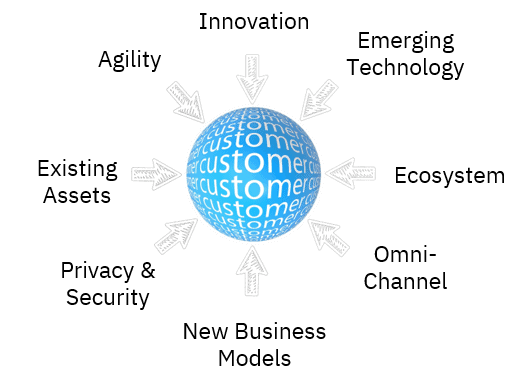
Historically businesses focused on the offerings they brought to market – my products, my services. In some cases, this alone is what a client wants, but maybe it is only a part of the desired customer solution. For example, Banks offer a variety of accounts, loans, credit cards, financial advice, etc. Sometimes a customer is just coming to the Bank to open an account. But other times, opening an account or obtaining a loan is part of a larger customer-centric scenario – moving to a new home, buying a car, or sending a child away to college. Delivering on the client perspective and not just supplying the company offerings is the digital transformation differentiator.
Switching perspectives from “provider-focused” to “consumer-focused” is
this first major obstacle. Continuing
the Banking example… “We provide bank accounts – here is all the information
about each account type so you can figure out which one is the best fit for what
you need” puts the burden on the consumer to build their solution from parts
provided by possibly many separate businesses rather than providing a consumer
scenario oriented complete offering. Certainly, banking or other industries do
the work to understand customer needs within a ‘user journey’ and build their
offerings appropriately to meet these needs. But frequently following the
market opportunity work that helps define the offering, the go-to-market sales
approach for the offering loses this context and solely provides a set of
offered products and services. Some companies do better with industry- or
scenario-based solutions that tailor a recommended set of their offerings. But
when a customer solution reaches outside the company’s own product set (see
next obstacle), this is far less often the case. And, the more feature-rich
(read – complicated) your offerings are, the more likely it is that your market
offering is provider-centric.
Further supporting this obstacle are the IT systems that are used to
manage the offerings we bring to market. Systems of record handle customers
(CRM), accounts, orders, products, logistics, etc. Each system is built to
provide information related to its purpose.
These systems provide general capabilities that can be used across multiple
consumer context scenarios, which are not necessarily a bad thing. These
provide reusable capabilities for our business across scenarios, but they do
not help move us toward a consumer orientation.
How do we overcome this obstacle? The first step and perhaps most
difficult is to obtain agreement at the corporate level that this is an
obstacle we want to overcome. The company leadership needs to agree with
what it means to become a digital business. They also must agree that they want
to act upon this digital transformation initiative and change behavior across
many aspects of the business to address the opportunity. Simply making a
digital transformation assignment to the IT organization is not going to work.
This is less about changing the products or offerings themselves
(although this might be necessary in some cases) and more about how you present
your offerings to the consumer. Your sellers, your web site, your mobile App,
should all be able to show consumer use cases that drive to offerings,
not solely describe each offering standalone without consumer context. As you
grow to include assets from other companies in your offerings or you become
part of another company’s offering, this consumer orientation enables seamless
behavior across the ecosystem.
From a technology perspective, Business APIs have become a common mechanism to provide a consumer orientation on top of the existing enterprise systems of record assets that have the reusable provider orientation. We cannot and should not try to change our entire set of systems of record that are running our business. Creating a system of engagement in front of the existing systems of record allows us to map a consumer orientation on these systems and enables rapid time to market and increased market reach – the goals of digital transformation.
Obstacle 2 –
Ecosystem
As mentioned in the first obstacle, we may need to create
an ecosystem to provide complete consumer-oriented solutions. Ecosystem
creation is about creating a “win-win-win” scenario for the customer, your
business, and your ecosystem partners. Consumers win through acquisition of a
complete and simple to consume offering. Your business and the additional
ecosystem businesses win through increasing revenue opportunities and improving
customer satisfaction. This is about finding the right business models
to enable this “win-win-win” situation.
Historically this was simply
called “partnering.” Businesses established a relationship, including
financial arrangements and technical integration to establish a
partnership. Following a business level agreement,
an IT organization exposed selected interfaces for the new partner to use. The
secure access, visible scope, and technical on-boarding was a multi-week effort
to supply the interface to the partner IT organization, explain the parameters,
test, and ensure the integration was implemented successfully. Considering the
time and effort involved in each partner on-boarding, the number of partners
was usually limited.
This simply is not scalable. Investopedia describes Business ecosystems as a network of organizations
that may cross many industries. If our business is to drive significant value
from a digital transformation, the number of interactions in this channel and
the number of partners driving the interactions need to be able to increase at
a rapid pace. Individual lengthy on-boarding of partners will not suffice.
Today we can handle the technical integration aspects via
API management solutions to enable rapid on-boarding of many partners. We still
need to complete the business arrangement first, and this remains a “one
at a time” process. But, once the business agreement is complete, we can
provide access to our API developer portal containing pre-tested
consumer-oriented APIs that can be self-service consumed by the partner
organization. This allows for far more rapid on-boarding of partners and
expansion of our ecosystem.
While API solutions are a way to do this, they are
not the only way. Other capabilities such as events, blockchain, or more
traditional integration capabilities may also come into play. Blockchain, in
particular, can be a powerful tool to pull together an ecosystem working across
multiple participants potentially from multiple industries and geographies to
provide client-oriented ecosystem solutions.
Is this scalable enough? Maybe. But the one-at-a-time on-boarding at the business level may still be too slow. Predicting the future (always dangerous) I describe how we might be able to address more rapidly establishing the business relationship part of the ecosystem creation through API Marketplaces and/or other techniques.
Obstacle 3 –
Integration
Technology is a key part of all the definitions of Digital Transformation. In the Agile Elephant definition there are several references to the use of technology: “using digital, social, mobile and emerging technologies,” “the encouragement of innovation,” and “incorporating digitization of assets and an increased use of technology” are all parts of this specific definition.
In the prior sections, I have already mentioned APIs and Blockchain as two potential supporting technologies for Digital Transformation, but there are many others. Let’s focus on three specific technology areas that many companies are using/exploring to assist in their transformation:
Cloud: Companies are using cloud for many reasons – cost, agility, flexibility, etc. Most companies have on-premises IT systems, which may be traditional IT-managed or managed in a private cloud paradigm. They also have or are moving toward using cloud providers, and SaaS hosted solutions. This is resulting in a hybrid cloud and multi-cloud situation for many IT infrastructures.
Microservice Architecture: Two primary benefits gained from microservices are application agility and enabling the flexibility to move to the cloud. But, in addition, scalability and innovation are also key benefits.
Artificial Intelligence: Using AI to assist in customer-centric solutions is a natural fit. It enables a better understanding of the client perspective and can help in understanding customer intent, customizing a response, and communicating solutions to the customer in a natural way.
These technologies, plus others, are enablers for digital
transformation. However, the result of using these technologies is that there
are many components in multiple locations that all need to work together to
provide the solution. Multiple and hybrid clouds distribute work across
multiple geographic locations. Microservice architectures increase the number
of application components. AI solutions are frequently accessed using third-party
solutions (e.g., IBMs Watson). Add to this that you are working in an ecosystem
potentially with many partners who are also implementing these technologies and
the reality of a huge obstacle starts to appear – Integration.
Analysts concur.
Gartner states, “Integration has become an obstacle to success
because traditional, centralized and systematic integration approaches cannot
cope with the volume and pace of business innovation.” 1
IDC also recognized “Connectivity” as the number one issue
in their FutureScape Worldwide CIO agenda stating, “By 2021, driven by LoB needs, 70% of CIOs will deliver “agile
connectivity” via APIs and architectures that interconnect digital solutions
from cloud vendors, system developers, startups, and others.” 2.
Overcoming this obstacle, as the prior obstacles, requires
a change in behavior. Historically
integration tasks were handled by a centralized, highly skilled team. Attempting to scale this team to meet all the
required integration needs is simply not going to work. We would need too many
highly skilled people. And, without this, we would have a bottleneck waiting
for central IT to handle all the integration requests for our projects. We need
to address this using “agile integration” techniques that simplify most
integration tasks and allow for a distributed team approach to many integration
needs. Yes, some complex integration is still required and will be done
centrally. But the simpler majority must be offloaded to non-integration
specialists.
Additionally, several integration styles are required.
Integration between microservices in a Kubernetes cluster can be done within
the cluster (and simplified and further improved using a Service Mesh such as Istio) but APIs are typically used to integrate between microservice
clusters. Looking at integration needs solely within your business, other
styles of integration you will see include: handling events (becoming very
popular with Kafka), simplified integrations executed by application developers
or even business developers perhaps using SaaS applications, complex
integrations to non-standard back-end systems by highly skilled specialists,
transactional messaging, and yes, even files. Expanding this to a view across our
ecosystem, we also need APIs, events, and files, but also add integrating to
blockchain, and perhaps EDI or other legacy integration styles. Limiting styles of integration can limit your
ability to serve the client and requiring all capabilities to change to a
single integration style within the enterprise or across the ecosystem is
unrealistic.
Finally, we need to consider where we can secure and
execute our integration functions.
Funneling all integration execution to a single integration structure
either on-premises or in a cloud can cause unnecessary delays in response time.
It does not make sense to force a transaction that starts in the cloud to come
on-premises to then go back out to the same or another cloud. We also need to
be able to secure the transactions as they enter and throughout the transaction
and scale the integration tasks as needed. As businesses continue their digital
transformations adding more capabilities in more locations, the ability to
execute integration tasks anywhere – on-premises and on any/all vendor clouds
is a critical success factor.
Digital transformation is not easy, but the benefits are tremendous. According to MarketsandMarkets, “the global digital transformation market size is expected to grow from USD 290.0 billion in 2018 to USD 665.0 billion by 2023, at a CAGR of 18.1% during the forecast period.” To overcome the obstacles discussed, there is one additional thing that is required – commitment. Digital transformation is not a project that is executed once and then done. Corporate level commitment, including a commitment to creating and enabling targeted leadership roles and responsibilities, education, process changes, and support for the initiative is required to become a digital business.
1 Gartner-Modernizing Integration Strategies and Infrastructure Primer for 2018
Alan Glickenhouse is the IBM Digital Transformation Business Strategist. Alan assists clients with their business and IT strategy for Digital Transformation and the API Economy. He meets clients in all industries, all geographies, and of all sizes and brings knowledge of best practices shared with and by these businesses. Alan is the author of well over 100 papers, articles, and videos and a frequent speaker at industry conferences and events.
If you have questions, please let me know. Connect with me on LinkedIn or via twitter @Arglick to continue the discussion.
AI is quickly growing, and so must the enterprise environments that support it. Organizations that succeed will be those that pair innovation with governance, autonomy with accountability, and speed with structure.
The separation of front office and back-office functions goes back 300 years. While some believe AI will eliminate the divide, that business binary will remain in place no matter how many AI agents a company throws into the mix.
A unified semantic layer standardizes business definitions across systems, creating a shared contract for how metrics are defined, documented, and governed. That contract applies to dashboards, notebooks, APIs, and AI systems alike.
Domain-specific LLMs are how businesses move from AI curiosity to AI utility where outcomes are measurable, adoption actually sticks, and teams trust what the model tells them.
Accepting that AI is being designed for machines rather than humans forces a shift in responsibility. The burden moves away from making systems intuitively understandable and toward making them structurally accountable.
By treating unstructured data as a strategic asset rather than an operational byproduct, enterprises can resolve the tension between innovation and control.
AI is quickly growing, and so must the enterprise environments that support it. Organizations that succeed will be those that pair innovation with governance, autonomy with accountability, and speed with structure.
Analysis and market insights on real-time analytics including Big Data, the IoT, and cognitive computing. Business use cases and technologies are discussed.
Advertiser Disclosure: Some of the products that appear on
this site are from companies from which TechnologyAdvice
receives compensation. This compensation may impact how and
where products appear on this site including, for example,
the order in which they appear. TechnologyAdvice does not
include all companies or all types of products available in
the marketplace.

 Best Practices for Deploying and Scaling Industrial AIArtificial Intelligence (AI) is transforming industrial operations, helping organizations optimize workflows, reduce downtime, and enhance productivity. Different industry verticals leverage AI in unique ways.Link to The Center for Adaptive Edge Intelligence
 The Center for Adaptive Edge IntelligenceAdaptive edge intelligence brings real-time decision-making to the point of data creation, whether from sensors, machines, or cameras.Link to The Value of Vehicle Electrification
 The Value of Vehicle ElectrificationElectric vehicles (EVs) present automakers with many design, engineering, and manufactu ring challenges.Link to Accelerating Manufacturing Digital Transformation with Industrial Connectivity and IoT
 Accelerating Manufacturing Digital Transformation with Industrial Connectivity and IoTDigital transformation is empowering industrial organizations to deliver sustainable innovation, disruption-proof products and services, and continuous operational improvement.Link to Smart Manufacturing for Automotive
 Smart Manufacturing for AutomotiveLeading a transportation revolution in autonomous, electric, shared mobility and connectivity with the next generation of design and development tools.Link to Center for Data Pipeline Automation
 Center for Data Pipeline AutomationAs businesses become data-driven and rely more heavily on analytics to operate, getting high-quality, trusted data to the right data user at the right time is essential.Link to Center for Automated Integration
 Center for Automated IntegrationThe goal of automated integration is to enable applications and systems that were built separately to easily share data and work together, resulting in new capabilities and efficiencies that cut costs, uncover insights, and much more.Link to Continuous Intelligence: Insights
 Continuous Intelligence: InsightsDigital transformation requires continuous intelligence (CI). Today’s digital businesses are leveraging this new category of software which includes real-time analytics and insights from a single, cloud-native platform across multiple use cases to speed decision-making, and drive world-class customer experiences.