Best Practices for Deploying and Scaling Industrial AI
Artificial Intelligence (AI) is transforming industrial operations, helping organizations optimize workflows, reduce downtime, and enhance productivity. Different industry verticals leverage AI in unique ways.
Accelerating Manufacturing Digital Transformation with Industrial Connectivity and IoT
Digital transformation is empowering industrial organizations to deliver sustainable innovation, disruption-proof products and services, and continuous operational improvement.
Leading a transportation revolution in autonomous, electric, shared mobility and connectivity with the next generation of design and development tools.
As businesses become data-driven and rely more heavily on analytics to operate, getting high-quality, trusted data to the right data user at the right time is essential.
The goal of automated integration is to enable applications and systems that were built separately to easily share data and work together, resulting in new capabilities and efficiencies that cut costs, uncover insights, and much more.
Digital transformation requires continuous intelligence (CI). Today’s digital businesses are leveraging this new category of software which includes real-time analytics and insights from a single, cloud-native platform across multiple use cases to speed decision-making, and drive world-class customer experiences.
Best Practices for Deploying and Scaling Industrial AI
Artificial Intelligence (AI) is transforming industrial operations, helping organizations optimize workflows, reduce downtime, and enhance productivity. Different industry verticals leverage AI in unique ways.
Accelerating Manufacturing Digital Transformation with Industrial Connectivity and IoT
Digital transformation is empowering industrial organizations to deliver sustainable innovation, disruption-proof products and services, and continuous operational improvement.
Leading a transportation revolution in autonomous, electric, shared mobility and connectivity with the next generation of design and development tools.
As businesses become data-driven and rely more heavily on analytics to operate, getting high-quality, trusted data to the right data user at the right time is essential.
The goal of automated integration is to enable applications and systems that were built separately to easily share data and work together, resulting in new capabilities and efficiencies that cut costs, uncover insights, and much more.
Digital transformation requires continuous intelligence (CI). Today’s digital businesses are leveraging this new category of software which includes real-time analytics and insights from a single, cloud-native platform across multiple use cases to speed decision-making, and drive world-class customer experiences.
Enterprise reference architectures and stacks are becoming increasingly cluttered and complex. What’s needed is a pragmatic approach that focuses on process and data.
The
paradigms, tools, and platforms we use or are familiar
with influence our innovation approach and how we build solutions. We often use
familiar “bottom-up” technology approaches. But this inclination
towards the easier and familiar approach is at its core a digital
transformation debt that keeps accumulating. It does not often challenge long-held
convictions that could be at best sub-optimal and at worst detrimental to the
enterprise.
There are
many CIOs and IT managers who have chosen specific architecture patterns and
technologies because that is what they have done in the past, and that is what
they are familiar with. It is not necessarily what the enterprise in-motion
needs or could achieve for innovation. Stretching,
being challenged, and possibly disrupted with a different approach is not
comfortable!
In
this two-part article, we will contrast two leading paradigms for innovation using
digital technologies and platforms: Process and Data-Driven. Part I provides
the background, and Part II will delve into three important innovation use
cases for business value.
Process
and Data are not the only paradigms for application development in the digital
era. There are many others, some of which are complementary to either approach.
However, they are the two most important and enterprises in-motion embarking
upon a digital transformation journey cannot afford to ignore them.
Setting
the Stage
The
Enterprise-In-Motion needs to innovate continuously. But how? Innovation methodologies,
workshops, and techniques such as Design Thinking are good and helpful. But at
some point, innovation must be implemented and digitized to yield value.
Technology stacks and options are complex. There are too many digital
technologies trends du jour cluttering enterprise software systems.
Consider how the “Top
Ten” technology trends are changing over the years. Point solutions,
systems of records, as well as software platforms that were a “must-have” a
couple of years ago, are becoming legacy
at an accelerated rate.
Now,
to keep up with disruptive challenges from competitive incumbents or emerging disruptors,
digital enterprises need to accelerate innovation. In other words, they need to
be in-motion
and autonomic. But here is the challenge. What are the leading paradigms or
approaches for innovation, and what are their tradeoffs? How should the
innovators build enterprise applications? What are the paradigms, techniques,
or approaches in enterprise application innovations? Simply, how should
applications be developed? What are the must-have components or layers in a
robust next-generation digital transformation architecture?
These
are make-or-break questions for the enterprise. The answers are not that easy.
Enterprise reference architectures and stacks are becoming increasingly
cluttered and complex. Think of the spectrum of digital technology, language,
platform, and point solution choices! There are too many options, and their
tradeoffs are not that clear. Every organization is doing it differently, and
this simply does not add up!
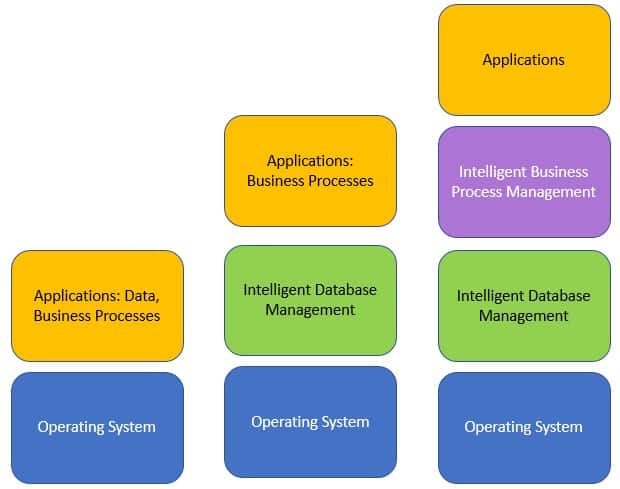
What’s needed is a pragmatic approach that focuses on two complementary and core approaches for enterprise application development: Process and Data. You can’t get more basic than that! There are, of course, others and numerous hybrids. But highlighting, contrasting, and complementing these two is key. As we shall see, especially in the use cases of Part II, a healthy and robust approach can be instrumental for innovation with business value.
Back to
Basics: Program + Data
There are now tens of programming languages. Every year there are new programming languages that are attempting to gain a beachhead in the already cluttered programming space. The following lists the top 10 programming languages in 2019. It includes rather old and dated languages such as C and even Java. It also includes the world’s most popular database language: SQL! The syntax and semantics – reflecting the underlying computational models – could be quite different. But there is a fundamental commonality behind all programming. The execution of the program manipulates data! Variables in the program represent data. The interaction with external systems could be done through sending & receiving data, processing events, or invoking programming interfaces (called “API”s).
This duality of execution
programming logic while manipulating data has been around since the inception
of computers!
The focus of this article is on the dynamics between two complementing paradigms: Data and Process.
Using
the programming language analogy, the “Data” corresponds to the variables manipulated
in the program, and the “Process” corresponds to the procedures and functions
of the program.
Now the terms “Data” and “Process” are overloaded. Each has its own characteristics, models, and capabilities. Data, for instance, can be transient or persistent. It can be simple (such as a number) or complex (such as an address). Similarly, processes can be simple workflows often depicted through flowcharts or swim lanes; or dynamic and complex via adaptive value streams or value chains. Each of these has emerged into formidable enterprise software domains with various products (Database Management Systems and Business Process Management Systems), methodologies, technologies, and solutions that are often essential for the digital transformation of the Enterprise-In-Motion.
So Why
DBMS & BPMS?
As computation evolved, several explicit separations emerged. It used to be that an application manipulating data, rules, and flows – including data, rules, and flows that persisted across multiple program executions. These were combined in its programming code with all the application logic. The separation transition started with the separation of the management of the persistent data of enterprise applications. This led to the emergence of Database Management Systems.
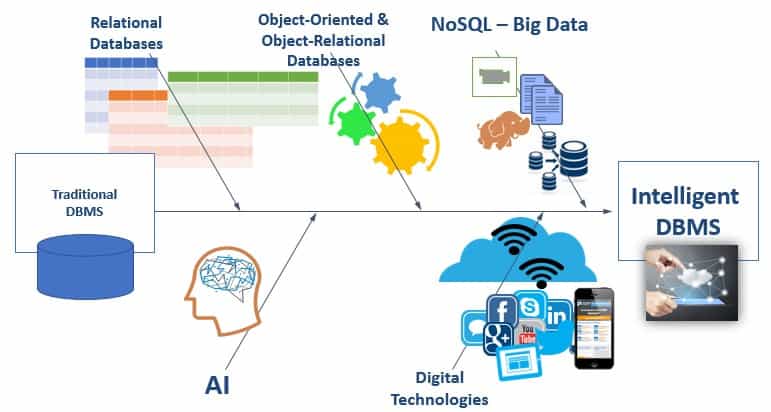
In the initial phases of the separation trend, the business logic – especially the processes (aka workflows) and business rules – were still part of the application. DBMSs that separated the management of the data from the application started to appear in the 1970s with navigational hierarchical and network models. In the 1980s, we saw a significant evolution to relational databases that became quite popular, especially with the emergence of SQL as the de-facto query language for databases! The evolution of databases from relational included Object-Oriented Databases that combined Object-Oriented and Database capabilities for persistent storage of objects, as well as Object-Relational Databases that attempted to combine the characteristics of both relational and object-oriented databases.
More recently – especially for handling large unstructured multi-media data in new digital applications – we saw the emergence of NoSQL (which more appropriately stands for Not-Only-SQL) to handle the demands of Big Data – such as large volume, variety, velocity with heavy demands on scalability, performance and fault-tolerance for modern data-intensive Web and Service applications. Data-centric application development commences by creating Entity Relationship models of data with entity type and the relationships between the entity types.
The DBA, together with the data analysts, creates the data models. However, emanating from digitization trends, the introduction of NoSQL databases especially for Big Data management, there are significant changes in designing, managing and maintaining physical repositories of databases: object-oriented, graphical, document-oriented, etc. Each has its sweet spot and purpose.
The focus of this new generation of databases is to deal with the explosion of heterogeneous data and the storage and management of this data for innovative Internet applications (especially IoT). Still, by and large, most transactional data for mission-critical systems of record (which require transactional integrity) remains relational. Interestingly, in the early 1990s, we also saw the emergence of intelligent DBMSs. SQL – the de-facto and most popular database language – has continuously been evolving. It has incorporated many declarative AI capabilities. Similarly, NoSQL databases are incorporating analytics capabilities – including for unstructured multi-media data within the DBMS.
The evolution of improvement in process efficiency and productivity within organizations goes back to Taylorism and Scientific Management. In the 1990s, business process re-engineering took a top-down approach for process improvement and reorganization. Due to the radical amount of change attempted, most re-engineering initiatives failed. Process improvement methodologies, such as Lean and Six Sigma, attempt to eliminate waste in work processing, while increasing the efficiency as well as the effectiveness and quality of products or services. Theory of Constraints and Net Promoter Scores (NPS) provide other robust frameworks for process improvement. The key point is that, whether improving NPS or critical-to-quality measurements for a Lean Six Sigma project, the intelligent Business Process Management approach allows organizations to keep these measurements as well as control the customer experience and operational efficiency in real-time.
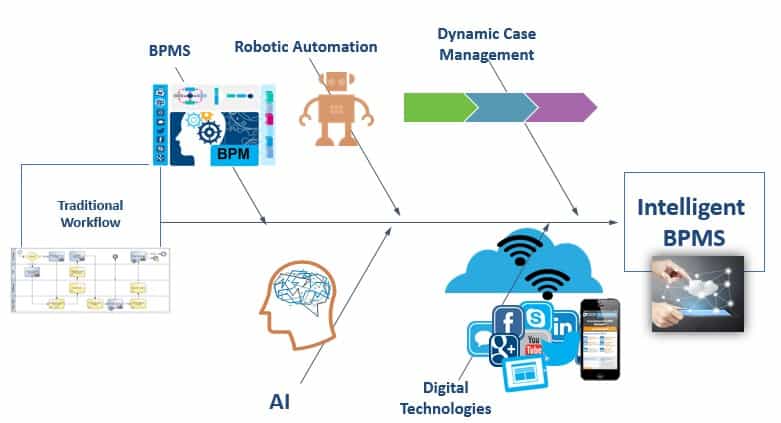
As platforms that digitize and automate business processes, Business Process Management Systems have evolved from human-centric and document-centric workflow systems to more comprehensive digital transformation platforms. Workflow products, at least in the earlier stages of their evolution, were document, forms, and content-centric. In fact, some of the earliest implementations of workflows focused on converting and processing paper-based documents through digitized media. Thus, scanners, specialized monitors for entering data from scanned documents, as well as backend optical repositories were integral parts of the workflow.
The main difference between the workflow systems up to the mid-1990s and the emergence of BPM systems of today is the involvement of system participants. BPM has its roots in human participant-focused workflow systems. The coordination in this category is human-to-human. While some BPM technologies and methods are still purely workflow-focused, BPM is much more than that.
Other significant categories of software that have influenced the evolution of BPM include Enterprise Application Integration (EAI) and Business-to-Business (B2B) integration. These were subsumed by Enterprise Service Buses and Service-Oriented Architectures. Inclusion of system participants meant that in the same process flow some of the steps were performed by backend applications such as enterprise resource planning (ERP) systems, human resources applications, or more generically Database Management Systems (DBMSs).
One of the earliest definitions of BPM included enterprise application integration as well as human-centric workflow and trading partner business-to-business (B2B) integration.
As BPMS
became more intelligent and advanced, Business Rules and AI analytics
capabilities became unified within the BPMS, and thus, we saw the evolution of intelligent BPM. Intelligent
Business Process Management (iBPM) is a digital transformation discipline with
the associated automation platform that aligns business objectives to
execution. There are several trends that have influenced the evolution of iBPM
– making it the core engine of transformation for digital enterprises. Two of
these trends are the process participants and process intelligence.
Robotic Automation started to become incorporated in robust Digital Process Automation (another way to designate iBPM) platforms. Next-generation iBPMSs support the entire spectrum of work automation: structured, cognitive, and AI-assisted. Also significant is the emergence of Dynamic Case Management to handle ad-hoc work and provide a more powerful model (compared to flowcharts and swim lanes) to work orchestration.
Unequally
Yoked – Not Two Sides of the Same Coin!
Given
the separation trend that was summarized above and the evolution of intelligent
database management and business process management, one would assume
enterprises will readily strategize on DBMS and BPMS platforms as core
capabilities to support Process + Data in their enterprise architectures: as a necessary and core component of their
solution stacks. They will need and use the two complementary paradigms and
systems.
That
is simply not the case. Many organizations have enterprise architectures or
reference models that have an underlying DBMS layer, but the BPMS layer is missing. No “respectful” enterprise
architecture can exist without one or more relational DBMSs and increasingly
several NoSQL databases for unstructured data management in emerging
applications.
Understandable. But often BPMSs are either completely ignored, postponed or diminished. IT organizations are not pursuing the procurement of BPMS with the same vigor as they are for emerging Database Management systems – especially the more recent and exciting NoSQL databases for Big Data!
Why
is that? There are several reasons. Here are some of the common explanations or
situations that I have seen over the years:
We have processes or workflows in our ERP systems
At some point we will consider a business process
system – it is too early for us
We have Low Code/No Code tool – we do not think we
need a BPMS
BPMS do not do anything: they do not come with any
business logic: we must develop it. Not sure what they do!
We need to have our databases – they differentiate
us. We are not sure about the processes. We can code them.
Data is the new crude oil. AI extracts or mines the
valuable “oil” from the data lakes. Not sure about the Process!
There are
others. Each of these “reasons” – if we can call it that – is false! Processes
are assumed to exist in the “Application” layers. This has several
implications. IT organizations have a budget for DBMSs. But not for BPMSs. As
indicated, one of the criticisms of BPMSs that is occasionally voiced is the
fact that a BPMS as a tool or platform does not do anything. It allows you to
model processes or value streams. But you must use the tool to come up with the
solution. It does not come with running and ready software out of the box –
unlike ERP systems, for instance, for financial services or HR or IT processes
or even CRM. True. But the same is true of DBMSs!
The Database
Management system also is just a tool to manage databases. It does not come
with intellectual properties for a specific application domain. You must
develop those. You must model, design, and implement your databases with a
DBMS. Similarly, you must design, model, and implement your processes with a
BPMS. Interestingly, due to the inherent need to manage databases for
enterprises and the popularity of databases as the new crude oil that contains
treasures that could be mined through AI, this objection is not raised for
DBMSs. It is raised for BPMSs. This is sub-optimal, does not support the
tenants of the enterprise in-motion and in some cases could be detrimental to
the organization.
Part II of
this article will delve deeper into this digital transformation challenge and
illustrate through three pragmatic use cases how a top-down approach could be
ideal for the enterprise in-motion: optimizing the Process + Data synergy!
Dr. Setrag Khoshafian is Principal and Chief Scientist at Khosh Consulting. He is a pioneer and recognized expert in the transformation of innovative and agile enterprises. He has invented pragmatic approaches for innovation and cultural transformation through a holistic approach leveraging Intelligent Business Process Management, Intelligent Database Management, Internet of Things (IoT), Blockchain, AI, Low Code/No Code, Service-Oriented Architectures and Automation. Previously he was the Chief Evangelist & VP of BPM at Pegasystems Inc., the Senior VP of Technology at Savvion, and Chief Scientist & VP of Development at Portfolio Technologies.
Dr. Khoshafian is an author, thought leader, keynote speaker, and educator who has helped the cultural transformation journeys of entrepreneurial enterprises leveraging digital technologies.
He has been a senior executive in the software industry for the past 30 years, where he has invented, architected, and steered the production of several enterprise software products and solutions.
He is well recognized and quoted frequently for his contributions in Intelligent BPMS, Intelligent DBMS, Blockchain, IoT, AI, and Service-Oriented Enterprises.
Dr. Khoshafian is a frequent speaker and presenter at international workshops and conferences. He is the lead author of more than 10 books and hundreds of publications in various industry and academic journals.
He has also been full-time as well as adjunct professor in several universities across the globe. Dr. Khoshafian holds a PhD in Computer Science from the University of Wisconsin-Madison. He also holds MSc in Mathematics from AUB.
Twitter: @setrag
Linked In: https://www.linkedin.com/in/setrag
A unified semantic layer standardizes business definitions across systems, creating a shared contract for how metrics are defined, documented, and governed. That contract applies to dashboards, notebooks, APIs, and AI systems alike.
The path from data islands to autonomous intelligence isn’t about centralizing everything. It’s about making distributed ecosystems operate as if they were unified with governance as the connective tissue.
The IBM acquisition of Confluent is indicative of the tech world’s fixation on real-time data streaming. However, the more pressing issue is the overwhelming volume of unstructured documents that hold the critical context that real-time AI often overlooks.
The concept of “data in motion” is transforming the way organizations think about their technology stack and will determine which organizations can actually execute on AI and which are left drowning in endless streams of data.
The industry’s movement toward sovereign AI reflects a maturation of the market and an acknowledgment that AI at scale requires the same rigor in governance and infrastructure design that enterprises have long applied to other mission-critical technologies.
Analysis and market insights on real-time analytics including Big Data, the IoT, and cognitive computing. Business use cases and technologies are discussed.
Advertiser Disclosure: Some of the products that appear on
this site are from companies from which TechnologyAdvice
receives compensation. This compensation may impact how and
where products appear on this site including, for example,
the order in which they appear. TechnologyAdvice does not
include all companies or all types of products available in
the marketplace.

 Best Practices for Deploying and Scaling Industrial AIArtificial Intelligence (AI) is transforming industrial operations, helping organizations optimize workflows, reduce downtime, and enhance productivity. Different industry verticals leverage AI in unique ways.Link to The Center for Adaptive Edge Intelligence
 The Center for Adaptive Edge IntelligenceAdaptive edge intelligence brings real-time decision-making to the point of data creation, whether from sensors, machines, or cameras.Link to The Value of Vehicle Electrification
 The Value of Vehicle ElectrificationElectric vehicles (EVs) present automakers with many design, engineering, and manufactu ring challenges.Link to Accelerating Manufacturing Digital Transformation with Industrial Connectivity and IoT
 Accelerating Manufacturing Digital Transformation with Industrial Connectivity and IoTDigital transformation is empowering industrial organizations to deliver sustainable innovation, disruption-proof products and services, and continuous operational improvement.Link to Smart Manufacturing for Automotive
 Smart Manufacturing for AutomotiveLeading a transportation revolution in autonomous, electric, shared mobility and connectivity with the next generation of design and development tools.Link to Center for Data Pipeline Automation
 Center for Data Pipeline AutomationAs businesses become data-driven and rely more heavily on analytics to operate, getting high-quality, trusted data to the right data user at the right time is essential.Link to Center for Automated Integration
 Center for Automated IntegrationThe goal of automated integration is to enable applications and systems that were built separately to easily share data and work together, resulting in new capabilities and efficiencies that cut costs, uncover insights, and much more.Link to Continuous Intelligence: Insights
 Continuous Intelligence: InsightsDigital transformation requires continuous intelligence (CI). Today’s digital businesses are leveraging this new category of software which includes real-time analytics and insights from a single, cloud-native platform across multiple use cases to speed decision-making, and drive world-class customer experiences.