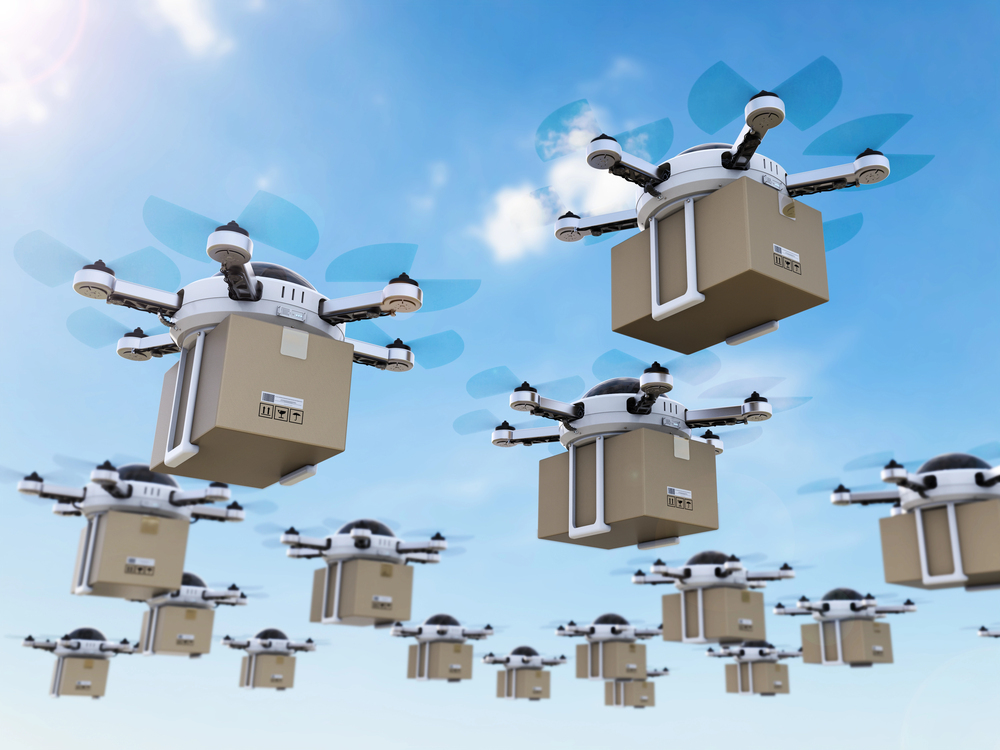
The advent of drones, eVTOL (electric vertical take-off and landing) vehicles, and other autonomous flying entities is fueling a boom in what is being called the low-altitude economy, an economy dependent on real-time analytics, data, insights, and decision making.
If you have not heard about this market, you soon will. Operations in airspace beneath 1,000 meters (about 3,280 feet) generated business revenue worth 506 billion yuan ($70 billion) in 2023, according to published accounts. By 2035, that market is projected to reach 3.5 trillion yuan (approximately $490 billion), according to Zhang Xiaolan, a researcher at the State Information Center, a think tank affiliated with China’s primary planning authority.
Additionally, Bank of America Global Research predicts that global civil adoption of eVTOLs could grow by 62% over the next five years. According to BofA Global Research, there are six applications for eVTOLs. Businesses and local governments will use them for public security, logistics distribution, medical and firefighting, tourism, urban commuting, and intercity/intracity transportation.
Real-time is Critical
Unlike traditional aviation, where aircraft operate in well-structured, sparsely populated airspace, the low-altitude layer is and will be dense, dynamic, and inherently chaotic. It’s filled with pedestrians, buildings, power lines, and thousands of autonomous assets operating simultaneously. As such, safety and operational efficiency require real-time insights from streaming data.
For the low-altitude economy to succeed, there will need to be a convergence of high-performance real-time technologies, including:
Streaming data ingestion and processing
The low-altitude economy depends on continuous, real-time ingestion and processing of high-volume telemetry, sensor, and imagery data from unmanned aerial vehicles (UAVs), eVTOLs, and ground infrastructure to support safe, scalable operations. As vehicles generate streams of location, status, and environmental data, systems must rapidly ingest, correlate, and analyze this information to enable dynamic routing, conflict detection, and traffic deconfliction in dense urban airspace.
Without high-throughput streaming pipelines and edge-to-cloud processing frameworks, latency in situational awareness would compromise safety, hinder autonomous decisioning, and restrict the ability to scale beyond isolated test corridors into fully operational commercial services such as logistics, inspection, or passenger mobility.
Edge AI and onboard compute
Edge AI and onboard computing capabilities are foundational for reducing reliance on centralized control and enabling autonomous behaviors essential to low-altitude vehicles. Onboard AI allows UAVs and other vehicles to interpret sensor data, detect obstacles, optimize flight paths, and execute collision avoidance locally when network connectivity is intermittent or latency is too high for centralized decisions.
Combining such capabilities with edge compute architectures close to the airspace, such as multi-access edge computing nodes integrated with cellular networks, accelerates decision loops and supports scalable autonomy, resiliency to network outages, and adherence to safety constraints. These capabilities make distributed intelligence practical for high-density operations where milliseconds matter for safety and mission success.
Autonomous Traffic Management (UTM) systems
Unmanned Traffic Management (UTM) systems are the digital backbone of the low-altitude economy, providing the automated airspace orchestration layer required to coordinate thousands of concurrently operating vehicles. UTM platforms perform essential tasks such as vehicle identification and registration, dynamic airspace zoning, flight plan authorization, real-time deconfliction, and automated rerouting in response to changing conditions. These are functions that traditional air traffic systems are not designed to handle at low altitudes.
By centralizing and standardizing these services, UTM enables interoperability across operators and jurisdictions, supports beyond-visual-line-of-sight (BVLOS) operations, and ensures safety and efficiency as UAV and UAM traffic densities increase. Without effective UTM, commercial scale-up of low-altitude services would remain constrained by manual oversight and fragmented data flows.
5G / NTN (Non-Terrestrial Networks) connectivity
Advanced connectivity, particularly 5G and NTN architectures that extend coverage via satellites and aerial relays, underpins reliable command, control, and data exchange for the LAE. 5G’s ultra-low latency, high bandwidth, and network slicing capabilities ensure that vehicles and UTM systems can exchange critical information with minimal delay, a necessity for remote piloting, autonomous operations, and high-definition sensor payload streaming. NTN enhances this connectivity by bridging coverage gaps beyond terrestrial cell footprints, enabling persistent links for UAVs operating over remote or urban fringe areas.
Together, 5G and NTN provide the resilient, scalable communication fabric that supports real-time telemetry, situational awareness, coordinated traffic management, and integration with ground systems — without which low-altitude operations would face unacceptable latency and coverage limitations.
Digital twins
Digital twins act as real-time virtual representations of airspace environments, vehicles, and infrastructure, enabling simulation, predictive analytics, and operational optimization at scale in the low-altitude economy. By continuously synchronizing live data from sensors, aircraft telemetry, and environmental sources, digital twins empower operators and UTM systems to model traffic flows, anticipate conflicts, and test responses to contingencies before they occur in the physical world.
Such capability enhances safety, reduces operational risk, and supports planning for corridor design, regulatory compliance, and infrastructure investment. Furthermore, digital twins facilitate iterative improvements to autonomy algorithms and airspace design by enabling stakeholders to explore “what-if” scenarios and validate innovations in a risk-free virtual environment, thereby accelerating the maturation of commercial LAE services.
A Final Word
Real-time analysis and insights enabled by these technologies can help inform maneuvering decisions and avoid crashes caused by sudden gusts around buildings, construction cranes appearing overnight, microclimate variations, and pop-up no-fly zones (events, police activity). These activities and events create a constantly shifting operating environment.

 Best Practices for Deploying and Scaling Industrial AIArtificial Intelligence (AI) is transforming industrial operations, helping organizations optimize workflows, reduce downtime, and enhance productivity. Different industry verticals leverage AI in unique ways.Link to The Center for Adaptive Edge Intelligence
 The Center for Adaptive Edge IntelligenceAdaptive edge intelligence brings real-time decision-making to the point of data creation, whether from sensors, machines, or cameras.Link to The Value of Vehicle Electrification
 The Value of Vehicle ElectrificationElectric vehicles (EVs) present automakers with many design, engineering, and manufactu ring challenges.Link to Accelerating Manufacturing Digital Transformation with Industrial Connectivity and IoT
 Accelerating Manufacturing Digital Transformation with Industrial Connectivity and IoTDigital transformation is empowering industrial organizations to deliver sustainable innovation, disruption-proof products and services, and continuous operational improvement.Link to Smart Manufacturing for Automotive
 Smart Manufacturing for AutomotiveLeading a transportation revolution in autonomous, electric, shared mobility and connectivity with the next generation of design and development tools.Link to Center for Data Pipeline Automation
 Center for Data Pipeline AutomationAs businesses become data-driven and rely more heavily on analytics to operate, getting high-quality, trusted data to the right data user at the right time is essential.Link to Center for Automated Integration
 Center for Automated IntegrationThe goal of automated integration is to enable applications and systems that were built separately to easily share data and work together, resulting in new capabilities and efficiencies that cut costs, uncover insights, and much more.Link to Continuous Intelligence: Insights
 Continuous Intelligence: InsightsDigital transformation requires continuous intelligence (CI). Today’s digital businesses are leveraging this new category of software which includes real-time analytics and insights from a single, cloud-native platform across multiple use cases to speed decision-making, and drive world-class customer experiences.