If there is anything that requires flawless implementation of real-time technologies, self-driving cars would be it.
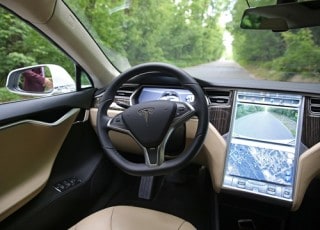
For all intents and purposes, today’s automobiles are no longer just automobiles. They are computers on wheels, with more code, sensors and input/output systems than even the most powerful supercomputers had just a decade ago.
With great computing power comes great computing responsibility – especially when it comes to real-time performance.
Mileage on demand
Take Tesla, for example. Much of the electric vehicle’s operating capabilities are based on updateable and downloadable software – not metallic components. The efficacy of this model was recently demonstrated when Hurricane Irma ravaged parts of Florida. Tesla’s battery life is based upon the fee structure the owner is willing to pay.
[ Related: Innovation Driving Connected Cars Gears Up at Mcity ]
According to a report by Keith Collins in Quartz, “some of Tesla’s Model X and S vehicles that were introduced in 2016 come with 75 kilowatt-hour batteries that are software-limited to only offer 60 or 70 kilowatt hours, capable of 200 to 230 miles per charge.” As the storm approach Florida, however, Tesla automatically upgraded the capacity of the state’s Tesla drovers to enable them to drive clear of Hurricane Irma’s cone of uncertainty.
Analytics to go
Evidence of the rise of real-time, software-driven driving abounds. Cars will soon be capable of conducting data analysis at real-time speeds to decipher best routes and avoid accidents. As Kirsten Korosec recently explained in Fortune, Intel and Waymo — a part of Alphabet – are collaborating on an effort to instill real-time intelligence into the upcoming generation of self-driving cars.
[ Related: Why the U.S. Military Is Gung-Ho About Autonomous Boats ]
Waymo says “it’s using Intel chips as part of a compute platform that allows its self-driving Chrysler Pacifica hybrid minivans to process huge amounts of data so it can make decisions in real time while navigating city streets.”
The goal of the Waymo-Intel collaboration is to achieve “level 4 and 5 autonomy,” which certifies that the car is ready to drive itself. If there is anything that requires flawless implementation of real-time technologies, self-driving cars would be it. At the same time, the evolution to computers on wheels means software updates and monitoring anytime and anywhere it is needed.
Joe McKendrick is RTInsights Industry Editor and industry analyst focusing on artificial intelligence, digital, cloud and Big Data topics. His work also appears in Forbes an Harvard Business Review. Over the last three years, he served as co-chair for the AI Summit in New York, as well as on the organizing committee for IEEE's International Conferences on Edge Computing. (full bio). Follow him on Twitter @joemckendrick.

 Best Practices for Deploying and Scaling Industrial AIArtificial Intelligence (AI) is transforming industrial operations, helping organizations optimize workflows, reduce downtime, and enhance productivity. Different industry verticals leverage AI in unique ways.Link to The Center for Adaptive Edge Intelligence
 The Center for Adaptive Edge IntelligenceAdaptive edge intelligence brings real-time decision-making to the point of data creation, whether from sensors, machines, or cameras.Link to The Value of Vehicle Electrification
 The Value of Vehicle ElectrificationElectric vehicles (EVs) present automakers with many design, engineering, and manufactu ring challenges.Link to Accelerating Manufacturing Digital Transformation with Industrial Connectivity and IoT
 Accelerating Manufacturing Digital Transformation with Industrial Connectivity and IoTDigital transformation is empowering industrial organizations to deliver sustainable innovation, disruption-proof products and services, and continuous operational improvement.Link to Smart Manufacturing for Automotive
 Smart Manufacturing for AutomotiveLeading a transportation revolution in autonomous, electric, shared mobility and connectivity with the next generation of design and development tools.Link to Center for Data Pipeline Automation
 Center for Data Pipeline AutomationAs businesses become data-driven and rely more heavily on analytics to operate, getting high-quality, trusted data to the right data user at the right time is essential.Link to Center for Automated Integration
 Center for Automated IntegrationThe goal of automated integration is to enable applications and systems that were built separately to easily share data and work together, resulting in new capabilities and efficiencies that cut costs, uncover insights, and much more.Link to Continuous Intelligence: Insights
 Continuous Intelligence: InsightsDigital transformation requires continuous intelligence (CI). Today’s digital businesses are leveraging this new category of software which includes real-time analytics and insights from a single, cloud-native platform across multiple use cases to speed decision-making, and drive world-class customer experiences.