








Real-time decisioning has moved from competitive advantage to operating assumption. Models score transactions as they arrive, flag anomalies in telemetry within seconds, triage service requests before a person reads them, and adjust operational parameters continuously. The value of these systems comes precisely from acting faster than a human could review the decision.
That speed also changes the nature of failure. When a model informs a quarterly report, a mistake surfaces in review. When a model acts in real time, a mistake propagates at the speed of the pipeline, and it can affect thousands of decisions before anyone asks whether the model is still working.
How rarely anyone is positioned to notice is the part worth dwelling on. In a 2025 AI governance survey conducted by Pacific AI, only 48% of organizations reported monitoring their production AI systems for accuracy, drift, or misuse. Slightly more than half of deployed AI is operating without systematic verification that it still performs as approved.
That gap helps explain a second figure. S&P Global Market Intelligence found that 42% of companies abandoned most of their AI initiatives in 2025, up from 17% the year before, with the average organization scrapping close to half of its proofs of concept before production. Some of those projects failed technically. Others were abandoned because nobody could demonstrate they were still delivering value, which is a measurement failure rather than a modeling one.
Real Time Removes the Human Checkpoint
In batch analytics, a person sits between the model and the consequence. A report gets read. A number looks odd. Someone asks a question. That review step is slow, but it functions as an error-detection layer.
Real-time systems remove it by design. If a model routes, prices, throttles, or escalates within seconds, there is no interval in which a human evaluates the individual decision. The system is trusted in advance, and that trust is only as good as the monitoring behind it.
This is why real-time deployments deserve a different standard of scrutiny than the accuracy figure that justified them. The relevant question is not whether the model performed well on historical data. It is whether the model running right now is still the model that was approved.
Three Stages, Three Different Failures
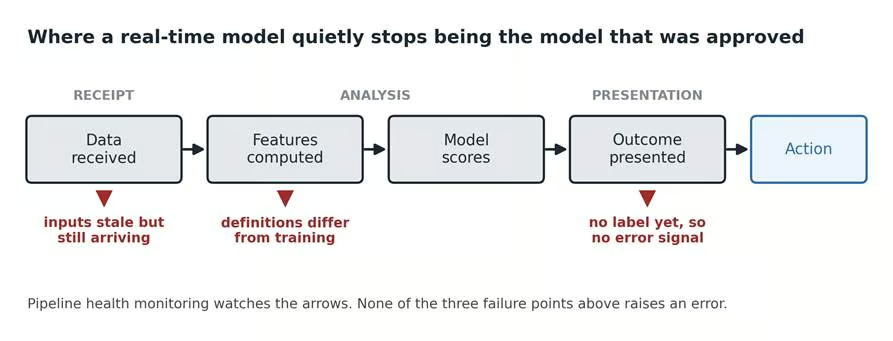
Real time is usefully defined as the interval from receipt of data, through analysis of that data, to presentation of possible outcomes. That framing matters here, because each of those three stages degrades in a different way, and conventional monitoring tends to watch the handoffs between them rather than the correctness of what moves through them.
At receipt, the failure is freshness. Data continues to arrive, so nothing looks broken, but what arrives no longer reflects current conditions.
At analysis, the failure is definitional. The features computed at decision time are not quite the features the model was fitted on, so the model is answering a slightly different question than the one it was validated against.
At presentation, the failure is feedback. The outcome that would tell you whether the decision was right arrives long after the decision was acted on, if it arrives at all.
This holds whether the decision is machine to machine in milliseconds or surfaced to an operator within several minutes. The operator case is often assumed to be the safer of the two because a human remains in the loop. In practice, an operator working under time pressure is checking whether a recommendation is plausible, not whether it is correct. A recommendation that is confidently wrong and entirely plausible will usually be accepted, which means human presentation is a weaker control than it appears on an architecture diagram.
How the Divergence Happens
Feature definitions drift apart between paths. A model is typically trained on features computed by a batch process over historical data, then scored on features computed by a streaming process on live data. Those two paths are usually written by different people at different times. A field may be aggregated over a slightly different window, handle missing samples differently, or resolve late-arriving records another way. The feature carries the same name in both places and means something subtly different in each. No errors. The model simply receives inputs it was never fitted on, and accuracy declines without a signal.
A concrete version of this looks completely ordinary. Suppose a model uses a seven-day count of customer support interactions as an input. In training, that count was computed from settled historical records, so an interaction logged a few hours late still fell inside the correct seven-day window. In serving, the same count is computed from a live stream at the moment of the decision, and a late-logged interaction falls outside the window entirely. Both implementations are defensible readings of a seven-day count. They disagree systematically, and they disagree most for the accounts that generate the most late-arriving records, which are often the high-contact accounts that matter most. The model now sees a lower count than it was trained to expect, precisely where that input carries the most weight. No error is raised. No input distribution moves far enough to trip a threshold.
Inputs go stale without going missing. Real-time systems depend on freshness, but most pipelines are instrumented to detect absence rather than staleness. If an upstream source stops updating while continuing to serve its last known value, every downstream check passes. The model scores confidently on a snapshot of a world that has moved on. In operational settings, this failure is more common than outright data loss, and considerably harder to see.
The relationship itself changes. Input drift and concept drift are worth separating: the first is a change in what the data looks like, the second a change in what the data means. Input drift can be caught by watching distributions. Concept drift frequently cannot, because the inputs look entirely normal and only the predictive relationship has moved.
See also:How Real-Time Data Helps Battle AI Model Drift
Why the Dashboard Stays Green
Most organizations do monitor their real-time systems. They monitor the wrong layer.
Operational dashboards are built to answer whether the pipeline is healthy: are jobs completing, is latency within bounds, are error rates low, is throughput normal. Those are necessary questions, and every one of them is answerable without knowing whether a single prediction was correct. A model can degrade substantially while all of those indicators stay green, because from the pipeline’s point of view a wrong prediction is a successful run.
Two further factors obscure the problem. Aggregate accuracy, where it is tracked at all, averages across the whole population and therefore conceals failure concentrated in specific segments. And in most real-time applications the ground truth arrives late, sometimes weeks after the decision, so there is no immediate error signal to compute against even in principle.
The result is a system that is monitored thoroughly and verified barely at all.
What to Monitor Instead
Four additions close most of the gap, and none of them require rebuilding the platform.
Compare the two feature paths automatically. Take a sample of cases, compute features through both the training path and the serving path, and assert that the results agree within tolerance. Run it on a schedule. This single check catches the most common cause of silent divergence and is usually the cheapest to implement.
Track freshness explicitly, with a stated tolerance per input. Define how old each input is allowed to be for the decision it supports, and alert on age rather than absence. A source that has not updated in six hours should be as visible as one that has stopped responding.
Measure performance by segment, not in aggregate. Recompute accuracy within the groups that matter operationally: geography, equipment generation, customer type, volume band. Degradation almost always appears in a segment well before it appears in the overall number, and the weakest segments are usually those with the least training data and the greatest operational consequence.
Monitor decision distributions while you wait for labels. When ground truth is delayed, the distribution of the model’s own outputs remains available immediately. A scoring pattern that shifts materially without a corresponding change in business conditions is an early warning that does not depend on knowing the right answer yet.
Five Questions Worth Asking
For executives accountable for systems that act without human review, these questions surface the gap quickly.
Is the model in production the model that was validated? Ask whether anyone has verified that serving features match training features, and when that was last checked.
How would we learn that accuracy had dropped, and how long would it take? If the answer depends on someone noticing a business outcome, the detection path is too slow for a real-time system.
Which segments is this model weakest on? An inability to answer means performance is only understood in aggregate, which means segment-level failure is invisible.
What is the oldest input this decision is allowed to use? If no tolerance is defined, staleness is not being managed.
Who owns this model, and when is it next reviewed? Models routinely outlive the projects and the people that created them, continuing to influence decisions with no accountable owner.
The Constraint Is Ownership, Not Technology
None of the monitoring described here is technically difficult. It is unglamorous, it produces no visible feature, and it tends to fall between teams. The platform group owns the pipeline. The data science group owns the model. Verification of the decision sits between them, and work that belongs partly to everyone tends not to get done.
The practical remedy is to attach the cost of verification to the use case rather than to a shared infrastructure backlog. If a real-time model is trusted enough to act without human review, it is important enough to fund the monitoring that proves it still works.
Speed was the reason to deploy these systems. Confidence is what makes the speed worth having, and confidence has to be measured rather than assumed.