Best Practices for Deploying and Scaling Industrial AI
Artificial Intelligence (AI) is transforming industrial operations, helping organizations optimize workflows, reduce downtime, and enhance productivity. Different industry verticals leverage AI in unique ways.
Accelerating Manufacturing Digital Transformation with Industrial Connectivity and IoT
Digital transformation is empowering industrial organizations to deliver sustainable innovation, disruption-proof products and services, and continuous operational improvement.
Leading a transportation revolution in autonomous, electric, shared mobility and connectivity with the next generation of design and development tools.
As businesses become data-driven and rely more heavily on analytics to operate, getting high-quality, trusted data to the right data user at the right time is essential.
The goal of automated integration is to enable applications and systems that were built separately to easily share data and work together, resulting in new capabilities and efficiencies that cut costs, uncover insights, and much more.
Digital transformation requires continuous intelligence (CI). Today’s digital businesses are leveraging this new category of software which includes real-time analytics and insights from a single, cloud-native platform across multiple use cases to speed decision-making, and drive world-class customer experiences.
Best Practices for Deploying and Scaling Industrial AI
Artificial Intelligence (AI) is transforming industrial operations, helping organizations optimize workflows, reduce downtime, and enhance productivity. Different industry verticals leverage AI in unique ways.
Accelerating Manufacturing Digital Transformation with Industrial Connectivity and IoT
Digital transformation is empowering industrial organizations to deliver sustainable innovation, disruption-proof products and services, and continuous operational improvement.
Leading a transportation revolution in autonomous, electric, shared mobility and connectivity with the next generation of design and development tools.
As businesses become data-driven and rely more heavily on analytics to operate, getting high-quality, trusted data to the right data user at the right time is essential.
The goal of automated integration is to enable applications and systems that were built separately to easily share data and work together, resulting in new capabilities and efficiencies that cut costs, uncover insights, and much more.
Digital transformation requires continuous intelligence (CI). Today’s digital businesses are leveraging this new category of software which includes real-time analytics and insights from a single, cloud-native platform across multiple use cases to speed decision-making, and drive world-class customer experiences.
The Foundation Before the Speed: Preparing for Real-Time Analytics
Real-time analytics is often approached as a technology upgrade. In practice, it is an organizational outcome. Organizations that succeed treat real-time analytics as the final stage of a deliberate progression.
Real-time analytics is increasingly viewed as a strategic capability for organizations seeking faster, more informed decision-making. Investments in streaming platforms, real-time dashboards, and AI-driven alerts reflect a growing recognition that speed can be a competitive advantage.
As organizations pursue real-time capabilities, they also encounter a crucial reality: speed delivers the greatest value when it is supported by robust foundations. Clear definitions, shared ownership, and trusted data enable real-time insights to translate into confident action.
To understand how real-time analytics creates impact at scale, it is useful to examine what “real-time” means in practice.
What “Real-Time” Actually Means in Practice
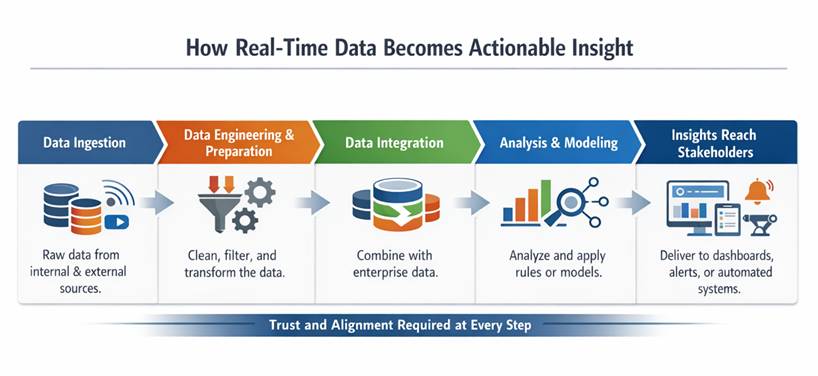
Real-time analytics is often discussed in terms of speed, how quickly data can be ingested, processed, and surfaced. In practice, real-time is an end-to-end operational process. The primary constraint is not how fast data arrives, but how quickly it can be made usable, understood, and acted upon.
Data Ingestion: The process begins with data ingestion. Data may arrive continuously or at high frequency from internal systems, applications, sensors, or external sources. In real-time scenarios, ingestion is designed to minimize delay, but ingestion alone does not create insight. Raw data is rarely usable in its original form.
Data Engineering and Preparation: Once ingested, data must be processed and prepared. This includes filtering irrelevant signals, transforming raw fields into usable formats, and applying consistent logic so the data can be analyzed reliably. Without this step, real-time data simply moves faster into inconsistency.
Data Integration: In many use cases, real-time data must also be combined with existing enterprise data. External signals often lack sufficient context on their own and must be joined with internal records such as customer history, product information, or operational state to become meaningful.
Analysis and Modeling: Only after these steps does analysis become possible. Queries, rules, or models operate on data that has already been shaped for consistency and relevance. At this stage, speed matters because the data is finally ready to support decisions.
Insights Reach Stakeholders: The final step is interpretation and action. Real-time insight creates value only when it reaches the right people or systems in time to influence outcomes. This may involve dashboards for decision-makers, alerts for operational teams, or automated responses.
Seen this way, real-time analytics is not a single technology or platform. It is an operational sequence that spans ingestion, preparation, integration, analysis, and action.
Advertisement
The Most Common Failure Pattern in Real-Time Analytics Initiatives
One of the most common reasons real-time analytics initiatives underperform is inconsistency. Organizations attempt to deliver real-time insights across marketing, product, operations, and leadership teams that do not share common definitions, metrics, or assumptions about what the data represents. Teams may rely on the same underlying data and dashboards yet evaluate performance through different lenses. As speed increases, these differences become more visible and more disruptive.
In a retail organization, different teams may look at the same real-time campaign data and reach very different conclusions.
Marketing: “Users are signing up within minutes of clicking the ad. Signup volume is increasing in real time, and acquisition targets are being met. From our perspective, the campaign is successful and should be scaled.”
Product: “These signups are driving traffic to the website, but users are not buying any products. In fact, most do not even add items to the cart. From our perspective, this indicates the campaign is failing.”
Both teams are reacting rationally to the data in front of them, but they are optimizing for different definitions of success. Real-time analytics surfaces these differences immediately, increasing debate over which metrics should drive action. Over time, this dynamic often creates mistrust between technical teams and business stakeholders, pushing stakeholders back toward more complicated, manual, and long-running analyses instead of relying on real-time insight.
The real-time process described above only creates value when specific foundations already exist. Without them, increasing speed amplifies inconsistency rather than clarity. Organizations that succeed with real-time analytics treat it as the outcome of disciplined preparation, not the starting point.
Establish Control Over Critical Data Sources
Real-time analytics requires predictable access to data. When essential data is owned by external vendors or arrives on unpredictable schedules, organizations lose control over timing and reliability. This makes it difficult to support decisions that depend on freshness.
For example, a logistics organization attempting to monitor delivery performance in near real time may depend on delayed feeds from third-party carriers. Even if internal systems update frequently, missing or late external inputs prevent confident action. Bringing critical data in-house or establishing controlled ingestion pipelines removes this dependency and enables timely analysis.
Advertisement
Shared Data Definitions
Before data can move faster, teams must agree on what it represents. Many real-time challenges stem from inconsistent definitions rather than missing data. Metrics that appear straightforward often mean different things across functions.
To address this, organizations establish shared data definitions, typically documented in what is commonly referred to as a data dictionary. This document captures agreed-upon definitions for key metrics and KPIs and makes them visible across teams. The work is led by business stakeholders, as definitions reflect how success is measured and decisions are made.
In industries such as finance, healthcare, or e-commerce, even small definitional differences can materially change interpretation. Aligning on shared definitions upfront prevents conflicting reactions once data begins flowing in real time.
Advertisement
Translate Definitions into Standardized Data Models
Once shared definitions are established, they must be translated into standardized data models. This step requires close and ongoing collaboration between data engineers and business stakeholders.
Data engineers ingest raw data and transform it according to the agreed definitions. Stakeholders validate that the resulting models accurately reflect business rules and operational reality. If definitions do not align with model outputs, the resulting analysis becomes irrelevant, regardless of how fast or sophisticated the pipeline may be.
Without this collaboration, organizations risk investing significant time and resources into models that do not answer the right questions. Engineering effort, automation, and infrastructure spend deliver limited value, and trust in the data erodes. Active stakeholder involvement ensures that data models remain aligned with business intent and that investments in real-time capabilities produce meaningful outcomes.
In manufacturing, for example, defining when a machine state counts as downtime versus idle time requires direct input from operations teams. Encoding these definitions correctly into data models prevents conflicting interpretations downstream.
Advertisement
Enable Analysis and Advanced Analytics From the Same Models
Standardized data models become the foundation for all analytical work. Analysts use them to monitor performance and support decision-making. Data scientists rely on the same models for forecasting, experimentation, and advanced analytics.
Using a shared foundation ensures that descriptive and predictive insights align. Without it, organizations often see forecasts and operational reports contradict one another simply because they are based on different assumptions.
Automate Only After Stability Is Achieved
Automation is most effective when applied to stable, well-understood processes. Automating ingestion or transformation before definitions and models are settled locks inconsistency into the system and makes correction more difficult.
Organizations that succeed introduce automation gradually. Initial refresh cycles may be monthly or daily. As confidence in data quality and definitions grows, refresh frequency can increase to hourly or near real-time intervals.
Advertisement
Sustain Collaboration Between Technical Teams and Stakeholders
The most critical foundation for real-time analytics is sustained collaboration. Data models are not static technical artifacts. They evolve as the business changes.
When collaboration breaks down, models proliferate, definitions drift, and teams stop trusting shared data assets. Stakeholders often respond by building manual workarounds or parallel analyses, undermining the purpose of real-time systems.
Organizations that succeed treat collaboration as an ongoing practice. Technical teams and stakeholders revisit definitions and models together, ensuring that real-time insights remain accurate, relevant, and actionable.
Real-time analytics is often approached as a technology upgrade. In practice, it is an organizational outcome. Speed creates value only when it is built on shared definitions, trusted data, and clear decision ownership.
When these foundations are in place, real-time insights support confident action. When they are missing, speed exposes misalignment. The difference is not the technology. It is the preparation.
Organizations that succeed treat real-time analytics as the final stage of a deliberate progression. Control comes before speed. Alignment comes before automation. Collaboration is treated as a requirement, not an afterthought.
The promise of real-time analytics is not instant answers. It is clarity at speed.
Nirmayee (Nemo) Dighe is the Associate Director of Business Intelligence at Group 1001, where she leads data and analytics strategy to drive smarter, faster, and more connected business decisions. With expertise in data strategy, AI adoption, and cross-functional collaboration, Nemo helps organizations translate technical innovation into measurable business value. Her work focuses on making AI practical, sustainable, and aligned with real-world impact—bridging the gap between data teams and decision-makers. Passionate about empowering others through data literacy and transparency, she brings a pragmatic, people-centered approach to digital transformation.
NVIDIA launched NVIDIA Nemotron 3 Super, a 120 billion parameter open model with 12 billion active parameters designed to run complex agentic AI systems at scale.
The expansion of smart cities and industrial deployments means infrastructure must be built to withstand harsh, evolving environments while maintaining reliable connectivity and power.
Time synchronization rarely gets much attention in cybersecurity, but it should. It underpins the security functions that teams rely on every day, from trustworthy logs and threat detection to forensic review and compliance reporting. In Zero Trust environments, trusted time helps keep those systems aligned and plays a growing role in resilience and compliance. A […]
AI-powered NaaS represents a foundational shift toward self-managed, adaptive infrastructure built to support the data-intensive demands of modern organizations.
Accepting that AI is being designed for machines rather than humans forces a shift in responsibility. The burden moves away from making systems intuitively understandable and toward making them structurally accountable.
Analysis and market insights on real-time analytics including Big Data, the IoT, and cognitive computing. Business use cases and technologies are discussed.
Advertiser Disclosure: Some of the products that appear on
this site are from companies from which TechnologyAdvice
receives compensation. This compensation may impact how and
where products appear on this site including, for example,
the order in which they appear. TechnologyAdvice does not
include all companies or all types of products available in
the marketplace.

 Best Practices for Deploying and Scaling Industrial AIArtificial Intelligence (AI) is transforming industrial operations, helping organizations optimize workflows, reduce downtime, and enhance productivity. Different industry verticals leverage AI in unique ways.Link to The Center for Adaptive Edge Intelligence
 The Center for Adaptive Edge IntelligenceAdaptive edge intelligence brings real-time decision-making to the point of data creation, whether from sensors, machines, or cameras.Link to The Value of Vehicle Electrification
 The Value of Vehicle ElectrificationElectric vehicles (EVs) present automakers with many design, engineering, and manufactu ring challenges.Link to Accelerating Manufacturing Digital Transformation with Industrial Connectivity and IoT
 Accelerating Manufacturing Digital Transformation with Industrial Connectivity and IoTDigital transformation is empowering industrial organizations to deliver sustainable innovation, disruption-proof products and services, and continuous operational improvement.Link to Smart Manufacturing for Automotive
 Smart Manufacturing for AutomotiveLeading a transportation revolution in autonomous, electric, shared mobility and connectivity with the next generation of design and development tools.Link to Center for Data Pipeline Automation
 Center for Data Pipeline AutomationAs businesses become data-driven and rely more heavily on analytics to operate, getting high-quality, trusted data to the right data user at the right time is essential.Link to Center for Automated Integration
 Center for Automated IntegrationThe goal of automated integration is to enable applications and systems that were built separately to easily share data and work together, resulting in new capabilities and efficiencies that cut costs, uncover insights, and much more.Link to Continuous Intelligence: Insights
 Continuous Intelligence: InsightsDigital transformation requires continuous intelligence (CI). Today’s digital businesses are leveraging this new category of software which includes real-time analytics and insights from a single, cloud-native platform across multiple use cases to speed decision-making, and drive world-class customer experiences.