Best Practices for Deploying and Scaling Industrial AI
Artificial Intelligence (AI) is transforming industrial operations, helping organizations optimize workflows, reduce downtime, and enhance productivity. Different industry verticals leverage AI in unique ways.
Accelerating Manufacturing Digital Transformation with Industrial Connectivity and IoT
Digital transformation is empowering industrial organizations to deliver sustainable innovation, disruption-proof products and services, and continuous operational improvement.
Leading a transportation revolution in autonomous, electric, shared mobility and connectivity with the next generation of design and development tools.
As businesses become data-driven and rely more heavily on analytics to operate, getting high-quality, trusted data to the right data user at the right time is essential.
The goal of automated integration is to enable applications and systems that were built separately to easily share data and work together, resulting in new capabilities and efficiencies that cut costs, uncover insights, and much more.
Digital transformation requires continuous intelligence (CI). Today’s digital businesses are leveraging this new category of software which includes real-time analytics and insights from a single, cloud-native platform across multiple use cases to speed decision-making, and drive world-class customer experiences.
Best Practices for Deploying and Scaling Industrial AI
Artificial Intelligence (AI) is transforming industrial operations, helping organizations optimize workflows, reduce downtime, and enhance productivity. Different industry verticals leverage AI in unique ways.
Accelerating Manufacturing Digital Transformation with Industrial Connectivity and IoT
Digital transformation is empowering industrial organizations to deliver sustainable innovation, disruption-proof products and services, and continuous operational improvement.
Leading a transportation revolution in autonomous, electric, shared mobility and connectivity with the next generation of design and development tools.
As businesses become data-driven and rely more heavily on analytics to operate, getting high-quality, trusted data to the right data user at the right time is essential.
The goal of automated integration is to enable applications and systems that were built separately to easily share data and work together, resulting in new capabilities and efficiencies that cut costs, uncover insights, and much more.
Digital transformation requires continuous intelligence (CI). Today’s digital businesses are leveraging this new category of software which includes real-time analytics and insights from a single, cloud-native platform across multiple use cases to speed decision-making, and drive world-class customer experiences.
Which is Right for Your Organization: Business Intelligence or Operational Intelligence?
As the pace and complexity of operations accelerate, organizations are rethinking architectures to enable real-time, human-in-the-loop decision-making.
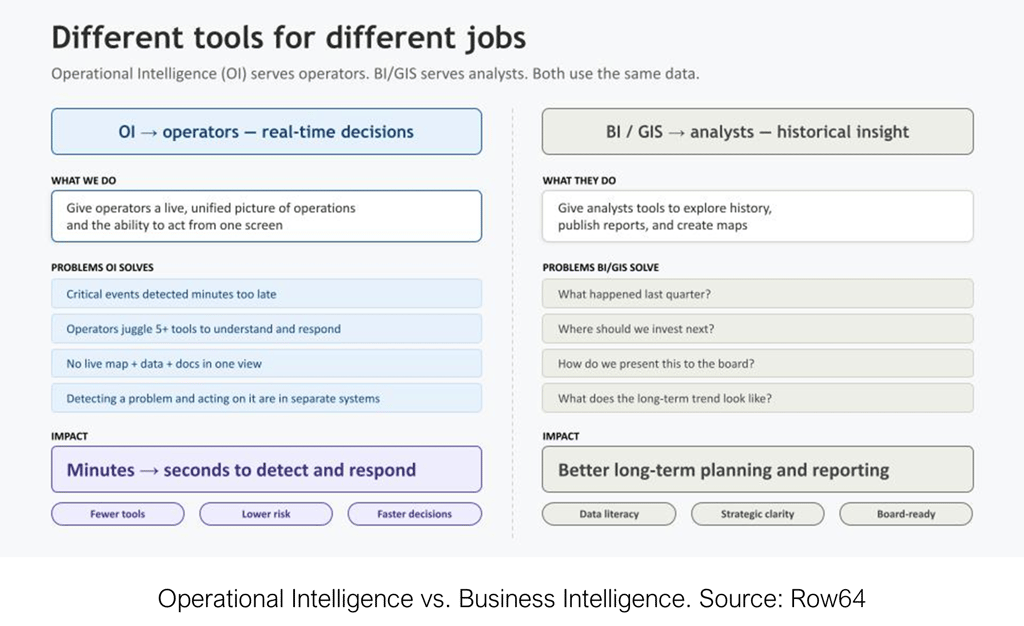
In boardrooms and back offices, business intelligence (BI) has long been the backbone of decision-making. Dashboards, reports, and historical analysis have helped organizations understand what happened, why it happened, and how to plan for what comes next. For many use cases, that’s enough.
However, in sectors like emergency response, fleet management, logistics, utilities, and financial services, decisions are not made in hours or even minutes. They happen in the moment, often under pressure, where the cost of delay is immediate and measurable. In these environments, the central question is no longer “What happened?” but “What is happening right now, and what should we do about it?”
This is where operational intelligence enters the conversation. Unlike traditional BI, which is designed for retrospective analysis, operational intelligence is built for continuous, real-time awareness and decision support. It focuses on live data and context, and enables action while events are still unfolding.
That distinction exposes a fundamental question: are traditional BI platforms designed for live operations?
In fleet management, a single vehicle sitting idle can cost as much as $760 per day in lost productivity and revenue (Source: American Transportation Research Institute estimates on operational costs).
In utilities, unplanned downtime can exceed $10,000 per minute, compounding rapidly as outages cascade across systems (Source: U.S. Department of Energy estimates on grid reliability and outage costs).
In financial services, regulators at the Financial Industry Regulatory Authority (FINRA) issued $3.3 billion in fines last year for failures in transaction monitoring and compliance.
In each scenario, the value of insight-to-action erodes in what we call the “Detection Gap” – the time between a critical event entering the data pipeline and a human operator detecting, interpreting, and acting on it. By the time a traditional BI system surfaces an issue, the opportunity to act has often already passed. Changes can be made in the future, of course, but in some instances, that may be too late, the financial opportunity may be missed, or the financial cost may be too high.
To understand why BI struggles in these environments, it is important to recognize that many BI systems were built when data sets were batched and/or smaller, and the velocity with which data was coming into an organization was lower. That introduces several challenges:
Historical data sets need to be pre-processed or sampled to be manageable within current BI tools, limiting end-user flexibility and requiring them to return to the data science teams for further processing, which can take hours or days.
Warehouses and OLAP systems rely on batch or micro-batch processing and are not optimized for high-velocity data, introducing latency for end users.
Data platforms focus on storage and movement, not on what happens when humans are in the loop or when downstream systems need to act with full operational context, as events unfold.
Observability requires integrating systems for multiple data types (structured, unstructured, spatial, etc.), necessitating parsing and copying large amounts of data as the data hops from one system to the next.
There are no tightly coupled integration options for downstream applications like action or intelligence systems.
The result is a gap between signal and response that high-stakes environments cannot afford.
Closing that gap between legacy and real-time systems requires more than faster dashboards. It demands a system designed for continuous awareness and human-centered, real-time decision-making. For that, three properties are essential:
1. Real-Time Performance at Scale: Handling Data in Motion
Operational environments generate vast volumes of continuously changing data from sensors, transactions, vehicles, networks, user interactions, etc. When a logistics network spans thousands of vehicles or a utility grid produces millions of telemetry signals per second, the intelligence system must scale seamlessly to keep pace, without introducing lag or data loss.
This requires a high-performance, vertically integrated set of components capable of handling massive amounts of batched and streaming event data in seconds, at device speeds. In these environments, techniques such as parallelized compute, GPU optimizations, shared contiguous memory, byte-level layout, reducing the need to parse or copy data, and websockets for efficient network communications are required to meet performance demands. Platforms purpose-built for these environments — GPU-native, browser-native, with zero-copy data pipelines — eliminate the bottlenecks that prevent commodity infrastructure from keeping pace, and deliver command-center-like control without heavyweight client installations.
2. Observability: Seeing Across Structured, Unstructured, and Spatial Data
Operational reality is messy. It comes from logs, messages, sensor feeds, and external data sources. Real-time systems must provide deep observability across structured and unstructured data, correlating signals in context to produce actionable insight. Just as importantly, they must incorporate spatial awareness, understanding not just what is happening, but where it is happening.
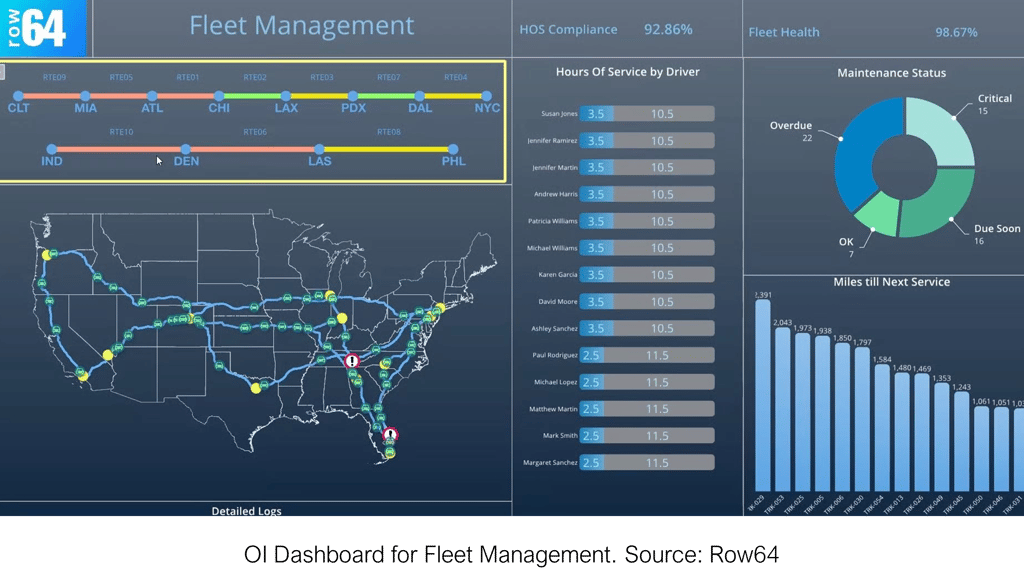
In fleet management, knowing a vehicle is off route is only useful if it can be visualized live on a map, alongside traffic conditions, weather patterns, and nearby assets. In utilities, identifying a fault requires precise geospatial context to isolate the affected segment of the grid and dispatch crews effectively.
This fusion of telemetry, warehouse data, event streams, and GIS/mapping data creates a unified operational picture that reflects the real world as it changes. Critically, that picture must reflect operational reality, not just geography. A utility fault is not located on a street map. It is located on a network schematic. A warehouse exception is not a GPS coordinate. It is a position on a floor plan. A data center anomaly lives in a rack diagram, not a satellite view. The ability to overlay streaming operational data onto custom diagrams that mirror the actual structure of the operation is what separates a purpose-built observability layer from a generic mapping tool.
In fraud detection, for example, identifying suspicious behavior may require combining real-time transaction data with historical behavioral patterns, device signals, and external threat intelligence. Missing any piece of that puzzle can mean missing the context surrounding the fraud.
Advertisement
3. Integration: From Insight to Informed Action
In fast-paced environments, real-time systems must integrate directly with downstream applications, such as dispatch systems, control planes, alerting mechanisms, and workflow tools, to enable timely, informed responses.
Critically, humans should remain in the loop. Operational intelligence is not about removing human judgment. Systems should surface the right insight, in the right context, at the right time to help operators make decisions quickly and confidently. From there, actions can be executed either manually, semi-manually, or fully automated within defined guardrails.
If a fleet vehicle goes off route, a system should not simply flag it on a dashboard. It should alert the operator with context and recommended actions. If a grid anomaly is detected, the system should surface the issue, its location, and potential impact, enabling rapid intervention before disruption spreads. When guided by human decision-making, this tight coupling of insight and action is what transforms awareness into operational advantage.
4. The AI Layer: The Foundation for Intelligent Operations
The rise of AI in operations makes the Detection Gap more visible, not less. AI models can surface patterns no human operator would catch, but only as fast as the data they can see. Most operational AI today is being fed by batch pipelines. The problem is, a sophisticated detection model running on data that is minutes old is still too slow to act on. The real-time data layer is what finally makes AI useful at the operational edge, and what ensures the human decision window stays open long enough to matter. Without it, you have a very smart system giving you the right answer too late.
The Right Environment for Operational Intelligence
Today, business intelligence remains invaluable for strategic planning, performance analysis, and long-term optimization. But in environments where time is compressed, and latency has real-world financial consequences, organizations need a complementary real-time operational intelligence system.
This requires a different mindset, shifting from historical analysis to continuous awareness, from static dashboards to live “command-center” displays, and from delayed reporting to live decision support. It also means embracing a data architecture that supports warehoused and streaming data, event-driven systems, real-time processing, continuous uptime, and integrations into downstream applications.
Is BI or Operational Intelligence Better for Your Organization?
As industries become more digitized and interconnected, as processing power grows, and as AI agents take on more and more tasks, the number of high-stakes, real-time decisions will only increase. What was once confined to trading floors and emergency services will now extend to supply chains, infrastructure, and customer-facing operations such as retail.
The organizations that will lead the next decade are those that can sense and respond instantly, reducing the delay between signal and action while keeping human decision-makers firmly in control.
The question is no longer whether business intelligence is valuable — it is — but whether it is enough. If your operations operate at a speed where the Detection Gap has a dollar value, the answer is clear: operational intelligence is not optional. It’s the layer your organization is missing.
Marc Stevens is the CEO of Row64, a real-time operational intelligence platform that closes the gap between live data and operational decisions at the speed operations demand.
The edge is where it all happens. It is where innovation is created and where it is delivered. SQL Server workloads must therefore be just as resilient and highly available there as they are in the cloud or in a traditional data center.
NVIDIA launched NVIDIA Nemotron 3 Super, a 120 billion parameter open model with 12 billion active parameters designed to run complex agentic AI systems at scale.
As the pace and complexity of operations accelerate, organizations are rethinking architectures to enable real-time, human-in-the-loop decision-making.
Minimus, a leading provider of hardened container images and secure container images designed to eliminate CVE risk, today announced the appointment of Yael Nardi as Chief Business Officer (CBO). In this newly created role, Nardi will architect the company’s next phase of scale, overseeing a high-velocity top-of-funnel growth strategy, strategic operations, and future corporate development.
The edge is where it all happens. It is where innovation is created and where it is delivered. SQL Server workloads must therefore be just as resilient and highly available there as they are in the cloud or in a traditional data center.
Analysis and market insights on real-time analytics including Big Data, the IoT, and cognitive computing. Business use cases and technologies are discussed.
Advertiser Disclosure: Some of the products that appear on
this site are from companies from which TechnologyAdvice
receives compensation. This compensation may impact how and
where products appear on this site including, for example,
the order in which they appear. TechnologyAdvice does not
include all companies or all types of products available in
the marketplace.

 Best Practices for Deploying and Scaling Industrial AIArtificial Intelligence (AI) is transforming industrial operations, helping organizations optimize workflows, reduce downtime, and enhance productivity. Different industry verticals leverage AI in unique ways.Link to The Center for Adaptive Edge Intelligence
 The Center for Adaptive Edge IntelligenceAdaptive edge intelligence brings real-time decision-making to the point of data creation, whether from sensors, machines, or cameras.Link to The Value of Vehicle Electrification
 The Value of Vehicle ElectrificationElectric vehicles (EVs) present automakers with many design, engineering, and manufactu ring challenges.Link to Accelerating Manufacturing Digital Transformation with Industrial Connectivity and IoT
 Accelerating Manufacturing Digital Transformation with Industrial Connectivity and IoTDigital transformation is empowering industrial organizations to deliver sustainable innovation, disruption-proof products and services, and continuous operational improvement.Link to Smart Manufacturing for Automotive
 Smart Manufacturing for AutomotiveLeading a transportation revolution in autonomous, electric, shared mobility and connectivity with the next generation of design and development tools.Link to Center for Data Pipeline Automation
 Center for Data Pipeline AutomationAs businesses become data-driven and rely more heavily on analytics to operate, getting high-quality, trusted data to the right data user at the right time is essential.Link to Center for Automated Integration
 Center for Automated IntegrationThe goal of automated integration is to enable applications and systems that were built separately to easily share data and work together, resulting in new capabilities and efficiencies that cut costs, uncover insights, and much more.Link to Continuous Intelligence: Insights
 Continuous Intelligence: InsightsDigital transformation requires continuous intelligence (CI). Today’s digital businesses are leveraging this new category of software which includes real-time analytics and insights from a single, cloud-native platform across multiple use cases to speed decision-making, and drive world-class customer experiences.