Name of Organization: World Bank
Industry: Finance
Location: Washington, DC, USA
Can global poverty reduction strategies be tracked in real time? World Bank Group, which is an international, government-funded financial institution dedicated to reducing or eliminating poverty across the globe, is doing just that.
A few months back, as part of my research work with Forbes Insights, I had the opportunity to speak with Stephanie von Friedeburg, CIO of World Bank Group, who described how in recent years, her organization has been ramping up the digital capabilities of its operations and services, recognizing this as a way to reach populations more quickly and efficiently. Providing “access to our information, anytime, anywhere” has become the World Bank’s mantra, she explains. “We operate in 186 country officers, and many of those country offices are in very difficult parts of the world. Being able to provide our clients with the best development solution to some of the world’s most difficult problems really requires us to have the right information at the right time in the right place.”
Such as commitment means moving as much as possible to real time, and this has been the focus of World Bank’s technology initiatives. “We embarked on a strategy that was about changing the entire ecosystem in which our investment staff and tasking leaders operate in, from what are their end-user devices, to how do they access those applications, how do they access their knowledge and information,” Friedeburg says. “Our intention to make all information available from any device, anytime, anywhere. And that means the right mobile devices, the right mobile platform, and the right mobile applications.”
The World Bank Group has publicly declared that it “would be less bureaucratic, gather more feedback from citizens affected by its projects, and measure more effectively whether its programs are successful.” One way to achieve this is to make the latest data the organization has immediately available to its constituents.
How This Business Opportunity or Challenge Was Met:
To provide access to real-time information on its goals and activities, the World Bank established a Delivery Unit to help set targets and track progress. Metrics can be seen on its tracking website, PDU.worldbank.org, intended to “lend insight in real time into how the Bank Group is doing by continuously updating results as new data become available.”
As documented in a case study published by the World Bank, the site launched with 12 targets “that reflect the priorities of the Bank Group vis-a-vis its developing country partners and the bank’s goals to end extreme poverty by 2030, and boost shared prosperity for the bottom 40% of the population in the developing world.”
The initial 12 targets “aim at increasing development impact by, for example, reducing by one-third the time it takes to deliver a development project; boosting financial assistance to poor, fragile, and conflict-affected areas by 50%; and increasing transparency by geo-mapping all investment projects by 2015. With the site, viewers can see in real time, where the bank is working and on what.”
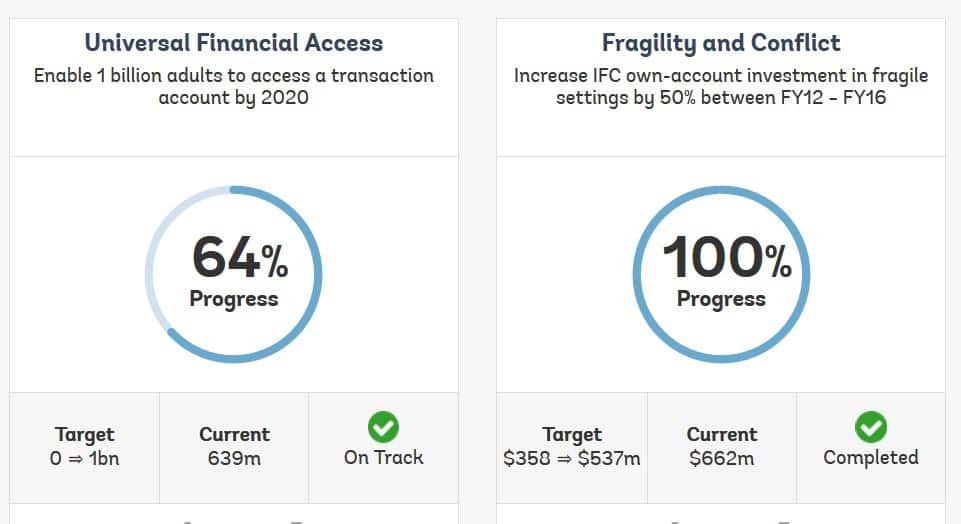
World Bank poverty reduction strategies, updated in real time.
As World Bank Group President Jim Yong Kim put it: “Having clear targets with clear end dates has to be the first step in transforming the way you do your work.” As part of this project, the President’s Delivery Unit “has brought together subject-matter experts from across the bank group to set the targets and develop data flows to track performance. Each target is specific and time-bound to help build momentum.”
The targets cover operations, finance, and solutions priorities, such as climate change, energy, the Bank Group’s advisory services, and financial inclusion.
Measurable/Quantifiable and “Soft” Benefits From This Initiative:
The scorecards posted at PDU.worldbank.org provide a view of the results and performance indicators of the three World Bank Group institutions: the World Bank (WB), the International Finance Corporation (IFC), and the Multilateral Investment Guarantee Agency (MIGA).
The targets “are meant to keep us focused on our goals,” according to Melanie Walker, director of the unit. “This is about how we adapt our bank, our practices, and how we improve our service to clients, using the data that we generate.” Data on each target is automated and updated as it is gathered “daily, weekly, hourly,” she said. “Whenever you click on it, the most recent data is there.”
The scorecards are structured in tiers, with Tiers 1 and 2 intended to “reflect aspects of growth, inclusiveness, and sustainability and resilience.” Tier 3 “captures the World Bank Group’s progress in implementing the strategy and includes measures of both operational and organizational effectiveness.”
For example, “a top target is to increase support by 50% for poor countries that are also fragile or affected by conflict – places where the Bank Group hopes to accelerate progress over the next three years. This target has already been 93% achieved, thanks to a record $52 billion replenishment of IDA, the World Bank’s fund for the poorest countries, at the end of 2013. Negotiators agreed to raise the allocation of grants and other financial assistance for these countries from 13% to 20%.”
The targets and real-time dashboard displays will adapt as time goes on, Walker says.
“Setting targets involves calibrating ambition with reality. The aspiration is to use targets to drive change rather than create perverse incentives that slow down progress towards reaching the twin goals,” she said. “Our hope is that over time is all the metrics we track as an institution will be digital in the most real-time fashion possible.”
(Source: World Bank)

 Best Practices for Deploying and Scaling Industrial AIArtificial Intelligence (AI) is transforming industrial operations, helping organizations optimize workflows, reduce downtime, and enhance productivity. Different industry verticals leverage AI in unique ways.Link to The Center for Adaptive Edge Intelligence
 The Center for Adaptive Edge IntelligenceAdaptive edge intelligence brings real-time decision-making to the point of data creation, whether from sensors, machines, or cameras.Link to The Value of Vehicle Electrification
 The Value of Vehicle ElectrificationElectric vehicles (EVs) present automakers with many design, engineering, and manufactu ring challenges.Link to Accelerating Manufacturing Digital Transformation with Industrial Connectivity and IoT
 Accelerating Manufacturing Digital Transformation with Industrial Connectivity and IoTDigital transformation is empowering industrial organizations to deliver sustainable innovation, disruption-proof products and services, and continuous operational improvement.Link to Smart Manufacturing for Automotive
 Smart Manufacturing for AutomotiveLeading a transportation revolution in autonomous, electric, shared mobility and connectivity with the next generation of design and development tools.Link to Center for Data Pipeline Automation
 Center for Data Pipeline AutomationAs businesses become data-driven and rely more heavily on analytics to operate, getting high-quality, trusted data to the right data user at the right time is essential.Link to Center for Automated Integration
 Center for Automated IntegrationThe goal of automated integration is to enable applications and systems that were built separately to easily share data and work together, resulting in new capabilities and efficiencies that cut costs, uncover insights, and much more.Link to Continuous Intelligence: Insights
 Continuous Intelligence: InsightsDigital transformation requires continuous intelligence (CI). Today’s digital businesses are leveraging this new category of software which includes real-time analytics and insights from a single, cloud-native platform across multiple use cases to speed decision-making, and drive world-class customer experiences.