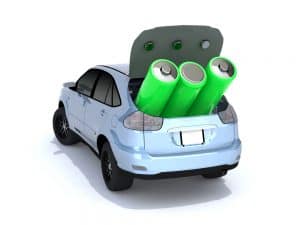
concept of electric car with green AA batteries
Using machine learning to accurately predict and improve the health and life of a battery will enable manufacturers to embed this software straight into their battery devices and improve the in-life service for the consumer.
A collaborative study between the University of Cambridge, A* Star and the Nanyang Technological University showed machine learning to be an accurate approach for modeling battery technology.
With many automakers moving to an electric-first business model in the next ten years, having long-lasting batteries that charge quickly is imperative. Researchers around the world are attempting to improve lithium-ion, with some looking beyond it to solid-state batteries.
The machine learning algorithm
was built by Intellegens, a spin-out of the University of Cambridge’s Cavendish
Laboratory. It uses deep neural networks to extract information from existing
processes, which has been used in material science and healthcare.
“The insights in
this review article could have a transformative effect on the battery industry.
Highlighting how machine learning can accurately predict and improve the health
and life of a battery will enable manufacturers to embed this software straight
into their battery devices and improve their in-life service for the consumer,”
said Dr. Gareth Conduit, co-founder of Intellegens.
Research and testing of battery tech can take years, as several key parameters are tested. Voltage, temperature, and state of change are all variables that can cause malfunction. With the machine learning algorithm, that testing period can be shortened to a few weeks.
“Our machine learning technology, Alchemite, can see correlations between all available parameters, both inputs and outputs, in sparse and noisy datasets,” added Conduit.
“The result is accurate models that can predict missing values, find errors and optimize target properties. Capable of working with data that is as little as 0.05% complete, Alchemite can unravel data problems that are not accessible to traditional machine learning approaches.”
This is not the first attempt by academics to use artificial intelligence in building better batteries. MIT and the Argonne National Laboratory have both published similar studies in 2019.
David is a technology writer with several years experience covering all aspects of IoT, from technology to networks to security.

 Best Practices for Deploying and Scaling Industrial AIArtificial Intelligence (AI) is transforming industrial operations, helping organizations optimize workflows, reduce downtime, and enhance productivity. Different industry verticals leverage AI in unique ways.Link to The Center for Adaptive Edge Intelligence
 The Center for Adaptive Edge IntelligenceAdaptive edge intelligence brings real-time decision-making to the point of data creation, whether from sensors, machines, or cameras.Link to The Value of Vehicle Electrification
 The Value of Vehicle ElectrificationElectric vehicles (EVs) present automakers with many design, engineering, and manufactu ring challenges.Link to Accelerating Manufacturing Digital Transformation with Industrial Connectivity and IoT
 Accelerating Manufacturing Digital Transformation with Industrial Connectivity and IoTDigital transformation is empowering industrial organizations to deliver sustainable innovation, disruption-proof products and services, and continuous operational improvement.Link to Smart Manufacturing for Automotive
 Smart Manufacturing for AutomotiveLeading a transportation revolution in autonomous, electric, shared mobility and connectivity with the next generation of design and development tools.Link to Center for Data Pipeline Automation
 Center for Data Pipeline AutomationAs businesses become data-driven and rely more heavily on analytics to operate, getting high-quality, trusted data to the right data user at the right time is essential.Link to Center for Automated Integration
 Center for Automated IntegrationThe goal of automated integration is to enable applications and systems that were built separately to easily share data and work together, resulting in new capabilities and efficiencies that cut costs, uncover insights, and much more.Link to Continuous Intelligence: Insights
 Continuous Intelligence: InsightsDigital transformation requires continuous intelligence (CI). Today’s digital businesses are leveraging this new category of software which includes real-time analytics and insights from a single, cloud-native platform across multiple use cases to speed decision-making, and drive world-class customer experiences.