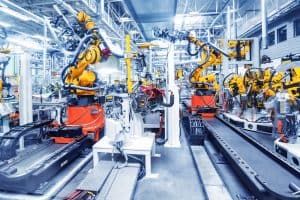
While many manufacturers had been exploring or experimenting with technology approaches to automating their production lines and supply chains in recent years, the Covid-19 crisis pushed things ahead by at least five years. Such has been the case with artificial intelligence and machine learning, which saw a rapid acceleration in adoption during 2020.
For one, there have been shifts in consumer behavior that demanded — and continue to demand — greater automation and virtualization, according to a report in Manufacturing Global. “We will see advancements in how IoT and augmented and virtual reality better enable the non-remote workforce,” according to Rajaram Radhakrishnan, senior VP at Cognizant. “Smart factories and offices will increase, allowing critical functions that currently need to be overseen in person to be monitored remotely or, at a minimum, by fewer people.”
A recent survey of 1,000 senior manufacturing executives from Google Cloud, conducted by The Harris Poll, confirms that the Covid-19 crisis may have spurred a significant increase in the use of AI and other digital enablers among manufacturers. More than three-quarters of executives, 76%, have turned to next-generation technologies such as data and analytics, cloud, and 66% of manufacturers who use AI in their day-to-day operations report that their reliance on AI is increasing.
There are many ways in which AI is being applied. For example, it is instrumental in the “visual inspection of finished products,” the study’s authors report. “Using AI vision, production line workers spend less time on repetitive product inspections. They can instead focus on more complex tasks, such as root-cause analysis.”
See also: Can Factory Work go Remote? Real-Time Information is the Key
Connected factories and AI
Another example of AI in action across manufacturing spaces is powering connected factories to assisting with predictive maintenance. “Custom ML models can predict machine events that left unchecked, could cause unscheduled downtime and negatively impact production schedules,” the report states. “In construction, AI can help builders reduce critical errors that lead to delays while optimizing energy consumption and supporting complex logistics and scheduling tasks.” AI and machine learning (ML) can augment manufacturing employees’ efforts, “by providing prescriptive analytics like real-time guidance and training, flagging safety hazards, and detecting potential defects on the assembly line.”
At this point, almost two-thirds of manufacturers (64%) rely on AI to assist in day-to-day operations, with a quarter already allocating half or more of their overall IT spend towards AI. The average manufacturer now spemds 36% of its IT budget on AI-related initiatives. Among manufacturers who use AI in day-to-day operations, the top three
reasons are to assist with business continuity (38%), help employees increase efficiency (38%), and help employees overall (34%).
The top five areas where AI is currently deployed in day-to-day operations include quality inspection (39%), supply chain management (36%), risk management (36%), product and/or production line quality checks (35%), and inventory management (34%).

 Best Practices for Deploying and Scaling Industrial AIArtificial Intelligence (AI) is transforming industrial operations, helping organizations optimize workflows, reduce downtime, and enhance productivity. Different industry verticals leverage AI in unique ways.Link to The Center for Adaptive Edge Intelligence
 The Center for Adaptive Edge IntelligenceAdaptive edge intelligence brings real-time decision-making to the point of data creation, whether from sensors, machines, or cameras.Link to The Value of Vehicle Electrification
 The Value of Vehicle ElectrificationElectric vehicles (EVs) present automakers with many design, engineering, and manufactu ring challenges.Link to Accelerating Manufacturing Digital Transformation with Industrial Connectivity and IoT
 Accelerating Manufacturing Digital Transformation with Industrial Connectivity and IoTDigital transformation is empowering industrial organizations to deliver sustainable innovation, disruption-proof products and services, and continuous operational improvement.Link to Smart Manufacturing for Automotive
 Smart Manufacturing for AutomotiveLeading a transportation revolution in autonomous, electric, shared mobility and connectivity with the next generation of design and development tools.Link to Center for Data Pipeline Automation
 Center for Data Pipeline AutomationAs businesses become data-driven and rely more heavily on analytics to operate, getting high-quality, trusted data to the right data user at the right time is essential.Link to Center for Automated Integration
 Center for Automated IntegrationThe goal of automated integration is to enable applications and systems that were built separately to easily share data and work together, resulting in new capabilities and efficiencies that cut costs, uncover insights, and much more.Link to Continuous Intelligence: Insights
 Continuous Intelligence: InsightsDigital transformation requires continuous intelligence (CI). Today’s digital businesses are leveraging this new category of software which includes real-time analytics and insights from a single, cloud-native platform across multiple use cases to speed decision-making, and drive world-class customer experiences.