The COVID-19 crisis has brought biosensing technology to the
forefront of our lives. Just as people now take for granted the requirement
that they be searched prior to boarding airplanes, we’re going to have to get
used to being scanned for infectious diseases in many public places.
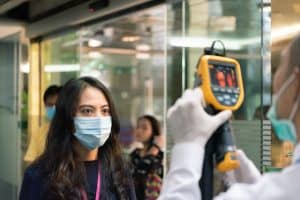
Every time we’re scanned at the office, supermarket, or any
other public place for the possibility of infection, we’re being monitored for
the possibility that you’re a carrier of the novel coronavirus. As a current
example of what we can expect more generally going forward, RXR Realty, the
owner of Rockefeller Center, has
installed thermal cameras that measure body temperatures as employees enter
the office towers. The landlord is also developing a mobile app for tenants to
monitor how closely their workers are complying with social distancing.
See also: The Impact of AI on the Healthcare Industry
IoT-Connected Biosensors Will Become Ubiquitous in the “New Normal”
In the battle against this pandemic, the Internet of Things
(IoT) has become a critical biosensing defense for the human race.
Increasingly, IoT-connected sensors, scanners, and other
monitoring devices will be where the inception, spread, and impact this and
future contagions will be monitored and controlled. These solutions are
supporting such
pandemic-related initiatives as contact
tracing, remote patient monitoring, interactive medicine, inpatient
monitoring, quarantine monitoring, and proximity registration.
Connected IoT biosensors can
detect viral pathogens in the air, water, soil, surfaces, and human and animal
tissues. They will also measure any symptomatic vital signs, such as heart
rate, blood pressure, temperature, blood glucose, asthma, mood, and oxygen saturation. Aggregation of IoT-sourced biosensor data
with clinical test results can provide a clearer picture of how a contagion
spreads and how severely it impacts various demographics. This data can yield key
intelligence for use in controlling an outbreak and speeding the delivery of
appropriate pharmaceuticals, medical supplies, and skilled personnel for
treating those who come down with an infectious disease.
Artificial intelligence (AI) will be a key component in the
fight against infectious diseases. Only by deploying machine learning (ML),
deep learning (DL), and other AI models to vast amounts of biosensor data will
the human race be able to detect and quarantine infections early on in the
general population. For example, San Francisco-based Kogniz Health provides an
AI-enabled real-time IoT system that tracks fevers from a distance, identifies
exposure risks, and sends automatic health and safety alerts to help facility
managers enforce rules governing social distancing and face-mask wearing.
To detect symptoms even before people realize they’re
infected, automated environment sensing will use multimodal AI to monitor the
environment, such as by pairing
facial recognition with temperature scanning and listening
to the audio of people coughing. For example, a Chinese AI company,
called MEGVII, is
developing an AI-enabled temperature-detection IoT solution that integrates
facial recognition.
Deploying Specialized Biosensors for COVID-19 Detection
While we’re in the thick of the current pandemic, the
imperative will be for AI-driven biosensors that are engineered specifically to
detect COVID-19 rapidly without having to depend on clinical testing. In fact,
the US Centers for Disease Control recently
called for all workplaces to require that personnel submit to temperature
and symptom checks when showing up at the office.
With that in mind, we see three broad IoT-centric approaches
for biosensing, hence defending ourselves against, COVID-19 in the wild:
- Sense the COVID-19 pathogen: The US National Science
Foundation recently
awarded a $200,000 grant to the University of Utah electrical and computer engineering professor Massood
Tabib-Azar to develop a prototype of a portable, reusable coronavirus sensor.
The biosensor will plug into the power jack of an app-equipped cellphone or
communicate with it wirelessly. The user would place a drop of their saliva on
the sensor, with the results appearing on the phone within 60 seconds. The
sensor is embedded with “aptamers” (i.e., single-strand DNA) that will attach
to the proteins in any COVID-19 virus molecules that might be present in the
saliva sample. In addition, the presence of the COVID-19 virus on any surface
could also be tested by brushing a swab across the surface and then across the
sensor. In addition, the same technology
could be used to detect the presence of airborne COVID-19 particles in elevators,
aircraft, and other enclosed spaces. Separately, Harvard and MIT
researchers are
developing a face mask that lights up when sensors detect COVID-19 in
saliva, producing a fluorescent signal when a person with the coronavirus
breathes, coughs, or sneezes.
- Sense the symptoms of COVID-19:
High temperatures are one of many symptoms associated with COVID-19, though
fevers are
not found in a large proportion of people who come down with coronavirus. Nevertheless,
thermal cameras and connected thermometers are being used all over the world to
spot individuals who might be ill with or carrying the contagion. Infrared
thermal imaging is being used for active surveillance and
screening of infected and carrier persons at borders, airports, and elsewhere
throughout the world. In China alone, people have been scanned with handheld,
non-contact infrared thermometers or “temperature guns” as they
entered buildings, or had to submit to an ear thermometer check prior to being
allowed to enter railway stations. Many hospitals are already using connected
thermometers to screen patients and staff. For example, COVID-19 patients in China’s
Shanghai Public Health Clinical Center and other hospitals throughout the
country have been
equipped with continuous temperature sensors. Built by California-based
connected health startup VivaLNK’s, the sensors provide continuous, real-time
monitoring of any changes in body temperature. They rely on IoT Access
Controller from Cassia to receive real-time patient data from the sensors and
transmit this data wirelessly via Bluetooth Low Energy to nursing stations for
continuous monitoring. As an alternate
approach for outpatient environments, researchers at IIT-Istituto Italiano
di Tecnologia have developed a prototype of a wearable smartband that alerts
users when their body temperature is higher than 37.5 degrees Celsius. If worn
by others, this smartband can alert users with high temperatures when the
distance to another person is too close to be safe.
- Sense environmental conditions
conducive to the spread of COVID-19: Yet another approach is to
sense the surfaces that are carrying COVID and other infectious agents, and,
optionally, disinfect them. This process can be automated through robotics. One
solution that does this is from UVD Robots.
It is designed to roll through hospital operating theatres and patient rooms
and irradiate all critical surfaces with enough ultraviolet light to kill
viruses and bacteria. The company’s flagship robot consists of a mobile base
with multiple lidar sensors and UV lamps mounted on top. It scans the room
using its sensors and creates a digital map, which users annotate to indicates
the places where the robot should perform disinfecting tasks. The robot emits
short-wavelength ultraviolet-C light powerful enough to destroy the DNA or RNA
of any microorganisms exposed to them. A similar system from Texas-based Xenex Disinfection Services
uses a pulsed xenon UV light system. Soon to be equipped with IoT connectivity,
it can be used in any department and in any unit within a healthcare facility,
including isolation rooms, operating rooms, general patient care rooms, contact
precaution areas, emergency rooms, restrooms, and public spaces.
Implementing Flexible Biosensing into General-Purpose IoT Environments
To brace themselves against the current pandemic and future
outbreaks, organizations need to ensure that they have IoT biosensors and
corresponding AI that has the flexibility to sense any type of contagion.
When evaluating IoT solution vendors in this light, we can
subset the most strategic contenders as such:
- Alliot
Technologies: This vendor provides IoT biosensor solutions for body
temperature monitoring. To reduce the risk of transmission of COVID-19 and
other infectious diseases, its Kentix SmartXcan
body temperature sensor can screen up to 700 people per hour with contactless
body temperature monitoring. With over 1,000 measuring points, the Kentix
SmartXcan body temperature sensor provides contactless measurements via the
eyes and forehead. The sensor uses thermal analysis to produce high precision
measurements. Based on the sensor readings, the Kentix SmartXcan can be
configured to admit/refuse entry. The sensor is available as a standalone
product or soon with an integrated RFID reader. It provides temperature
measurements in less than 1 second and can be configured to work with access
control systems and turnstiles.
- Baidu:
This vendor provides IoT biosensor solutions for AI-driven infrared sensing to
predict people’s temperatures. The solution, now in use in Beijing’s Qinghe
Railway Station, combines computer vision and infrared to detect the forehead
temperature of up to 200 people a minute within a range of 0.5 degrees Celsius.
The system alerts authorities if it detects a person with a temperature above
37.3 degrees Celsius (99.1 degrees Fahrenheit). To support this deployment, Baidu has developed several tools that
are effective in building awareness and screening populations, including an
AI-powered, non-contact infrared sensor system that provides users with fast
multi-person temperature monitoring that can quickly detect a person if they
are suspected of having a fever, one of the many symptoms of the coronavirus.
This technology is currently being used to identify passengers who are
potentially infected where it can examine up to 200 people in one minute
without disrupting passenger flow. Baidu’s AI temperature sensor system can
quickly screen crowds to improve detection efficiency and accuracy. In
addition, Baidu provides an open-source model to detect whether individuals in
crowded areas are wearing masks, boasting a classification accuracy of 97.27%
with a robust performance in long-tail scenarios, such as an oronasal mask or
side faces.
- CloudMinds:
This vendor provides IoT biosensor solutions for AI-enhanced, infrared,
large-scale, body temperature monitoring for rapid detection of high
temperature. The sensors can provide initial temperature screening for groups
of people whose temperatures are above the normal extent and provide high
temperature warnings after detection. Application scenarios include crowded
places ranging from sports arenas, exhibition centers, airports and transport
hubs, office buildings, shopping centers, grocery stores, manufacturing
facilities, schools, and retail shops.
- IBM:
This vendor provides IoT biosensor solutions for ensuring the safety of
worksites and employees with site monitoring and management of temperature,
occupancy, face mask detection, and social distancing. IBM Maximo Worker
Insights provides near real-time access to workplace and employee data from
cameras, Bluetooth beacons, and mobile phones. It supports temperature
monitoring, management of occupancy and no-go zones, and facilitation of
employee social distancing and contact tracing while protecting privacy. It
uses IoT data and prebuilt analytics for monitoring and contact tracing. It
generates insights gathered from thermal imaging or infrared cameras, Bluetooth
beacons, and mobile phones to help conduct body temperature monitoring, health
monitoring, and workplace contact tracing. It sees occupancy and workplace use
in real time and responds to safety concerns. It helps workers stay informed
and help supervisors use predictive information and insights to address issues
before they become problems. By monitoring crowd density and no-go zones, it
alerts personnel when a policy has been breached. Wearable sensors provide data
that can help monitor behavior, track vital signs, and deliver more predictive
protection. Prebuilt or customized “safety shields” apply aggregate
data results against conditions to detect hazards.
- iWEECARE:
This vendor provides IoT biosensor solutions for cloud-based continuous
temperature monitoring of COVID-19. Temp Pal can lower the risk of
infections by early warning a fever and prevents the overwhelming of health
systems by reducing physical contact between caregivers and patients. Temp Pal
is currently used in protecting healthcare workers at Ireland’s Cork
University Hospital and Taiwan’s Cheng Hsin General
Hospital. It is also used for self-quarantine management in Nanjing
City of China to reduce workloads and close contacts with people at high risk.
The coin-sized soft patch, which weighs 3 grams and lasts 36 hours per battery
charge, can transmit temperature data via mobile app or gateway to the cloud,
allowing one-to-many centralized tracking and timely treatment.
- Kinsa:
This vendor provides IoT biosensor solutions for tracking COVID-19 via
connected thermometers. The solution collects a large amount of anonymous
health data that could offer insights into the current and future pandemics.
The system’s networking technology connects thermometers via Bluetooth to an
app on the user’s phone, which reports anonymized data back to Kinsa’s cloud
over the Internet. These data points can enable real-time disease surveillance
and serve as an early warning sign of new clusters of the disease. The company
only organizes data down to the county level. The apps, which provides the
temperature reading and some basic demographic information about the person
whose temperature was taken as well as their other symptoms, can offer
rudimentary guidance about whether a visit to the doctor is needed or not, and
whether the user’s area is seeing unusual levels of fever. Kinsa provides
aggregated data from the million-plus thermometers in its connected ecosystem
and analyzes and breaks out on its U.S. Health Weather Map.
Kinsa sells its thermometers directly to consumers but plans to collaborate
more closely with local governments, health authorities, and school
districts.
- Semtech:
This vendor has teamed with Polysense Technologies to provide IoT biosensor
solutions for monitoring of human body temperatures based on Semtech’s
LoRa LPWAN.
The Semtech sensors provide real-time data to frontline healthcare workers and
let them quickly screen individuals with a high temperature. The sensor uses
connectivity based on the LoRaWAN protocol to communicate temperature data
to cloud-based applications for trend analysis. Alerts are pushed to mobile
devices if temperature thresholds are exceeded, allowing the patient to limit
exposure to others and seek medical attention. The offerings come either in a
wireless sensor for individual use and as a standalone thermal meter for use in
public spaces. Polysense’s thermal temperature monitoring applications serve as
an example of how LoRa-based IoT solutions can provide immediate insights that
help communities and healthcare providers better address the COVID-19 crisis.
Takeaway
Biosensors are becoming ubiquitous in our lives, and the
current COVID-19 emergency is accelerating a trend that was already underway.
Enterprises should incorporate AI-driven biosensors into their IoT strategies. The
post-pandemic “new normal” will see a proliferation of IoT-connected biosensors
both in their traditional locations—in other words, healthcare providers–and
in entirely new locations, such as government, enterprise, and consumer
environments.
The entire healthcare ecosystem—ranging from pharmaceutical
companies and drug makers to vaccine developers, insurers, and hospitals—is
adopting IoT biosensors to address the COVID-19 emergency. To detect and
prevent the spread of contagions, biosensors will become ubiquitous
at airports,
office buildings, restaurants, and other public places. We will see biosensors
on new platforms, such as drones feeding back real-time sensor AI into
databases, dashboards, and applications managed by public health authorities.
More biosensors will be wearables
intended for scientific, commercial, and personal use. And we will see medical
biosensors incorporated as standard components in smart homes, especially in
those and assisted-living facilities serving vulnerable populations. The
privacy issues involved in sourcing and accessing all of this personally
identifiable information will need to be addressed head-on, but that shouldn’t
deter governments, companies, and private citizens everywhere from adopting IoT
biosensors promptly.
As this smart health-monitoring infrastructure takes hold
worldwide, the human race will be able to stop pandemics in their tracks before
losses of life, health, and vitality grow too dire.
Read other articles by James Kobielus here.

 Best Practices for Deploying and Scaling Industrial AIArtificial Intelligence (AI) is transforming industrial operations, helping organizations optimize workflows, reduce downtime, and enhance productivity. Different industry verticals leverage AI in unique ways.Link to The Center for Adaptive Edge Intelligence
 The Center for Adaptive Edge IntelligenceAdaptive edge intelligence brings real-time decision-making to the point of data creation, whether from sensors, machines, or cameras.Link to The Value of Vehicle Electrification
 The Value of Vehicle ElectrificationElectric vehicles (EVs) present automakers with many design, engineering, and manufactu ring challenges.Link to Accelerating Manufacturing Digital Transformation with Industrial Connectivity and IoT
 Accelerating Manufacturing Digital Transformation with Industrial Connectivity and IoTDigital transformation is empowering industrial organizations to deliver sustainable innovation, disruption-proof products and services, and continuous operational improvement.Link to Smart Manufacturing for Automotive
 Smart Manufacturing for AutomotiveLeading a transportation revolution in autonomous, electric, shared mobility and connectivity with the next generation of design and development tools.Link to Center for Data Pipeline Automation
 Center for Data Pipeline AutomationAs businesses become data-driven and rely more heavily on analytics to operate, getting high-quality, trusted data to the right data user at the right time is essential.Link to Center for Automated Integration
 Center for Automated IntegrationThe goal of automated integration is to enable applications and systems that were built separately to easily share data and work together, resulting in new capabilities and efficiencies that cut costs, uncover insights, and much more.Link to Continuous Intelligence: Insights
 Continuous Intelligence: InsightsDigital transformation requires continuous intelligence (CI). Today’s digital businesses are leveraging this new category of software which includes real-time analytics and insights from a single, cloud-native platform across multiple use cases to speed decision-making, and drive world-class customer experiences.