Best Practices for Deploying and Scaling Industrial AI
Artificial Intelligence (AI) is transforming industrial operations, helping organizations optimize workflows, reduce downtime, and enhance productivity. Different industry verticals leverage AI in unique ways.
Accelerating Manufacturing Digital Transformation with Industrial Connectivity and IoT
Digital transformation is empowering industrial organizations to deliver sustainable innovation, disruption-proof products and services, and continuous operational improvement.
Leading a transportation revolution in autonomous, electric, shared mobility and connectivity with the next generation of design and development tools.
As businesses become data-driven and rely more heavily on analytics to operate, getting high-quality, trusted data to the right data user at the right time is essential.
The goal of automated integration is to enable applications and systems that were built separately to easily share data and work together, resulting in new capabilities and efficiencies that cut costs, uncover insights, and much more.
Digital transformation requires continuous intelligence (CI). Today’s digital businesses are leveraging this new category of software which includes real-time analytics and insights from a single, cloud-native platform across multiple use cases to speed decision-making, and drive world-class customer experiences.
Best Practices for Deploying and Scaling Industrial AI
Artificial Intelligence (AI) is transforming industrial operations, helping organizations optimize workflows, reduce downtime, and enhance productivity. Different industry verticals leverage AI in unique ways.
Accelerating Manufacturing Digital Transformation with Industrial Connectivity and IoT
Digital transformation is empowering industrial organizations to deliver sustainable innovation, disruption-proof products and services, and continuous operational improvement.
Leading a transportation revolution in autonomous, electric, shared mobility and connectivity with the next generation of design and development tools.
As businesses become data-driven and rely more heavily on analytics to operate, getting high-quality, trusted data to the right data user at the right time is essential.
The goal of automated integration is to enable applications and systems that were built separately to easily share data and work together, resulting in new capabilities and efficiencies that cut costs, uncover insights, and much more.
Digital transformation requires continuous intelligence (CI). Today’s digital businesses are leveraging this new category of software which includes real-time analytics and insights from a single, cloud-native platform across multiple use cases to speed decision-making, and drive world-class customer experiences.
How Can AI Improve Industrial Inventory Management (Practical Use Cases)
AI can improve industrial inventory management where traditional systems struggle most. This includes forecasting intermittent demand, positioning inventory across multiple sites, improving execution accuracy, and moving surplus inventory from planning to action. In each case, the value comes from better decisions grounded in data.
Industrial inventory behaves very differently from retail stock. You deal with MRO spares, long and variable lead times, irregular consumption, industrial surplus, and assets that have a direct impact on uptime. Inventory decisions are operational decisions.
Drawing from hands-on experience across industrial environments, this article looks at where AI can be applied to improve specific inventory management processes. The focus is practical. You’ll see how AI can be used in targeted ways and where early adopters are already applying it to solve real problems.
What Industrial Inventory Management Entails
Industrial inventory management is the system used to ensure the right materials and parts are available in the right quantity at the right time, without tying up unnecessary working capital.
Advertisement
Core Industrial Inventory Types
Industrial operations typically manage four inventory classes, each with different demand patterns, lead-time exposure, and risk.
Raw materials: Inputs required for production. Availability depends on supplier lead times, minimum order quantities, quality requirements, and inbound logistics.
Work-in-progress (WIP): Material that has entered the production process but is not yet finished. WIP directly impacts cycle time, capacity utilization, and bottleneck management.
Finished goods: Completed items held for shipment. Finished goods levels must align with customer service targets, production schedules, and demand variability.
Maintenance, Repair, and Overhaul (MRO) and spare parts: Parts and consumables are used to maintain equipment. This category is high risk because demand is often intermittent, but stockouts can trigger unplanned downtime, missed production, and expedited freight.
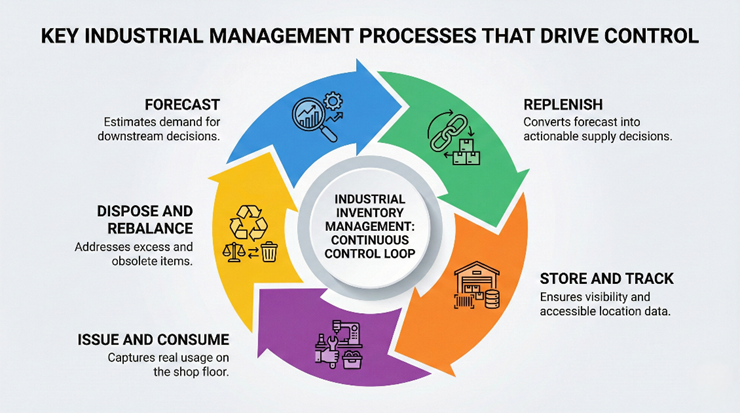
Key Industrial Management Processes That Drive Control
Industrial inventory management operates as a continuous control loop. Each stage depends on the accuracy of the one before it. When issues such as stockouts, excess inventory, or inaccurate records occur, the root cause can usually be traced to a breakdown within this loop.
Forecast: Forecasting estimates how inventory will be consumed over time. This step relies on production plans, historical usage patterns, equipment maintenance history, and supplier lead-time variability. Accurate forecasting sets the foundation for all downstream inventory decisions.
Replenish: Replenishment converts forecasted demand into actionable supply decisions. This includes setting procurement strategy, safety stock levels, min-max thresholds, and supplier schedules. Poor replenishment logic often leads to either shortages or unnecessary overstock.
Store and track: Storage and tracking ensure inventory remains visible and accessible. This stage focuses on maintaining accurate location data across warehouses, tool cribs, and point-of-use locations. Tracking may also include lot numbers, serial numbers, shelf life, and asset criticality, depending on operational requirements.
Issue and consume: Issuing and consumption capture reflect how inventory is actually used. Withdrawals must match real usage on the shop floor or in maintenance activities. Inaccurate consumption data is a common source of planning errors and unreliable inventory records.
Dispose and rebalance: Disposal and rebalancing address inventory that no longer aligns with operational needs. This includes identifying excess, obsolete, or slow-moving items and deciding whether to redeploy them internally, sell them through the appropriate disposition channel, Asset disposition, or write them off based on carrying costs and recovery potential.
How AI Can Improve Inventory Management, With Early Industry Examples
1. Demand Forecasting
In industrial environments, demand forecasting is one of the areas where AI can deliver meaningful improvements, particularly for MRO and spare parts. Traditional forecasting methods struggle with intermittent demand, long periods of zero usage, and demand-driven consumption failures. These limitations often lead to stockouts for critical parts and excess inventory for low-usage items.
AI can improve this process by applying probabilistic models designed for intermittent and irregular demand patterns. Rather than relying on averages or fixed trends, AI-based approaches model uncertainty and variability. They can incorporate signals from maintenance activity, asset age, operating conditions, and production intensity to better anticipate when demand is likely to occur.
Related Industry Implementation
Airbus’s Skywise platformapplies advanced analytics and machine learning to support predictive maintenance. Operators use AI-driven insights to anticipate maintenance events and improve spare parts planning. By analyzing fleet and maintenance data at scale, Skywise helps reduce unscheduled maintenance, improve planning accuracy, and support more informed inventory decisions.
2. Multi-Echelon Optimization (Where to Stock Across Plants and Distribution Centers)
In multi-site industrial networks, deciding where inventory should be held is a persistent challenge. Stocking the same items at multiple plants or distribution centers improves responsiveness but increases duplication and carrying costs. Centralizing inventory reduces duplication but introduces transfer delays that can affect service levels when demand shifts or disruptions occur.
AI can improve this decision-making process by modeling inventory at the network level rather than optimizing each site independently. Multi-echelon optimization approaches treat plants, warehouses, and distribution centers as connected nodes within a single system. By accounting for uncertainty in demand and transfer times, AI-based models can evaluate trade-offs between local availability and centralized pooling under different scenarios.
Related Industry Implementation
A case involving a global FMCG manufacturerthat used simulation and digital-twin modeling to analyze inventory behavior across a multi-echelon distribution network. While this example comes from a different industry, it illustrates how network-level modeling can be used to evaluate inventory placement decisions under uncertainty. The same analytical concepts can be extended to industrial environments where plants and distribution centers are tightly linked through internal transfers.
3. Surplus Asset Disposition
Disposition in manufacturing often becomes an exercise in wishful thinking. Teams agree on what should be scrapped, sold, or reused, but execution stalls when inventory visibility is limited, and volumes are too large to parse across multiple facilities. Decisions also break down due to inconsistent part data, unclear equipment condition, and fragmented ownership across functions, which slows approvals and delays action.
This gap is what turns surplus inventory into a warehouse graveyard. Items remain flagged for disposition but sit untouched because conditions are unclear, ownership is fragmented, or execution steps are not defined. As time passes, value erodes. What could have been reused or sold becomes obsolete or defaults to scrap.
AI can help close this gap by linking disposition decisions directly to execution pathways. Instead of producing static excess lists, AI can be used to assess the probability of future use, resale value, and reuse potential at the item level by parsing massive inventory lists.
Related Industry Implementation
Amplio uses AI agentsto turn surplus disposition into an execution-ready workflow. The agents parse inventory data at the SKU and equipment level, normalize information across systems, and identify which assets require action first. Instead of reviewing every item manually, teams receive a prioritized view of surplus based on relevance, condition, and market signals.The agents then evaluate disposition paths by combining internal inventory context with external demand indicators. Assets are routed toward redeployment, resale, or scrap based on where value can be realized fastest. Each recommendation is traceable to underlying internal data in ERP systems across different facilities, allowing teams to validate decisions without rebuilding analysis.
4. Warehouse Operations with Computer Vision (Accuracy and Speed)
Warehouse execution is another area where AI can improve inventory management, particularly in environments where speed and accuracy are difficult to maintain at scale.
Manual receiving, picking, and cycle counting are prone to errors caused by mislabels, damaged packaging, and inconsistent counting practices. These errors accumulate over time and reduce inventory accuracy, even when the planning logic is sound.
AI can support warehouse operations through computer vision applied at key control points. Vision-based systems can be used to verify inbound shipments by reading labels, comparing items against purchase orders, and flagging visible damage during receiving.
In picking operations, vision can assist with item confirmation and location validation to reduce mispicks.
For cycle counting, camera-based systems can automate counts or validate manual counts without stopping operations.
Related Industry Implementation
Amazon has publicly discussed early implementations of warehouse robotics that combine vision and sensing to improve object identification and handling. While these systems are developed for high-volume fulfillment rather than industrial warehouses, they demonstrate how computer vision can be applied to improve accuracy and speed in physical inventory operations. Similar concepts can be explored in industrial settings where verification, counting, and damage detection remain manual and error-prone.
AI can improve industrial inventory management where traditional systems struggle most. This includes forecasting intermittent demand, positioning inventory across multiple sites, improving execution accuracy, and moving surplus inventory from planning to action. In each case, the value comes from better decisions grounded in data, not from replacing operational judgment.
The common pattern is focus. AI delivers results when it is applied to specific inventory processes with clear objectives. It works best where uncertainty is high, data already exists, and the cost of error is measurable in downtime, excess stock, or manual effort.
The practical path forward is to start small. Identify one inventory problem that consistently creates friction and apply AI to support that process.
Luke Crihfield (https://www.linkedin.com/in/luke-crihfield) is Director of Demand Gen at Amplio (amplio.com), helping manufacturers turn surplus into opportunity through AI-driven growth.
Enterprises have built intelligence layers that can observe, predict, and recommend, but they have stopped short of allowing AI to execute decisions end-to-end. Here is what’s needed to overcome this.
Digital transformation suffers when employees can’t master new solutions quickly enough. Application simulation and AI-based roleplay training can overcome such issues, creating comprehensive preparedness that enables users to master digital workflows and interpersonal interactions.
The development of L-MAP is a step forward in making automated decision-making more reliable and efficient in complex scenarios. The tool could greatly benefit industries that rely on automation, such as self-driving cars and advanced manufacturing, where decisions must be made quickly and accurately.
For organizations looking to scale automation beyond IT, the path forward is clear: stop creating more silos and start connecting business logic with orchestration logic in a shared control plane.
Analysis and market insights on real-time analytics including Big Data, the IoT, and cognitive computing. Business use cases and technologies are discussed.
Advertiser Disclosure: Some of the products that appear on
this site are from companies from which TechnologyAdvice
receives compensation. This compensation may impact how and
where products appear on this site including, for example,
the order in which they appear. TechnologyAdvice does not
include all companies or all types of products available in
the marketplace.

 Best Practices for Deploying and Scaling Industrial AIArtificial Intelligence (AI) is transforming industrial operations, helping organizations optimize workflows, reduce downtime, and enhance productivity. Different industry verticals leverage AI in unique ways.Link to The Center for Adaptive Edge Intelligence
 The Center for Adaptive Edge IntelligenceAdaptive edge intelligence brings real-time decision-making to the point of data creation, whether from sensors, machines, or cameras.Link to The Value of Vehicle Electrification
 The Value of Vehicle ElectrificationElectric vehicles (EVs) present automakers with many design, engineering, and manufactu ring challenges.Link to Accelerating Manufacturing Digital Transformation with Industrial Connectivity and IoT
 Accelerating Manufacturing Digital Transformation with Industrial Connectivity and IoTDigital transformation is empowering industrial organizations to deliver sustainable innovation, disruption-proof products and services, and continuous operational improvement.Link to Smart Manufacturing for Automotive
 Smart Manufacturing for AutomotiveLeading a transportation revolution in autonomous, electric, shared mobility and connectivity with the next generation of design and development tools.Link to Center for Data Pipeline Automation
 Center for Data Pipeline AutomationAs businesses become data-driven and rely more heavily on analytics to operate, getting high-quality, trusted data to the right data user at the right time is essential.Link to Center for Automated Integration
 Center for Automated IntegrationThe goal of automated integration is to enable applications and systems that were built separately to easily share data and work together, resulting in new capabilities and efficiencies that cut costs, uncover insights, and much more.Link to Continuous Intelligence: Insights
 Continuous Intelligence: InsightsDigital transformation requires continuous intelligence (CI). Today’s digital businesses are leveraging this new category of software which includes real-time analytics and insights from a single, cloud-native platform across multiple use cases to speed decision-making, and drive world-class customer experiences.